
Fundamentals · 3 min read
Check the Pool Shot Line Before and After Lowering Your Head
Choosing the correct line while standing is only half the alignment task. The cue and useful view must stay connected to that line while the body lowers. This progression checks the transition itself with visible gates. The broad alignment guide covers the full stance; here the reader measures whether the standing decision survives the descent.
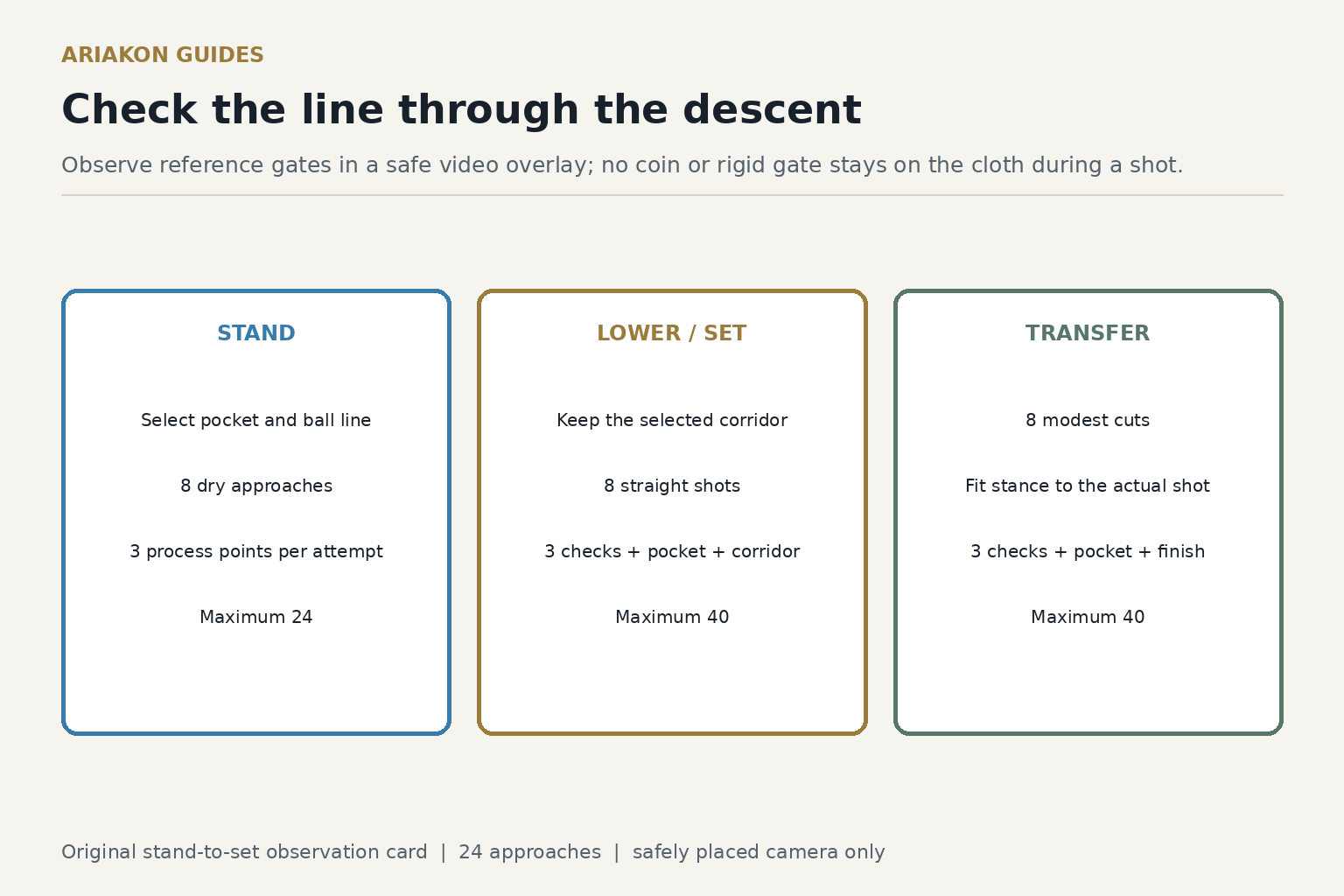
Build one visible line
Set a straight-in object ball one diamond from a corner pocket and the cue ball three diamonds away. Identify the center-to-center line while standing. Use a safely positioned rear camera with two reference gates drawn on a still frame or screen overlay. No coin, chalk cube or other rigid gate stays on the cloth during a struck shot.
The gates are observation references in the recording, not targets or obstacles. Keep the camera outside the cue, player and ball paths. Dry approaches can use room-permitted removable flat setup references, but remove every loose aid before striking a ball.
Review floor-up shot alignment for stance, vision center and cue placement.
Practice footwork before lowering if the line changes during the step-in.
Use three checks on every approach
If a reset trigger appears, stand up. Do not score a rescued shot as a preserved line. The ability to notice and restart is part of the drill.
| Phase | Check | Reset trigger |
|---|---|---|
| Stand | Pocket, object-ball center and cue-ball center appear on one line | Target is still being searched for |
| Lower | Cue remains inside the gate while feet and torso settle | Cue sweeps across either marker |
| Set | Bridge lands on line and warm-up strokes stay inside gate | Large sideways correction is required |
| Finish | Cue and cue ball finish in the registered corridor | Head or cue exits before contact |
Complete twenty-four approaches
Block 1 has a maximum of twenty-four points; Blocks 2 and 3 have forty each. Record resets separately. A reset loses no honesty point—the attempt simply reveals where the transition failed.
| Block | Task | Attempts | Points each |
|---|---|---|---|
| 1 — Dry approach | Lower, set and stand up without shooting | 8 | Stand line + gate + set line |
| 2 — Straight shot | Same approach, then center-ball shot | 8 | Three checks + pocket + cue-ball corridor |
| 3 — Modest cut | Move object ball half a diamond sideways | 8 | Three checks + called pocket + finish |
Use a rear camera as confirmation, not a perfect ruler
Place a phone safely behind the shot line, outside player and ball traffic, with permission from the room and anyone recorded. Film only four attempts at a time. Review whether the cue enters the gate from the same side and whether the head shifts after the bridge lands.
A single camera angle has perspective error and cannot identify a personal vision center by itself. Use it to compare repeated approaches, not to declare that one body part must occupy an exact pixel.
Worked diagnosis and transfer
A hypothetical player scores 21/24 on dry approaches but 29/40 on straight shots. Six lost points occur after the bridge lands, and video shows the cue rotating right during the final warm-up. The standing and lowering lines are mostly stable; the next action is a set-position cue-path block, not new foot placement.
When two blocks reach at least 80 percent of available component points without a repeated miss side, remove the gates and play six ordinary shots. Keep only the three verbal checks. If performance collapses, restore one visible gate rather than redesigning the stance.