
Fundamentals · 3 min read
Practice Pool Footwork Before Lowering Into the Shot
Footwork is the transition between a standing decision and a settled cue. A complete pre-shot routine contains that transition, but it does not tell you whether your trail foot lands consistently, the lead foot creates clearance or the body twists the cue during descent. This drill isolates the approach before adding difficult pocketing.
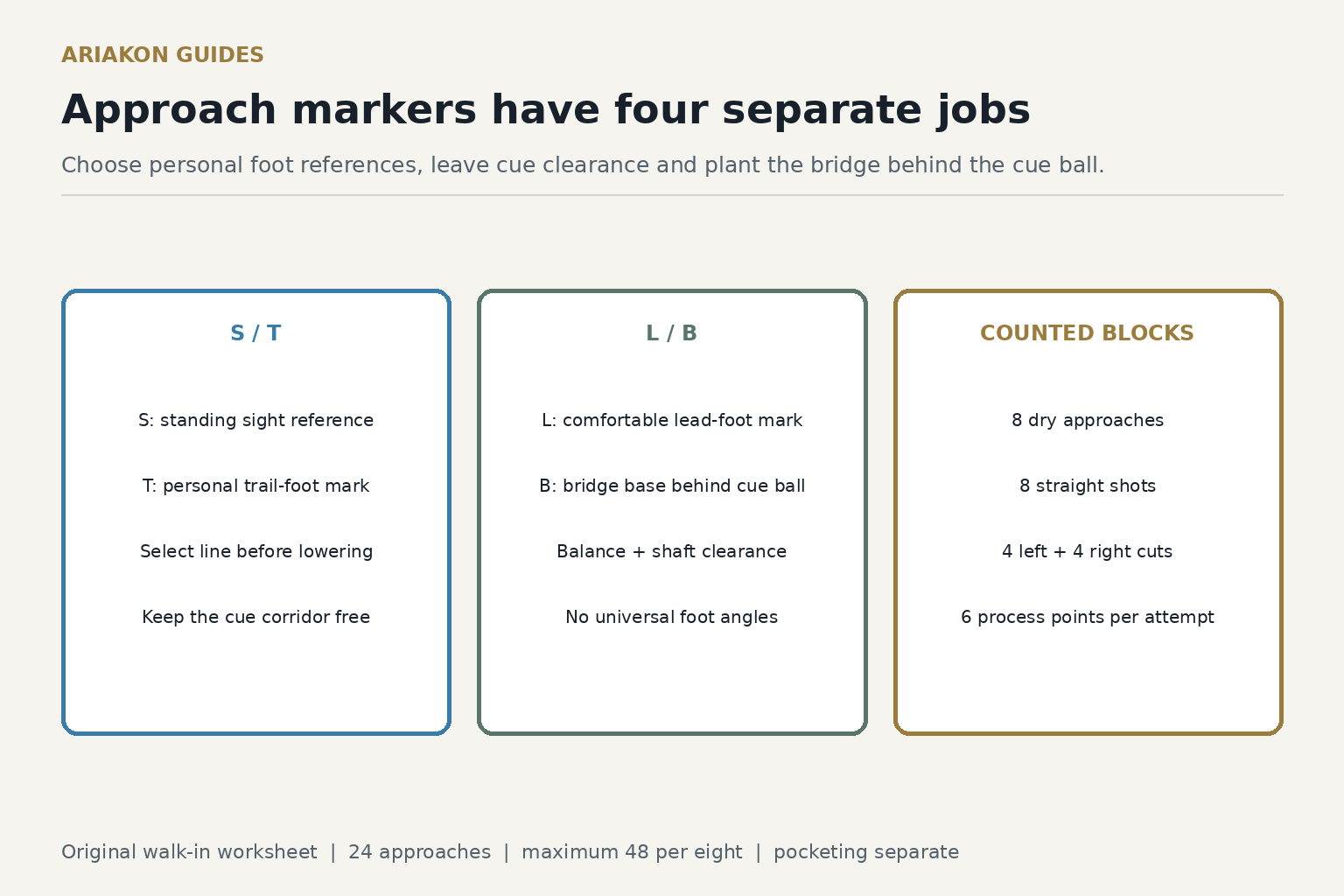
Mark a lane, not a universal stance
Test a simple approach: sight the chosen line while standing, bring the cue into that line, land the trail foot at a comfortable personal reference and step the lead foot aside for balance and cue clearance. Keep the head aligned as the bridge lowers. Record what works for your body rather than prescribing identical foot angles to every player.
Use low-tack removable markers only where the room permits them. Stop if the stance causes pain, instability or a blocked cue path; adjust the marks to your body rather than forcing the body to the marks.
| Mark | Location | Job |
|---|---|---|
| S — sight | Standing behind cue ball on the chosen line | Decision and visual alignment |
| T — trail | Personal trail-foot landing near the line | Repeatable entry without forcing anatomy |
| L — lead | Comfortable open position to the side | Balance, head space and cue clearance |
| B — bridge | Bridge-hand landing on the shot line | Confirms descent did not steer the cue |
Build the complete pre-shot routine around the isolated footwork sequence.
Approach along a chosen line when the standing picture changes during descent.
Rehearse eight approaches without a stroke
Set a straight shot with the cue ball and object ball one diamond apart. Stand at S, place the cue visually on the line, land T, open to L and lower the bridge to B. Pause at address, check balance and stand up without striking.
Award one point for each reference reached in order, one for finishing balanced without a recovery step and one for cue clearance through a slow air stroke. Eight approaches yield a maximum of forty-eight. Move a marker only after two approaches show the same conflict.
Add sixteen scored shots
For struck shots, score the same six approach points and record pocketing separately. The footwork score protects the purpose of the drill: a made ball after a sideways correction does not certify the approach.
Use a rear camera only to confirm marker order and gross cue movement. Ordinary video cannot measure tiny alignment or eye position, so do not claim more precision than it shows.
| Block | Setup | Attempts | Main observation |
|---|---|---|---|
| A | Straight shot; no ball struck | 8 | Order, balance and clearance |
| B | Same straight shot at pocket speed | 8 | Cue stays on the marked line |
| C | Moderate cut left, then mirror right | 4 + 4 | Footwork adapts without a last-step twist |
Diagnose the first visible break
| Observation | Likely place to inspect | One bounded change |
|---|---|---|
| Cue moves sideways while lowering | Trail-foot or bridge landing | Widen the entry lane by one shoe width |
| Hip blocks the grip hand | Lead-foot opening and torso clearance | Rotate or move lead foot slightly |
| Head crosses the line late | Standing sight mark | Begin square to the visual line |
| Recovery step after address | Stance width or weight distribution | Shorten the step and repeat without shooting |
| Only one cut direction fails | Mirrored approach | Create separate left/right marker records |
Worked twenty-four-approach record
A hypothetical player scores 43/48 without striking, 39/48 on straight shots and 31/48 on mirrored cuts. Seven lost points occur because the lead foot crosses inward on right cuts, followed by a cue correction. Pocketing is 7/8 straight, 3/4 left and 1/4 right.
The next session keeps S and T, moves the right-cut lead-foot mark half a shoe outward and repeats only eight mirrored approaches. The player changes no grip, bridge length or aiming method until the approach score is stable.