
Fundamentals · 4 min read
Approach a Pool Shot Along a Chosen Line
The approach connects a standing decision to the final cue line. It is not the entire pre-shot routine and it does not prescribe one universal foot position. The test is whether your chosen line remains visible while the body enters, the bridge lands and the cue settles without being steered sideways. This drill makes that transition observable with a floor corridor, video checkpoints and a restart rule.
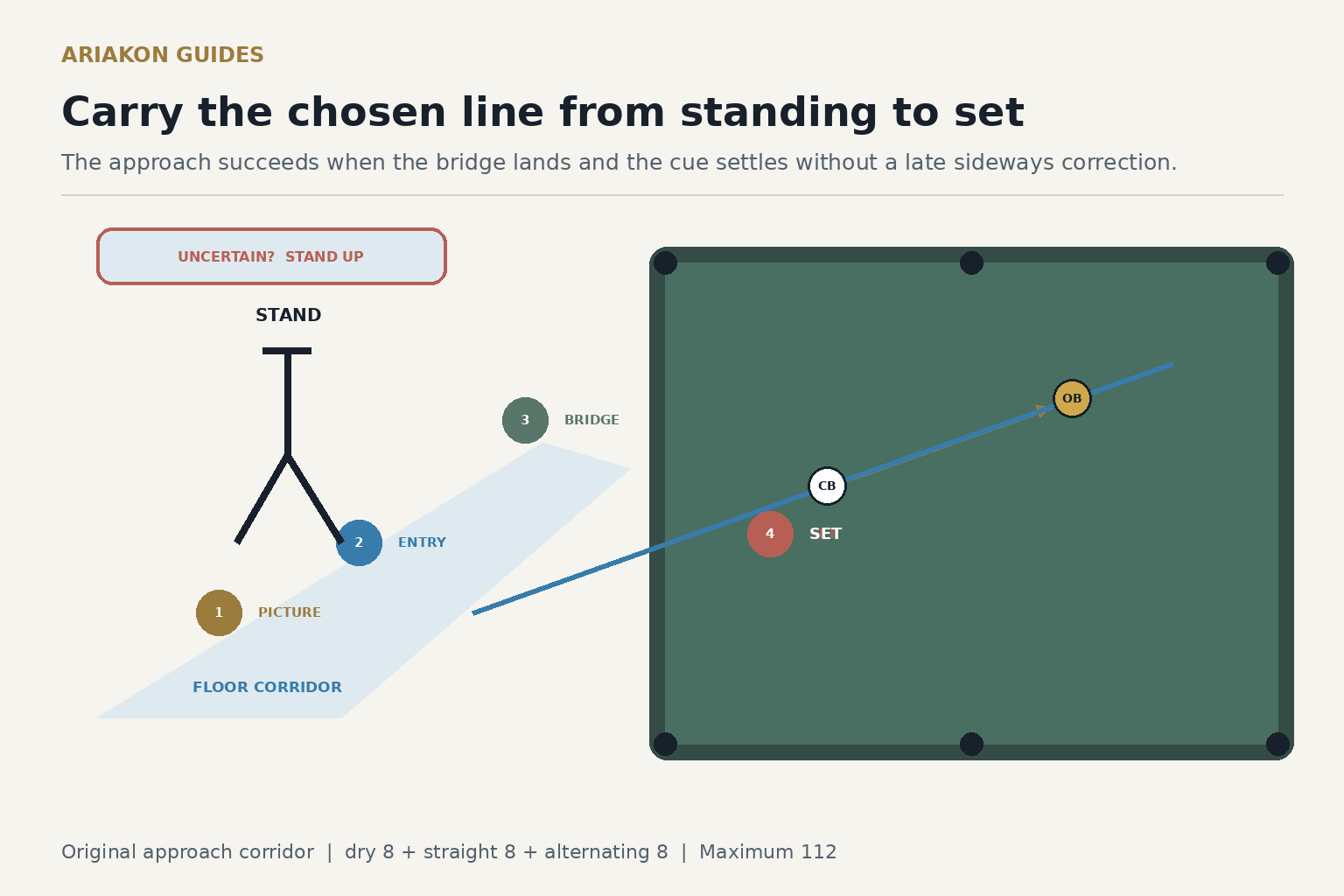
Finish the shot decision while standing
From behind the cue ball, name the object ball, pocket, cue-ball contact and speed. See the line from cue-ball center toward the chosen contact picture. Pick a distant visual reference on that line, such as a pocket point or rail feature. The reference supports orientation; it does not replace the object-ball aiming picture.
Place two short strips of removable floor tape or flat markers outside the table footprint to create a comfortable approach corridor. They must not create a trip hazard or interfere with other players. The corridor records your own repeatable entry path; it is not a claim that every player's hips, head and feet belong in identical positions.
Build a repeatable pre-shot routine for the complete decision-to-delivery sequence.
Find a repeatable vision center if the line looks different after the head settles.
Use four approach checkpoints
A stand-up reset is successful evidence, not a miss. It shows the player noticed a broken transition before delivering the cue. Keep the reset compact and within the event's pace requirements. Do not repeatedly freeze over the ball trying to move the bridge a fraction sideways.
| Checkpoint | Observable question |
|---|---|
| 1. Picture | Was line, speed and contact complete before the first step? |
| 2. Entry | Did the body travel through the personal floor corridor? |
| 3. Bridge | Did the bridge hand land without searching sideways? |
| 4. Set | Did the resting cue point along the chosen line without a late correction? |
| Reset | If any answer is no, stand up and begin again |
Run a twenty-four-approach progression
Set a straight object ball one diamond from a corner and the cue ball two diamonds behind it. Place a second station as a comfortable half-ball cut to the same corner. Use a phone behind the shot line only when it is safe, stable and outside every cue and ball path. Frame the standing reference, first step, bridge landing and cue line.
Block A: eight dry approaches on the straight station, stopping at set without striking. Block B: eight straight shots. Block C: eight attempts alternating the straight and cut stations. For dry approaches, stand up after the set checkpoint. For live shots, deliver only when all four checks are complete.
| Point | Requirement |
|---|---|
| 1 | Shot plan completed while standing |
| 1 | Entry stayed inside personal floor corridor |
| 1 | Bridge landed without sideways search |
| 1 | Cue settled on chosen line or player stood up |
| 1 | Live shot pocketed in the called corner; dry approaches omit this point |
| Maximum | 32 for dry block; 40 each live block; 112 total |
Worked example: pocketing hides a late correction
The dry block scores 27 of 32. On three approaches the bridge searches left after landing. The first live block pockets seven of eight but scores only 32 of 40 because the cue is corrected sideways at set four times. Outcome alone would have hidden the unstable transition.
The player moves the starting stance half a foot backward to create a clearer first step, without changing the chosen cue line. The alternating block scores 36 of 40 with one successful stand-up reset and no bridge search. The next action is the same alternating block on the opposite cut direction, not a narrower corridor.
Diagnose where the chosen line was lost
| Video or worksheet evidence | Next check |
|---|---|
| First step crosses corridor | Standing location and distant visual reference |
| Feet settle; bridge searches | Bridge target and distance from cue ball |
| Bridge stable; cue points off line | Head/vision-center placement and grip alignment |
| Everything shifts only on cuts | Rebuild the cut picture while standing |
| Correct set; delivery swerves | Stroke path, grip pressure and finish—not approach |
| Repeated discomfort or forced reach | Change station or use the mechanical bridge |
Diagnose cue wobble with a delivery gate when the approach is stable but the delivered cue leaves the line.