
Fundamentals · 3 min read
Diagnose Cue Wobble With a Delivery Gate
Watching the cue appear to wobble does not tell you where its path changes. A delivery gate turns that vague impression into an observable contact: rear gate, front gate, both or neither. This drill uses soft, straight shots and lightweight markers outside the ball path. It is a diagnostic aid, not a claim that every effective stroke must look identical.
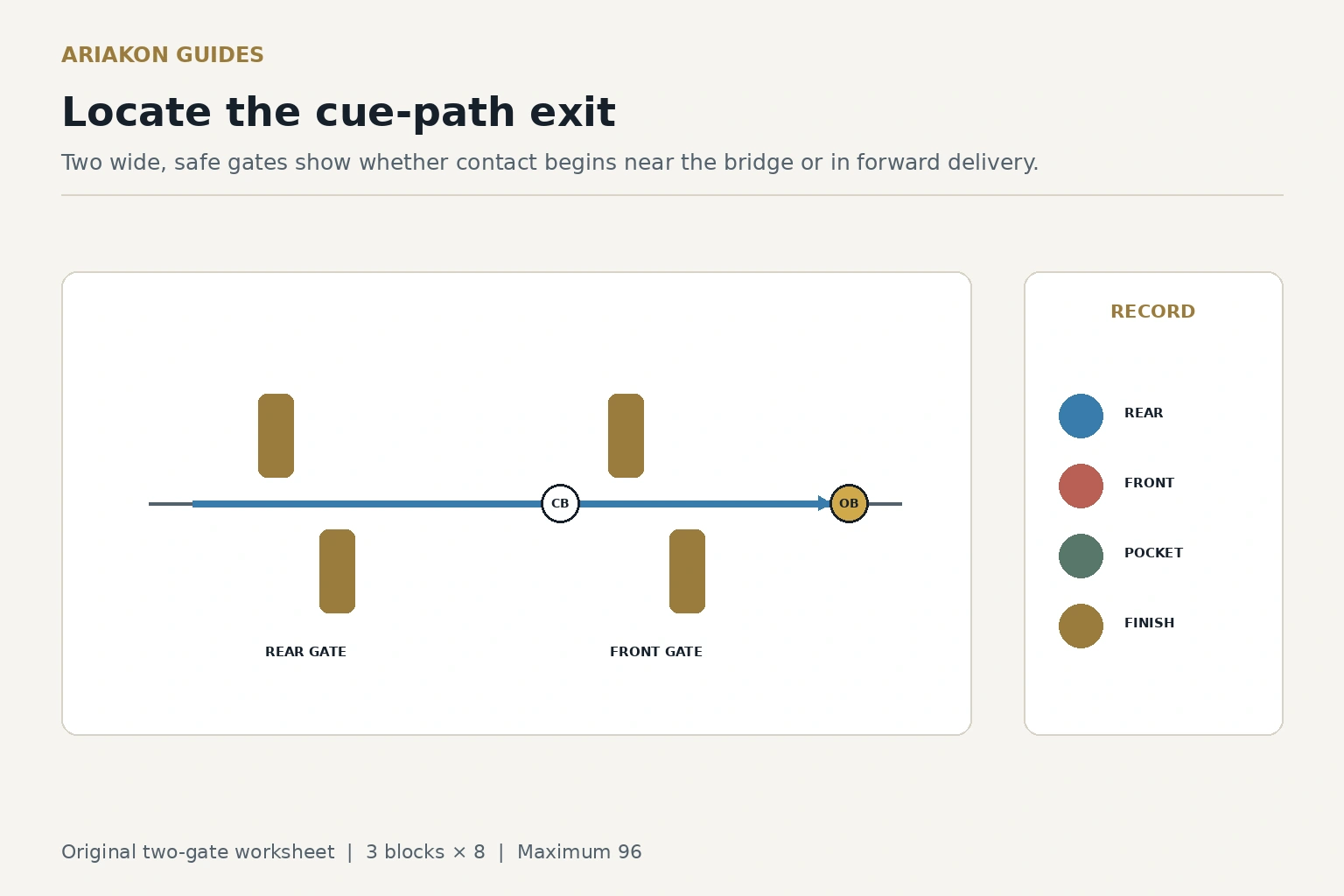
Build a safe two-gate lane
Set a straight object ball to a corner pocket with the cue ball one diamond behind it. Place two pairs of lightweight, low-profile markers outside the cue's path: a rear gate just behind the bridge hand and a front gate several inches in front of the cue ball, inside the observable natural forward cue travel, with each marker well outside all ball paths. Begin with each opening at least two cue-tip widths wider than the shaft.
The markers must not risk damaging cloth or cue and must never obstruct a moving ball. Avoid bottles, chalk cubes under the cue, hard tools or anything tall enough to catch a hand. If you cannot create a safe lane on the available table, use overhead video instead.
A marker beyond the cue’s natural reach cannot test clearance. Set the front pair where the shaft actually passes, viewed from above, and use only low, soft, wide-set markers. If this cannot be achieved clear of the ball path, use video and record a visible corridor crossing instead of physical gate contact.
Reduce excess stroke tension first if the gate makes grip pressure or shoulder motion increase.
Advance to a straight-shot change ladder after the gate identifies a repeatable path issue.
Record three events, not one impression
| Event | Options | What it locates |
|---|---|---|
| Rear gate | Left, clear, right | Cue path near the bridge and backswing lane |
| Front gate | Left, clear, right | Forward delivery and follow-through lane |
| Object ball | Left miss, made, right miss | Shot result, not gate cause |
| Cue-ball finish | Left, center, right | Post-contact line on a stop-speed shot |
Run three eight-shot blocks
Possible single changes include slightly lighter grip pressure, a more stable bridge length or finishing the cue forward without steering. Do not change stance, bridge, grip and tempo together; the gate would show a different pattern without identifying which instruction mattered.
| Block | Gate width | Instruction | Maximum |
|---|---|---|---|
| A | Wide | Normal routine and soft center-ball delivery | 32 |
| B | Same | One chosen change only | 32 |
| C | Same | Return to baseline instruction | 32 |
Score clearance and outcome separately
| Point | Requirement |
|---|---|
| 1 | Rear gate clears |
| 1 | Front gate clears |
| 1 | Object ball pockets in called corner |
| 1 | Cue ball finishes within one ball width of the centerline |
| Maximum 96 | Twenty-four attempts |
Choose the next action from the contact pattern
| Pattern | Observation | Next action |
|---|---|---|
| Rear only, same side | Path changes near bridge/backswing | Widen lane; verify bridge stability |
| Front only, same side | Forward path exits after rear lane | Use soft follow-through rehearsals away from balls |
| Both, same side | Whole cue line may begin displaced | Reset standing alignment before narrowing gates |
| Alternating contacts | No stable direction yet | Keep wide gate; reduce speed and tension |
| No contact; misses persist | Gate does not explain pocketing error | Return to aim and visual alignment |
Use a worked comparison, then remove the gate
Worked example: Block A touches the right front gate five times but clears the rear gate seven times. Block B uses a lighter grip call and touches the front gate twice. Block C returns to the original instruction and touches it five times again. That comparison supports retesting the grip-pressure cue; it does not prove a permanent mechanical cause.
Finish with six un-gated straight shots. Score 1 for the called pocket and 1 for a cue-ball finish within one ball width of centerline; maximum 12. If the un-gated result worsens while the gate score improves, keep the observations separate and seek qualified instruction before rebuilding the stroke.