
Stroke practice · 3 min read
A Straight Shot Ladder for Detecting Stroke Changes
A straight shot cannot diagnose every stroke issue, but it can show when a familiar delivery changes. This ladder fixes the pocket line, increases cue-ball distance and records two observable results: where the object ball enters or misses the pocket, and where the cue ball finishes after a stop-shot attempt. The goal is a repeatable baseline—not a medical diagnosis, perfect mechanics claim or one-number rating.
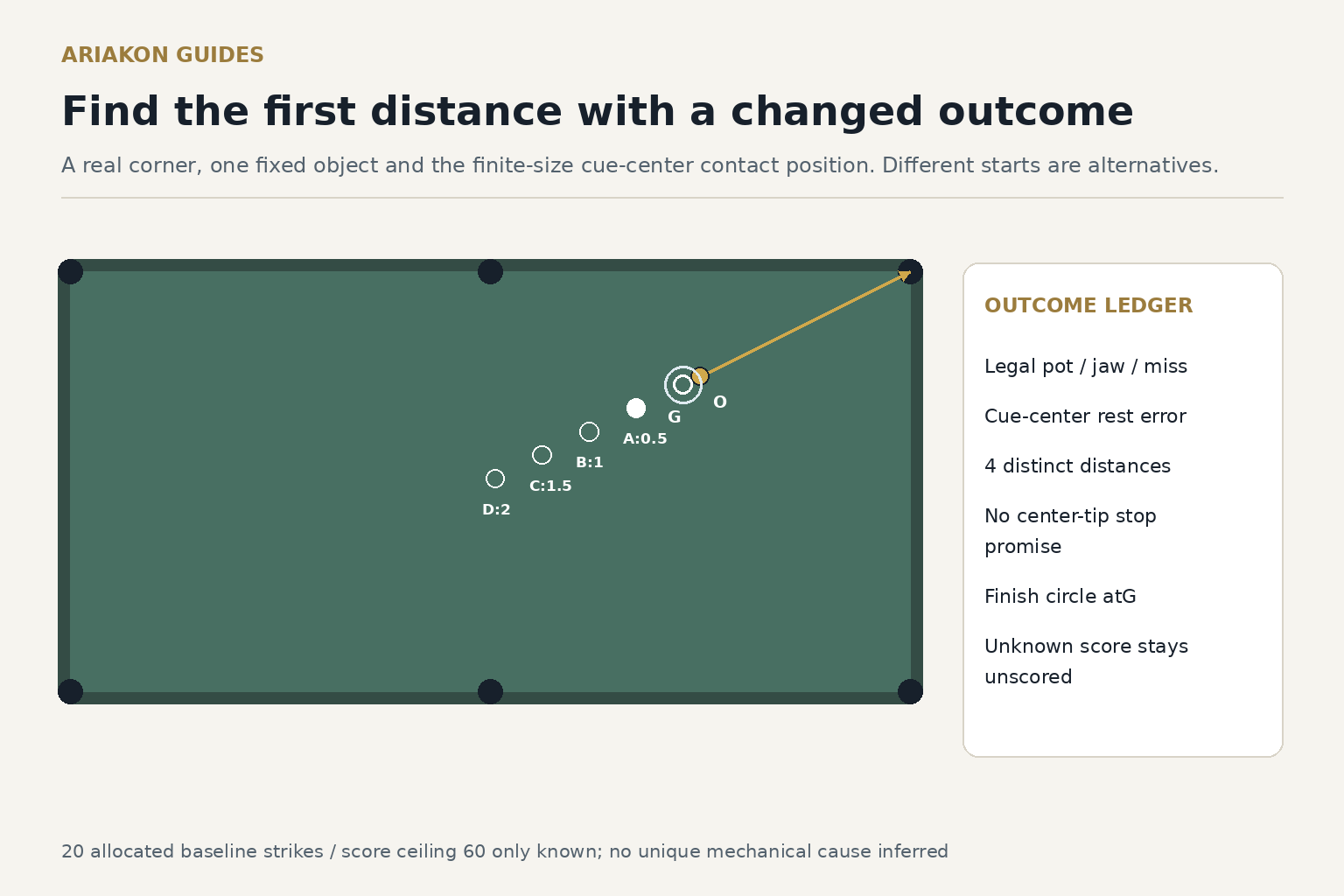
Build one centerline with four starts
Coordinates are ball centers on an illustrative 100 by 50 inch bed: x=0..8 along length, y=0..4 across width, origin at the lower left cushion nose. One unit is 12.5 inches. For 2.25 inch equal balls, radius is 0.09 and diameter 0.18 units. Intact cushion center boundaries are x=0.09,7.91 and y=0.09,3.91; pockets interrupt the physical boundary at the four corners and (4,0),(4,4). Measure actual bed, balls and jaws before scaling. Remove every measuring aid before shooting; never mark a competition table.
Fix O(6,3),P(8,4),G(5.839003,2.919502),u=(2,1)/sqrt(5). Cue starts C=G−d u for d=0.5,1,1.5,2 units. The stop target is a cue-center disk radius 0.18 about G, one diameter behind O, not the original object center. All four setups are ordinary straight references.
Request a comfortable stop arrival with no intentional sidespin; do not prescribe center-height contact as a universal stop recipe. Keep each row’s personally repeatable pace/contact labels. Five reset strikes per distance create 20 allocations; stop before discomfort or uncontrolled delivery. A visible finish is evidence of an outcome, not proof of one mechanical cause.
Use the broader diagnostic-drill workflow when the ladder points to speed, alignment or cue-ball-control work.
Shoot a twenty-attempt ladder
| Stage | Cue-ball distance | Attempts | Observe | Advance check |
|---|---|---|---|---|
| A | 0.5 unit toG | 5 | Pocket and resting-center error | Record all safe attempts |
| B | 1 unit toG | 5 | Same | Record all safe attempts |
| C | 1.5 units toG | 5 | Same | Record all safe attempts |
| D | 2 units toG | 5 | Same | Record all safe attempts |
Score line and stop independently
| Points | Object ball | Cue ball | Record |
|---|---|---|---|
| 0 | Known foul or object miss without jaw contact | Any | First failed event |
| 1 | Known legal jaw contact without pot | Any | Near/far jaw |
| 2 | Known legal pot | Known finish outside disk | Forward/back/lateral |
| 3 | Known legal pot | Known finish inside disk | Baseline outcome |
| Unscored | Required pocket or finish unknown | Retain known event fields | Reduce own denominator |
Find the first distance that changes
Twenty attempts have a maximum of 60 points. Keep stage subtotals out of 15. A meaningful session baseline is at least 12 at Stages A and B, with no more than one same-side miss. The first stage that drops by 4 or more points from the previous stage becomes the working distance.
Repeat the fixed ladder on a second day before calling a visible pattern persistent. This is an original local worksheet, not an organizational rating or proof of one mechanical cause.
Map the observable pattern
| Pattern | Likely category to inspect | Next five-shot block | Avoid |
|---|---|---|---|
| Object ball misses same side | Alignment or delivery line | Return one stage; use a cue-line gate | Aiming compensation |
| Cue ball consistently forward | Stop contact or speed | Freeze aim; lower speed/contact slightly | Adding sidespin |
| Cue ball consistently back | Residual draw | Freeze aim; adjust contact toward center | More force |
| Outcomes scatter | Reset or tempo | Shorten bridge and rebuild routine | Several changes at once |
Compare before and after one change
Choose one adjustment from the map and shoot five unscored rehearsal balls at the working distance, then five scored balls. Keep the change only if the subtotal improves by at least 3 points and the signed pattern narrows. Restore the baseline if pocketing improves but cue-ball scatter widens.
Transfer with five slight-cut stun-position shots at the passed distance. Score 0 for foul, 1 for correct object-ball side, 2 for pocket, and 3 for pocket plus called cue-ball zone. Straight-shot improvement that disappears on a small cut becomes the next practice question, not proof that the ladder failed.
Sources and further reading
References support the specific factual information above. The practical checklists are Ariakon editorial guidance.