
Stroke practice · 4 min read
Three Advanced Pool Stroke Drills That Produce Useful Feedback
An advanced drill is useful when a failure tells you what to inspect. These three original tasks separate stop control, free-roll speed and follow contact. None requires extreme spin, a scratch target, a copied named stroke sequence or hard objects on the cloth. Scores describe this setup, not a certified playing level.
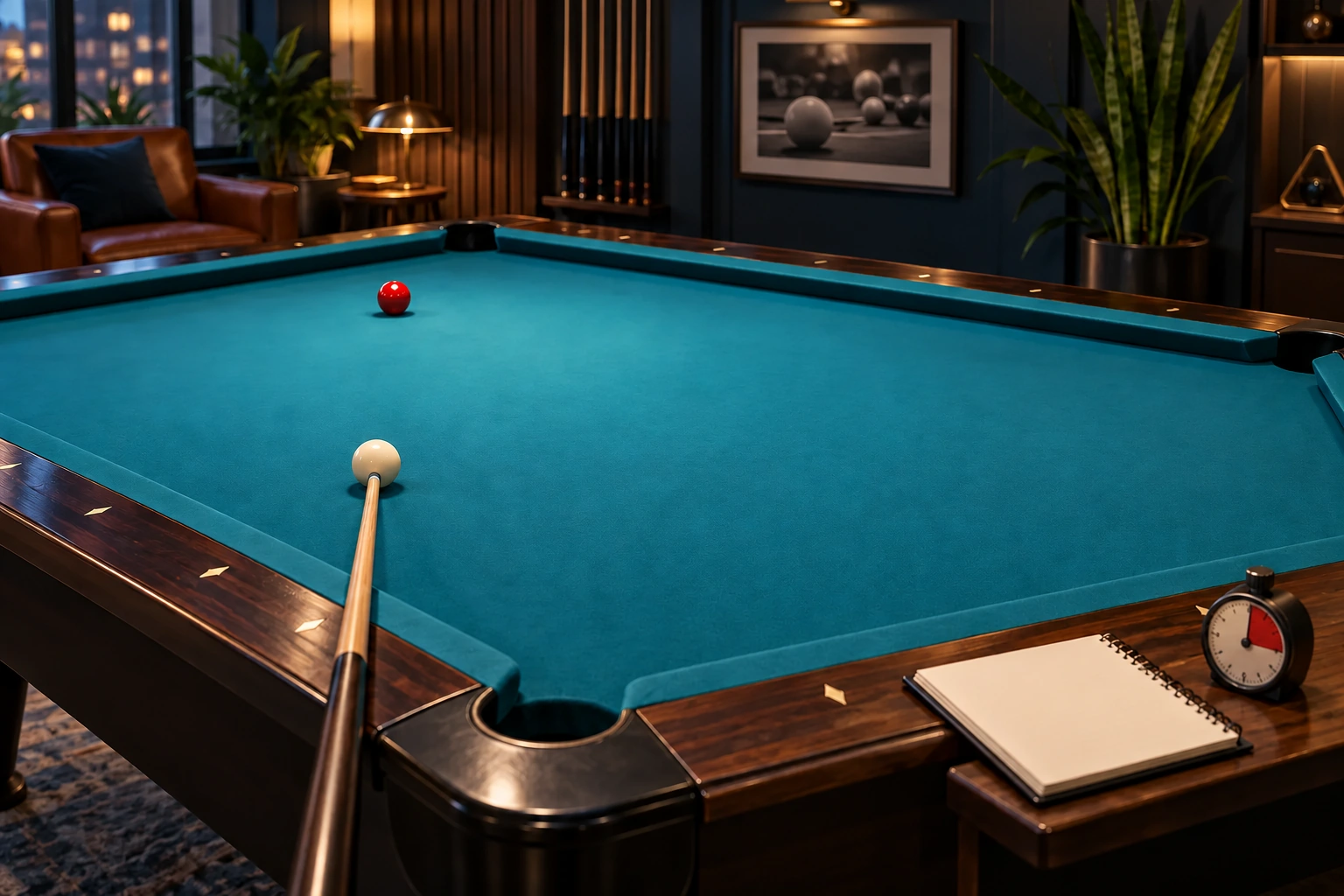
Set one active layout and one observable question
Use an illustrative 100×50-inch playing bed represented by x=0 to 8 and y=0 to 4, measured between cushion noses. Ball radius is 0.09 and diameter 0.18 units. Real pockets are the four corners and the two side midpoints. Only the active cue ball and the specified object ball are placed; remove unused balls and setup helpers before striking. Scale positions to your measured table and actual balls.
Use a familiar comfortable bridge and controlled stroke. No compulsory foot angle, head height or pause count is scored. Place a permitted camera outside all paths only when it can answer one delivery question; a viewpoint cannot prove three-dimensional alignment. Stop for unsafe reach, discomfort or uncontrolled contact.
Record the initial centers using a measured photograph or room-approved removable references. Remove physical helpers before striking. After all balls stop, measure the resting cue center against the called disk; do not leave a hard target on the cloth. Cue-only measurement is not an ordinary game shot: a scratch, off-table ball or unintended collision scores target 0 and remains an attempt.
Check the six ordinary fundamentals fields if a supported address is not repeatable.
Register a camera viewpoint before comparing delivery clips.
Task 1 — observe a controlled stop
The incoming cue center, tangent ghost center, object and pocket are collinear. The ghost lies one diameter behind the object along the pocket line; the cue start is 1.6 units farther back. A successful stop remains near the cue center at collision, not at the old object center. The disk tolerance is an outcome boundary, not a drawn route or exact spin prescription.
Calibrate two unscored strikes first, then freeze the personally usable stop contact and pace for eight scored attempts. Pocket flag is 1 only for a called pot without foul. Stop flag is 1 only when that pot succeeds and the cue center rests within the disk. Record one independent process flag for retaining the frozen setup and delivery plan. A foul is not removed from the eight.
| Element | Center or boundary |
|---|---|
| Object | (6, 3) |
| Called pocket | (8, 4), real foot-right corner |
| Tangent ghost center | (5.839003, 2.919502) |
| Cue start | (4.40792, 2.20396) |
| Stop target | Cue center within 0.12 units of the ghost center after contact |
Develop basic stop control first if a near-collision finish is not yet predictable.
Task 2 — change only free-roll speed
Take two unscored calibration strikes, one at each target, then retain the chosen tip contact. Vary the delivery pace only. The cue should travel on the same unobstructed interior line and come to rest before a cushion. Do not add a cushion rebound or object-ball collision: that would introduce a different task.
Target flag is 1 only if the resting cue center is inside the called disk. Record short, long or lateral miss and an independent retained-input flag. There are four opportunities per target, eight total; inspect them separately before totaling. A target selected after the ball stops is invalid scoring.
| Element | Definition |
|---|---|
| Cue start | (2, 1) |
| Near target | Disk radius 0.15 centered at (4, 1) |
| Far target | Disk radius 0.15 centered at (5.5, 1) |
| Order | Near, far, near, far, far, near, far, near |
| Frozen inputs | Same direction, ordinary rolling contact, cue and bridge |
Task 3 — change only follow contact at a fixed pace
These two target disks lie along the forward pocket-direction line, 0.35 and 0.70 units beyond the tangent ghost center. They are finish requests after a straight collision, not guarantees of how either ball accelerates. Take two unscored calibration strikes and choose one comfortable fixed delivery pace; select and record a personally usable contact height for each request without intentional sidespin.
Alternate short and long for eight strikes. Keep pace and layout fixed, changing only the frozen contact-height request. Pocket, requested follow finish and retained-input flags are separate; follow earns 1 only after a called pot without foul. If the longer request needs a pace change or uncomfortable contact, hold that request and redesign a new version rather than forcing or falsely labeling a single-variable trial.
| Called request | Cue-center target | Attempts |
|---|---|---|
| Short follow | (6.152053, 3.076026); disk radius 0.12 | 4 |
| Long follow | (6.465102, 3.232551); disk radius 0.12 | 4 |
Read three records, not a combined ability score
A full session allocates 8+8+8=24 scored strikes plus 2+2+2=6 calibration strikes, 30 total. Calibration is declared before shooting and never used to erase a scored miss. Break the work into safe sessions if needed and use actual denominators for unfinished blocks.
Hypothetical results: stop pocket 6/8 and finish 4/8; free-roll near 3/4 and far 2/4, totaling 5/8; follow pocket 7/8 and finish 3/8. Those finish counts happen to total 12/24, but the mixed tasks do not measure one ability. Low process flags ask for a simpler delivery question; good process with short or long finishes asks for contact or pace calibration.
Retest the same version on a separate occasion before tightening a target. Ordinary-game transfer is a new record, not extra attempts in this 24-shot worksheet.
Budget these tasks within a solo session including resets, rest and review.
Use a distinct draw-return protocol when backward travel is the actual question.
Sources and further reading
References support the specific factual information above. The practical checklists are Ariakon editorial guidance.