
Stroke mechanics · 5 min read
Pendulum Pool Stroke: What Moves and What Stays Still
The pendulum model makes one motion question visible: does the forearm swing around a comparatively quiet elbow into contact? It is not a demand that every joint remain locked, or a branded pause sequence. Compare observable timing with actual cue delivery and keep dry practice separate from ball-contact evidence.
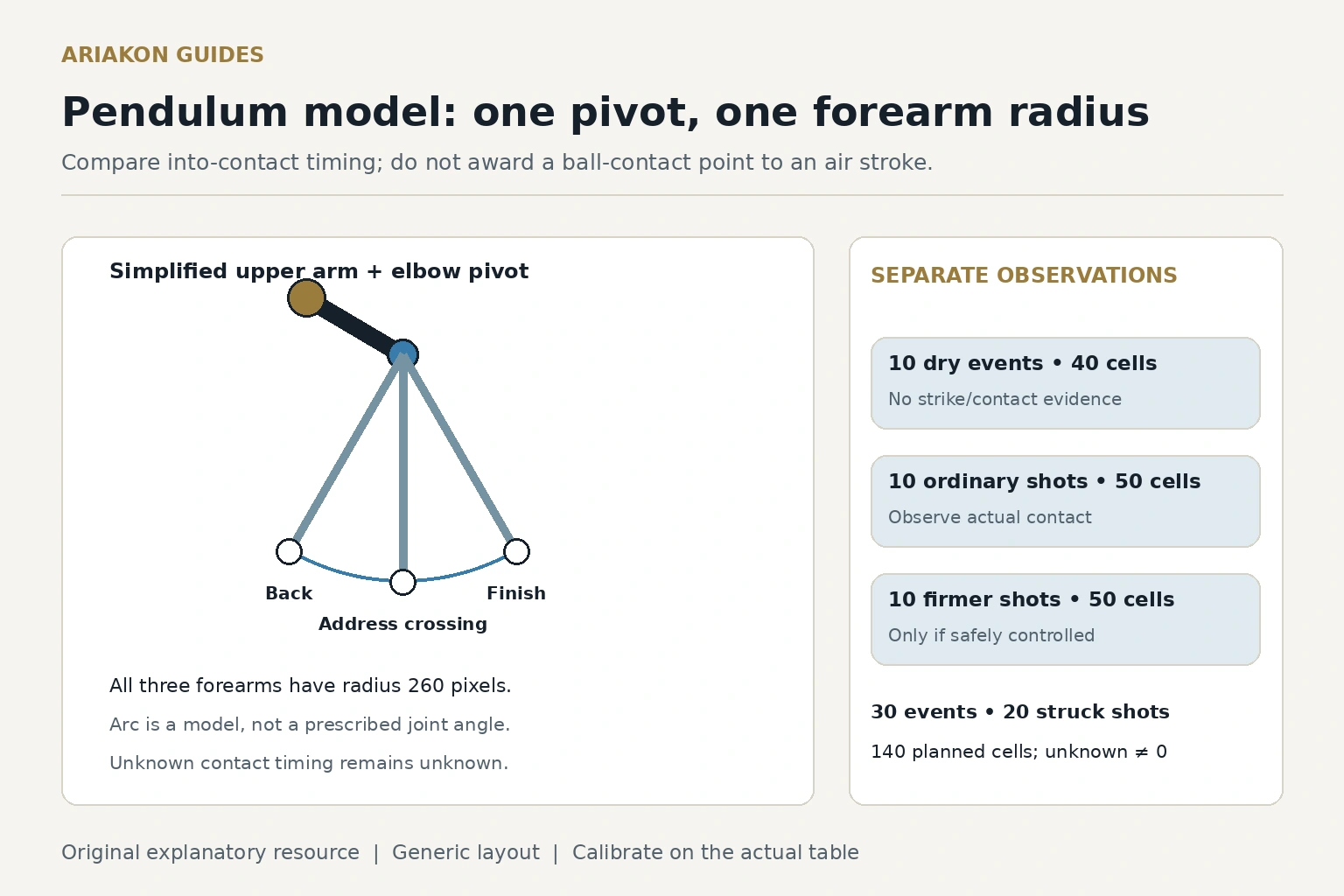
Use a model, not a forced body shape
In the simplified model, the upper arm is comparatively stationary while the forearm and grip rotate about the elbow. Equal forearm lengths trace an arc, not a straight hand path. A guided cue, wrist freedom and body proportions make the real motion more complex than a two-segment sketch. The illustration cannot prove contact accuracy or a universal tip trajectory.
Choose a comfortable stable address with ordinary cue clearance, a planted bridge and an unforced grip. A near-vertical forearm at address can be a useful observation checkpoint, not a mandatory 90-degree pose for every player. Stop for pain or unsafe reach. No instructor’s named sequence has been renamed as an Ariakon invention.
Review the whole fundamentals task separately before isolating elbow timing.
Record when motion begins rather than judging the final pose
Place a permitted fixed side camera approximately perpendicular to the cue, clear of players and balls, showing shoulder, elbow, grip, cue and ball. A separate rear view can help with lateral cue movement; do not infer lateral truth from the side view alone.
If the tip-ball separation or impact frame cannot be resolved, mark timing or contact unknown. Early upper-arm movement plus a changed tip path is a test candidate, not proof of causation. Movement after verified contact does not retroactively change that contact. Do not force the arm to stop abruptly to make a still photograph look better.
| Moment | Useful record | Limit |
|---|---|---|
| Address | Bridge, chosen cue line and intended tip region | Static appearance does not prove dynamic contact |
| Into contact | First visible upper-arm change and cue-path change | A camera frame may not resolve exact impact |
| After contact | Natural movement and balanced finish | A late finish alone does not explain an earlier miss |
Use one exact straight shot for the recorded balls
Coordinates describe ball centers on an illustrative 100×50-inch bed: x=0..8 along the length, y=0..4 across the width, origin at the lower-left cushion-nose corner. Equal 2.25-inch balls have radius 0.09 and diameter 0.18 units. Intact-cushion center limits are 0.09 and 7.91 in x, 0.09 and 3.91 in y. Pockets interrupt these limits at the four corners and at (4, 0),(4, 4). Inspect actual mouths and jaws; scale to the measured bed and actual ball size. These are not universal diamond coordinates. Remove measuring aids before a shot; do not mark a competition table.
Hold object O(6, 3), real corner P(8, 4), tangent contact center G(5.839003, 2.919502) and cue start (4.944576, 2.472288). The cue lies one unit behind G on the same pocket line. Request an ordinary controlled stop near G, but score the actual pot and stop separately from movement observations.
Use the same cue, bridge, standing line and comfortable pace request. The view must capture the approach and finish without changing the camera every repetition. These positions make the test reconstructible; they do not mandate an identical human stance.
Locate the exact stop point when judging whether the cue-ball finish supports the observation.
Do not award a contact point to an air stroke
The total is 30 movement events, 20 actual ball strikes, and at most 140 observed cells. A dry stroke cannot demonstrate centered cue-ball contact, lack of sidespin or a pot. Record outcomes only for B and C. A process cell is 1 when its stated condition was observed, 0 when it visibly failed, and unknown when the view is inadequate.
Count successes over observed cells and disclose unknowns. For example, A30/40, B36/45 observed with 5 unknown, C34/48 with 2 unknown gives 100/133 observed, 7 unknown out of 140 planned. That is an observation record, not a certified stroke score; it must not become 100/140 by silently calling unknowns failures. Pot counts such as 8/10 and 7/10 remain separate.
| Block | Events | Observable process fields | Maximum complete cells |
|---|---|---|---|
| A — dry | 10 strokes beside the cue ball, no ball contact | Bridge/head stability; upper-arm timing at address crossing; smooth direction change; comfortable finish | 40 |
| B — ordinary | 10 real shots at frozen comfortable pace | Same four process fields plus clearly observed intended tip region at contact | 50 |
| C — modestly firmer | 10 real shots only when B is controlled and comfortable | Same five fields, with changed pace explicitly recorded | 50 |
Test the first repeatable cue-path change
If upper-arm motion begins early and the tip region changes with it, review a shorter comfortable stroke at the ordinary pace with an instructor. If the elbow appears quiet but the cue shifts laterally, examine the rear-view line, grip and clearance instead. If motion appears only after verified contact and outcomes repeat, the finish is not automatically a fault.
Use one extra six-shot confirmation at the same straight setup and ordinary pace, changing only the chosen observation cue or comfortable backswing extent. This adds six actual strikes, bringing a completed session to 26 strikes plus 10 dry events. Do not alter stance, grip, speed and camera simultaneously and credit the result to the elbow.
Review slow motion with observation limits when an impact frame is unclear.
Examine the backswing transition separately when the first change occurs before the forward delivery.
Carry a useful checkpoint into ordinary play
Retain one comfortable process observation that repeats on another day, then use normal shots without mentally controlling every joint at once. A break or specialist shot may use a different coordinated movement; this model does not declare every such stroke invalid.
When the same view and same setup still cannot explain the result, keep the uncertain record and seek qualified instruction. The next task is better evidence, not a rigid prescribed finishing pose or a promised perfect stroke.
Sources and further reading
References support the specific factual information above. The practical checklists are Ariakon editorial guidance.