
Stroke mechanics · 4 min read
Assess Your Pool Stroke Follow-Through
The finish is available to inspect after a shot, but the ball is already gone. Use it as a clue about a repeatable delivery, not as proof of what happened during an unresolved contact. This card records finish observations separately from pots and cue-ball position.
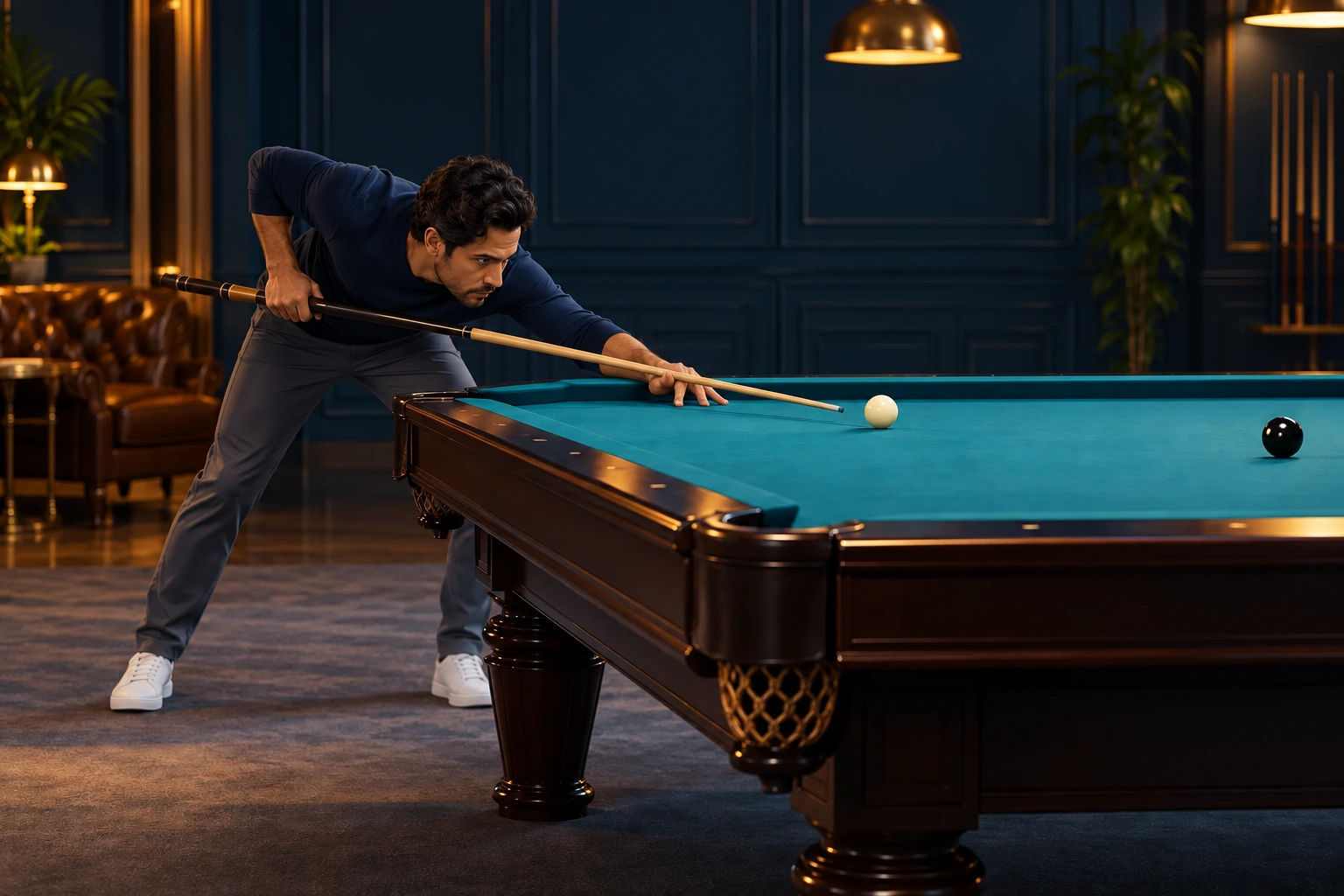
Ask a finish question the camera can answer
Once tip and ball have separated, extra forward cue travel cannot alter that ball’s motion. A short or sideways finish can justify looking earlier in the delivery; it does not by itself prove deceleration, a tight grip or the cause of a miss. Do not force a longer reach to match a picture.
Record lateral cue-path changes from a rear view and vertical changes from a side view. Record visible body or bridge movement relative to the first visible ball motion, with unknown when timing is unresolved. A comfortable finish is the player’s report, not a camera measurement of hand force.
Capture the whole stroke from useful views before trying to interpret an isolated finish.
Freeze one ordinary corner-pocket task
Use ball-center coordinates on an illustrative 100×50-inch bed: x=0..8 along the length, y=0..4 across it, origin at the lower-left cushion-nose corner. Equal 2.25-inch balls have radius 0.09 and diameter 0.18 units. Intact-cushion center limits are 0.09..7.91 and 0.09..3.91. Six real pockets interrupt the boundary at the four corners and (4,0),(4,4). Measure the actual bed, balls and pocket mouths before scaling; remove measuring aids before shooting and never mark a competition table.
Set object O(6, 3), real upper-right pocket P(8, 4), intended first-contact cue center G(5.839003, 2.919502) and cue start C(4.944576, 2.472288). Direction u=(2,1)/√5 points toward that pocket; G is one ball diameter behind O. The chosen stop target is a cue-center rest disk of radius 0.18 at G. It is a practice tolerance, not a guaranteed result of a center-height strike.
Use a comfortable stop-shot delivery with no intentional sidespin; choose two modest personally repeatable pace requests. The requested cue height and pace are inputs, not a certification of arrival spin. Keep bridge, cue and surface fixed. Stop before discomfort or loss of control.
Make twelve strikes and thirty-six planned observations
Film rear-view and side-view blocks sequentially with one fixed camera outside the table and stroke path. In each view take three strikes at each of the two pace requests: 2 views × 2 pace requests × 3 = twelve strikes. These are different attempts, not two synchronized views of the same strike.
For each struck attempt fill three observation fields and one separate shot result. Thirty-six planned observation cells measure documentation only; unknown stays unknown, not a normal finish. A missing result is unscored and reduces the shot maximum by two.
| Record | What belongs here |
|---|---|
| View / pace / attempt | rear or side / request 1 or 2 / 1..3 |
| Cue path | lateral from rear or vertical from side; visible or unknown |
| Body / bridge event | what moved, before or after first visible ball motion, timing limit |
| Comfort report | comfortable, uncomfortable or not reported |
| Shot result | 0 miss/foul; 1 legal pot; 2 legal pot plus called rest disk |
Use a repeated clue without inventing its cause
Hypothetical rear-view card: four of six finishes drift laterally. Only two show that deviation beginning before first visible ball motion; the other two have unresolved onset. Investigate the two observed earlier deviations and improve observation for the other two. Do not convert four finish flags into four proven contact errors.
Compare like view and like requested pace. If short finishes recur, inspect the visible precontact motion and comfortable space for the cue rather than declaring insufficient acceleration from the endpoint alone. Pots, misses and finish observations can disagree without making any one of them imaginary.
Test one recurring delivery issue at a time after locating a specific visible question.
Retest one change and keep transfer separate
Take four new strikes with one selected view and pace after one modest change. Use the same three observation fields and 0..2 shot score; maximum eight retest points. If the timing remains unreadable, improve filming instead of adding a second stroke change.
For six separate ordinary-play transfer attempts mirror the straight setup: O(2, 3), P(0, 4), G(2.160997, 2.919502), C(3.055424, 2.472288), with radius-0.18 stop disk at G. Maximum twelve transfer points. Twelve baseline + four retest + six transfer equals twenty-two actual strikes only when all blocks finish; never blend their three denominators.
Sources and further reading
References support the specific factual information above. The practical checklists are Ariakon editorial guidance.