
Stroke mechanics · 3 min read
Build a Stroke Mechanics Observation Checklist
An observation checklist should describe visible events, not prescribe one body shape. Players differ in stance, height, mobility and stroke style. The useful question is whether the chosen setup creates a repeatable cue path and stable contact. This checklist gives an observer a neutral order, then limits the correction to the first repeated departure.
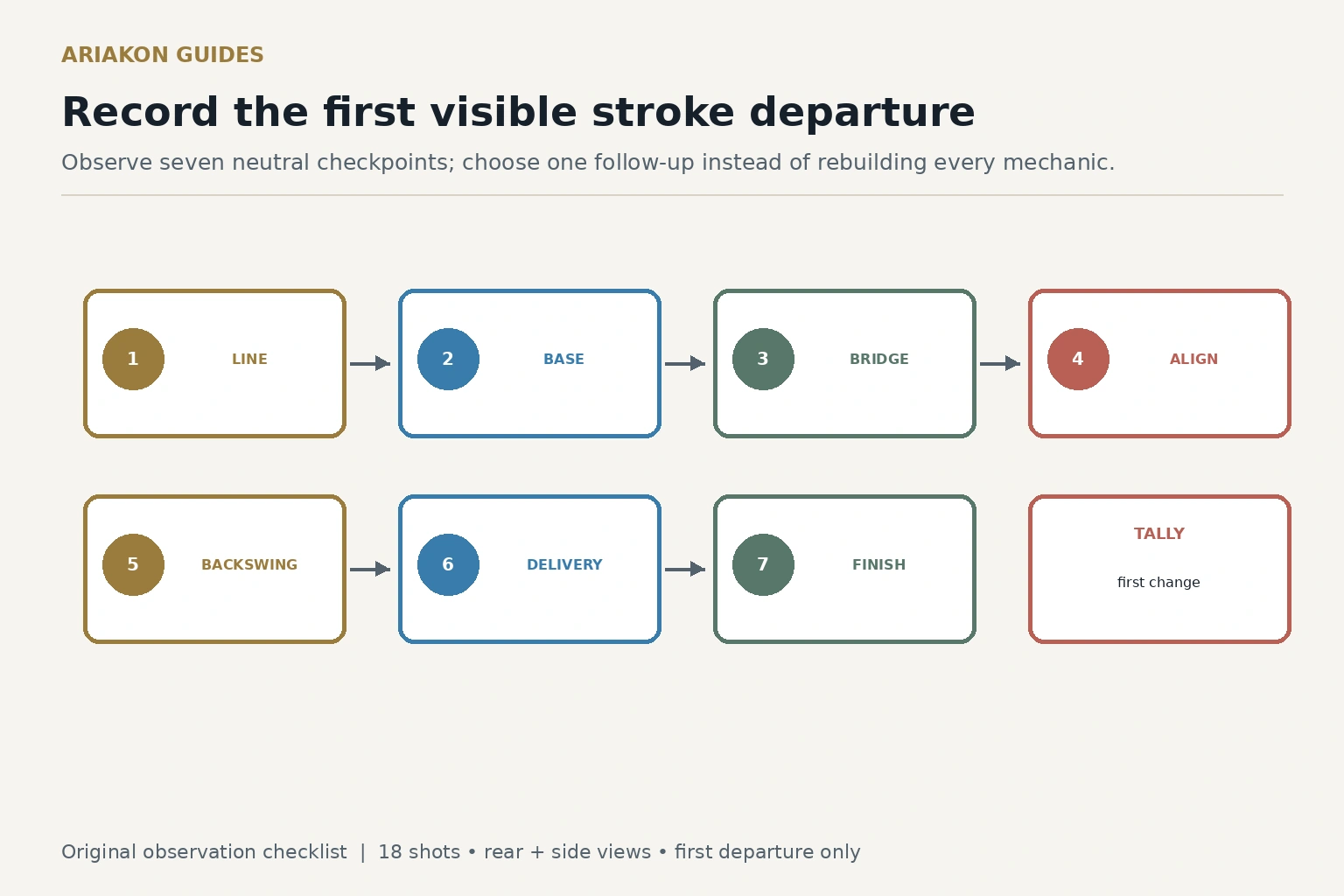
Use one controlled shot and two views
Mark a straight shot with the object ball one diamond from a corner and the cue ball two diamonds behind it. Use vertical-axis contact and pocket speed. Film six attempts from behind the shot line and six from the stroke-arm side, with the camera outside all player and ball paths. Obtain permission where required.
The observer watches the full-speed shot once, then reviews slowly. Do not call a miss a mechanics error by itself. Record the first visible checkpoint that changes from the player's own successful baseline.
Review advanced fundamentals for the role of stance, bridge, grip and tempo.
Use a straight-shot change ladder after one checkpoint is selected.
Observe seven checkpoints in order
| Checkpoint | Visible evidence |
|---|---|
| 1. Standing line | Cue, cue ball and object-ball target are chosen before bending |
| 2. Base | Feet and body support the shot without a late shuffle |
| 3. Bridge | Hand stays planted and shaft channel remains free |
| 4. Cue alignment | Cue begins on the selected line at address |
| 5. Backswing | Cue returns without a sideways loop or sudden grab |
| 6. Delivery | Forward motion stays through the intended contact line |
| 7. Finish | Head and bridge remain quiet; cue stops without a second push |
Run an eighteen-shot observation set
After the twelve filmed baseline shots, shoot six more alternating the rear and side camera every attempt. The observer calls only the first changed checkpoint after the ball stops. The player receives no mechanical instruction during the set.
Each attempt earns one point for exact setup, one for a complete routine, one when no repeated departure appears before contact, and one for pocketing. Maximum seventy-two. Record miss side separately; a make does not erase a visible departure and a miss does not create one.
| Checkpoint | Rear-view count | Side-view count | Total |
|---|---|---|---|
| Standing line / base | |||
| Bridge / cue alignment | |||
| Backswing | |||
| Delivery | |||
| Finish | |||
| No visible departure |
Choose one follow-up from repeated evidence
| Repeated first departure | One focused test |
|---|---|
| Late foot or torso adjustment | Restart from standing on six shots |
| Bridge moves | Run six short shots with bridge stability scored |
| Cue begins off line | Rebuild approach and address without stroking |
| Backswing loops | Use rear video at lower delivery speed |
| Delivery leaves line | Use a safe two-gate cue-path drill |
| Only finish changes after impact | Check whether result or next attempt is actually affected |
Worked example and pressure transfer
In a hypothetical sheet, the first departure is Delivery on five of eighteen attempts, Bridge twice and none on eleven. Four Delivery departures coincide with right-side misses. That pattern justifies a delivery-line test; it does not justify changing stance, bridge, grip and head position together.
For transfer, play two racks while the observer records only the selected checkpoint on shots longer than two diamonds. Compare its frequency with the straight-shot baseline. If the issue appears only when speed or decision pressure changes, preserve the sound baseline and train that condition rather than rebuilding the whole stroke.