
Stroke mechanics · 3 min read
Diagnose Follow Through Without Forcing Extra Cue Movement
Follow-through cannot change the cue ball after cue-tip contact has ended. Its value is diagnostic: a free, on-line finish often reflects what happened immediately before and during impact. Pushing farther on purpose, lifting the cue or holding a pose can manufacture a long finish without fixing the stroke. This drill scores the natural stop of the cue and the movements that produced it.
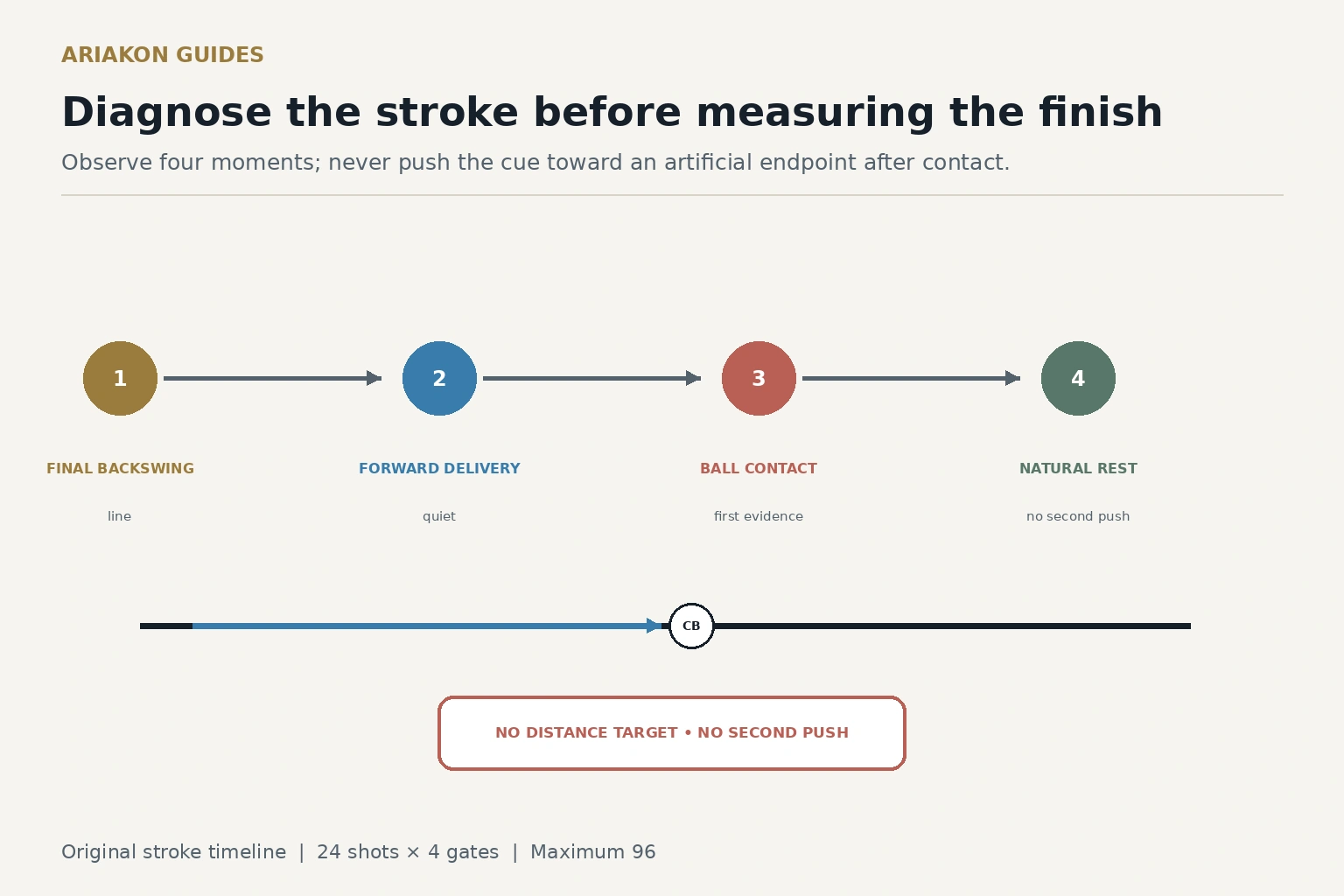
Mark evidence without setting a finish target
Set a straight shot with the object ball one diamond from a corner and the cue ball two diamonds behind it. Mark both centers. Place a phone safely to the side for six shots and behind the cue line for six more. Keep it outside player and ball paths and obtain permission where required.
On video, mark four frames: final backswing, forward delivery, first ball contact and the cue's natural rest. Do not place a physical stop, tape target or object under the moving cue. The purpose is to observe where the cue stops, not compel it to reach a distance.
For any straight stop-shot score in this guide, center the finish window on the cue-ball center at object-ball contact: one ball diameter behind the object-ball center on the incoming line. The cue-ball starting position is not the stop destination. Keep the window size fixed before the block.
Assess the overall follow-through for finish position, chalk and camera basics.
Review a straight stroke on video if the cue leaves the line before impact.
Score twenty-four natural deliveries
Shoot six side-view attempts and six rear-view attempts at pocket speed. Repeat both camera blocks at a slightly firmer but controlled speed. Use the same center-ball aim and bridge length. Freeze normally after each stroke, then relax; do not extend the cue after it has already stopped.
A partner can score live, but slow video is better for separating pre-impact movement from a harmless post-impact motion. Review only after each six-shot block so the camera does not turn every attempt into a pose.
| Point | Requirement |
|---|---|
| 1 | Cue remains on the intended line into contact |
| 1 | Head and bridge stay quiet through contact |
| 1 | Cue comes to rest without a second push or lift |
| 1 | Object ball is pocketed in the called corner |
| Maximum 96 | 24 shots; score side and rear views separately |
Find the first movement, not the longest finish
| First visible event | Likely training focus |
|---|---|
| Grip tightens before contact | Restore relaxed hold and smooth acceleration |
| Elbow or shoulder changes line before contact | Reduce effort and rehearse the delivery path |
| Head or bridge moves before contact | Stabilize support and pause the finish |
| Cue is straight at impact, then drifts | Do not correct a harmless late motion unless it disrupts the next shot |
| Cue stops, then is pushed forward again | Remove the manufactured extension |
Use dry rehearsals only to remove the second push
If the cue visibly stops and then moves again, stand away from the balls and make eight slow air strokes over a clear table area. Let each stroke decelerate and stop on its own. The test passes when the cue has one continuous forward motion and one rest, not when it reaches a chosen spot.
Return to six scored shots. If the second push is gone but the cue still finishes at different distances as speed changes, that variation may be normal. Judge line, stability and result before distance.
Worked example and pressure transfer
A player scores 79/96. Pocketing is 22/24, but rear video shows five cue lifts beginning before contact in the firmer block. The finish looks long, so distance alone would miss the error. The next action is six firm shots at lower effort with the bridge and head stability gates retained; no extra extension is added.
For transfer, play three racks and record only shots that require firmer speed. After the rack, review whether the same pre-impact lift appears. A follow-through correction earns transfer credit only when the first movement improves under a real route decision.