
Stroke mechanics · 3 min read
Troubleshoot Pool Stroke Acceleration With Three Measurable Checks
Every forward stroke changes speed before contact, but more acceleration at the instant of impact is not a magic source of spin or power. The cue's speed and contact point do the useful work. Diagnose a suspected timing problem with three observable checks: when the cue reaches useful speed, whether it stays on the intended delivery line and whether the cue ball reaches repeatable speed windows.
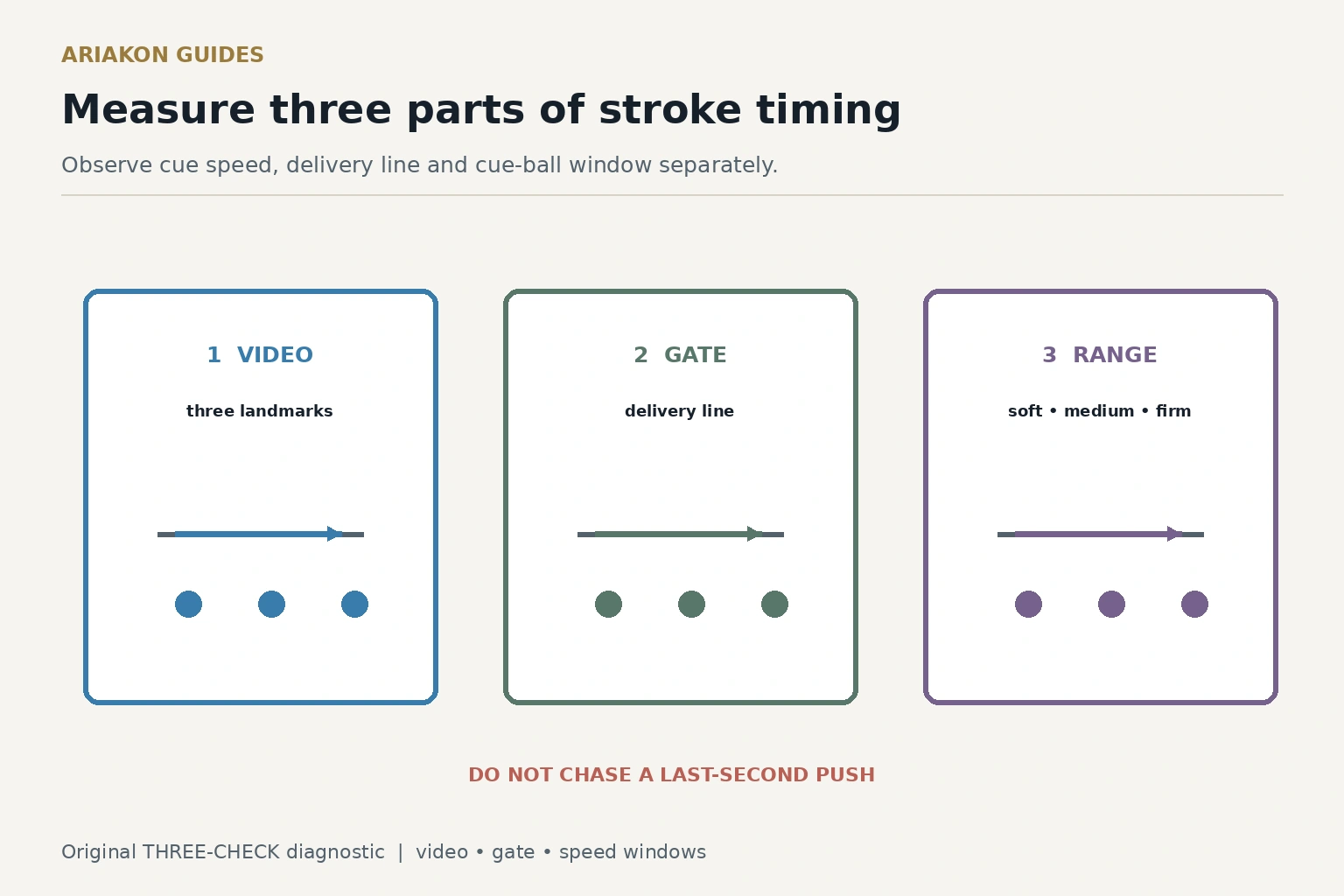
Check 1: mark three video landmarks
Record normal-speed and slow-motion views from a safe fixed side position. Video frame spacing can compare landmarks, but it is not a calibrated force or acceleration sensor. Use careful language: the cue appears to slow before contact, not the player has a measured acceleration of a specific value.
Record whether the cue develops speed smoothly and reaches the intended contact without an obvious check or lunge. Do not interpret a forced finish as extra impact energy. The video is an observation of timing, not a force measurement or evidence that the hand can add a special last-instant push.
| Landmark | Observe | Possible warning |
|---|---|---|
| Backstroke end | Clear change from back to forward motion | Abrupt snatch or changing pause |
| Halfway forward | Cue has gained most of the needed speed smoothly | Late lunge begins here |
| Just before contact | Speed is stable or still smooth, not visibly checked | Obvious let-up before the ball |
| Finish | Cue completes naturally on its line | Forced reach used to imitate acceleration |
Compare normal-speed and slow-motion footage for synchronized playback landmarks.
Use three advanced stroke drills after the diagnostic identifies one variable.
Check 2: protect the delivery line
A player can produce more cue speed while losing tip accuracy or line. If the timing view looks smoother but the gate and stop window get worse, the change is not ready for game use.
Use visual floor or table-reference marks that do not damage cloth and comply with the room's rules. The gate is a viewing aid, not a contact obstacle.
| Setup | Point | Stop rule |
|---|---|---|
| Straight-in stop shot at comfortable distance | 1 for pocket | Reset any moved ball |
| Two safe objects outside the cue path as a visual gate | 1 for centered passage | Never place an object where cue or hand can strike it |
| Marked cue-ball stop window | 1 for outcome | Stop after repeated miscues |
| Maximum | 18 points over six attempts | Change nothing mid-block |
Check 3: compare three cue-ball speed windows
For these eighteen shots use the cue ball alone. Mark one start and a wide straight viewing corridor, then three finish windows at safe increasing distances before the next cushion. Score one point for the named speed before stance, one for the initial corridor and one for the called window:18 possible per six-shot speed block. These are separate from the earlier six-shot pocketing gate test.
Worked example: normal-speed video shows a late shoulder surge only on firm shots. The player scores 15/18 on the gate at soft speed, 14 at medium and 8 at firm; four firm misses also cross the wrong side of the cue-ball window. The next action is a shorter firm-speed range with the same backswing rhythm—not trying to push harder through contact.
Change one landmark and repeat on another day. If pain, numbness or an injury affects the motion, stop and seek appropriate medical or coaching help rather than using the drill to diagnose health.
| Block | Attempts | Cue-ball target | Primary diagnosis |
|---|---|---|---|
| Soft | 6 | Stop in a near window | Does the player stab or overrun? |
| Medium | 6 | Stop in a middle window | Does the timing stay unchanged? |
| Firm | 6 | Reach a far window without forcing | Does line or contact break first? |