
Video practice · 3 min read
Compare Normal Speed and Slow Motion Pool Stroke Footage
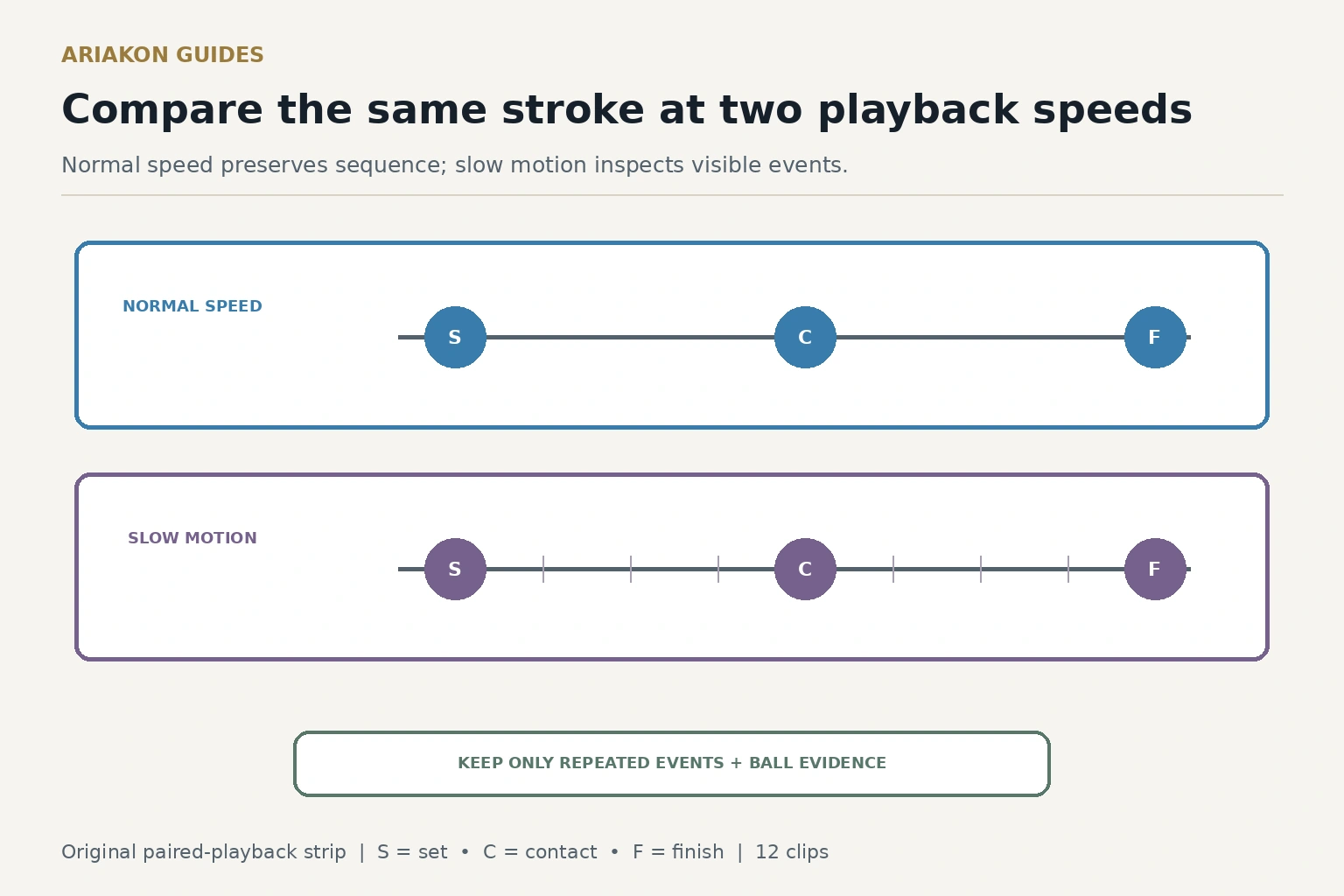
Normal-speed and slow-motion playback answer different questions. Normal speed preserves the rhythm, decision sequence and proportion of the whole action. Slow motion helps locate a visible event between the final set and finish. Compare both views of the same registered shots, synchronize them at named landmarks and let the ball result decide whether an observation deserves a test.
Register one shot and one camera view
Place an object ball one diamond from a corner pocket and the cue ball three diamonds away on the same line. Mark the ball positions and a one-ball-wide cue-ball finish corridor. Use a registered vertical-axis contact and comfortable pocket speed. Record twelve attempts from the side, framing the bridge, cue, grip hand and cue ball without placing equipment in player or ball traffic.
Use the same recording for both playbacks. A second camera angle is a later experiment, not a substitute for matching the first comparison. Obtain permission from the room and anyone who may appear in the footage.
The corridor follows the physical shot line around the collision area; it does not require the cue ball to return backward. Record actual stop, follow or draw distance separately, and use the same contact intention throughout the block.
Start with the slow-motion review guide for safe camera placement and basic observation.
Choose one change from video evidence after a repeated event survives this comparison.
Give each playback one job
| View | Observe | Do not infer |
|---|---|---|
| Normal speed | Decision-to-stance order, overall tempo, pause and finish proportion | Exact joint angle or a cause from one fast impression |
| Slow motion | Visible cue corridor, head timing, grip-height change and contact-to-finish sequence | Force, pain, intention or three-dimensional motion from one side view |
| Ball result | Pocket entry, cue-ball finish corridor and finish distance | That a tidy-looking stroke caused every result |
| Matched comparison | Whether the same event repeats in both coded notes | That one unusual frame is a stable pattern |
Synchronize three landmarks
For every clip mark S at the final still set near the cue ball, C at visible cue-ball contact and F when the cue reaches its natural finish. Watch normal speed once without pausing and write one sentence. Then inspect the S–C and C–F intervals in slow motion. Do not drag frame by frame until something looks wrong.
Camera frame rates and rolling-shutter behavior can distort apparent timing and straightness. Compare attempts recorded under the same settings; do not convert phone frames into laboratory force or speed measurements.
Score twelve paired reviews
After twelve attempts, count only events present on at least three clips from the same view. A candidate change earns a test when the visible event repeats and aligns with a repeated ball-result pattern. If normal speed looks stable while slow motion shows a small motion with no result pattern, record it and make no change.
| Evidence per attempt | Point |
|---|---|
| Normal-speed note names the sequence or tempo without diagnosis | 1 |
| Slow-motion note codes one visible event at S, C or F | 1 |
| Pocket entry and cue-ball corridor are recorded | 1 |
Worked example and game transfer
A hypothetical player writes “tempo stable” on nine normal-speed clips. Slow motion shows the head moving before C on five clips; four of those also miss the cue-ball finish corridor to the same side. The player tests one reversible cue—hold the finish through ball contact—for eight shots, not a complete stance rebuild.
Transfer uses six ordinary position shots recorded only at normal speed. If the sequence stays recognizable and the ball evidence improves, slow motion has supplied a useful observation. If the clip looks tidier but pocket entry or speed worsens, discard the change. Video feedback supports learning only when it remains tied to the task result.
Sources and further reading
References support the specific factual information above. The practical checklists are Ariakon editorial guidance.