
Cue buying · 4 min read
Map Pool Cue Features to Build Evidence and Service Limits
A cue listing can describe several technologies at once while proving none of their individual playing effects. Map each promised function to its physical component, evidence and service limit. This whole-cue worksheet is for a documented new configuration; identifying an unknown used cue or testing one shaft is a different task.
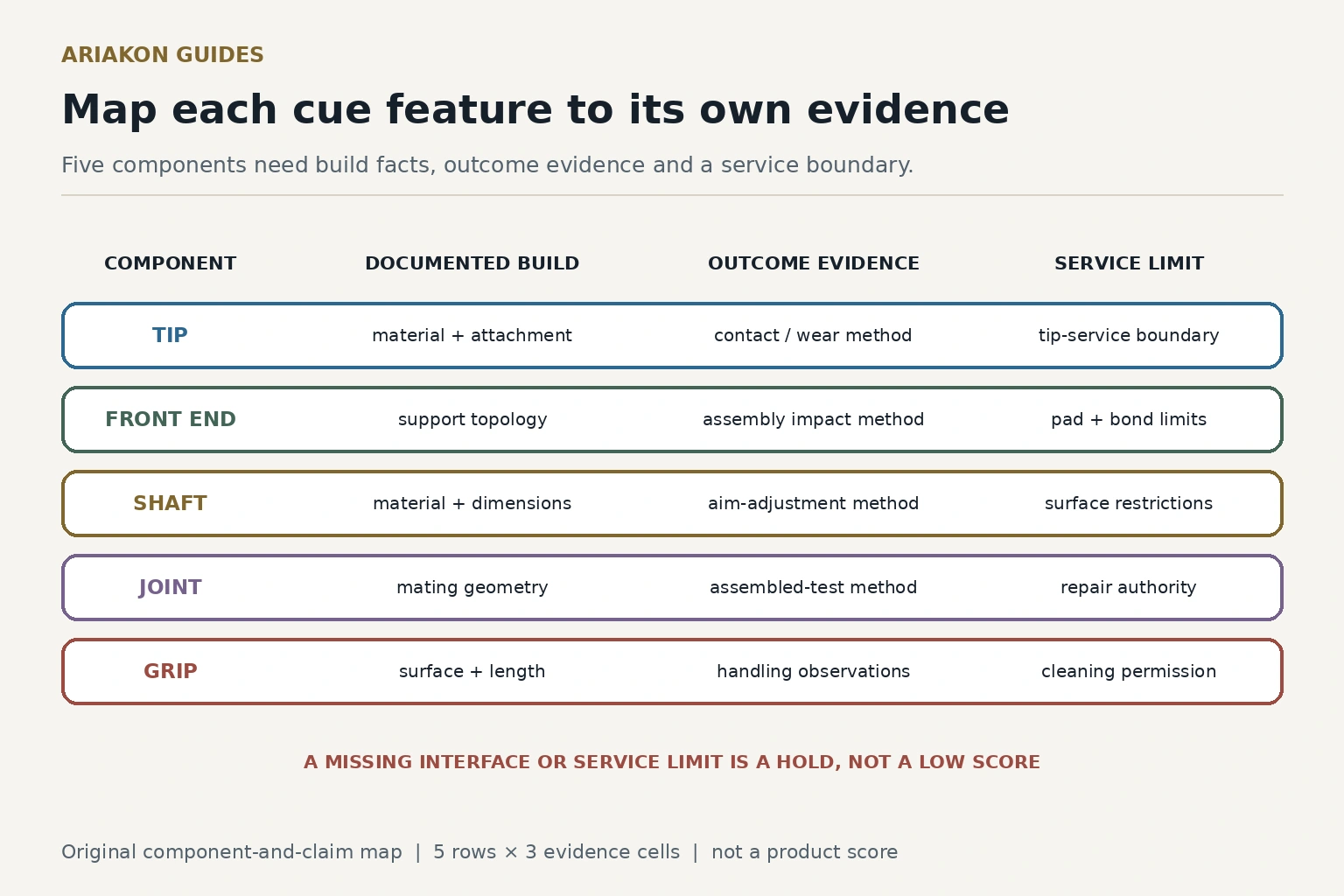
Freeze the exact proposed configuration
Save the current listing and date, selected variant, included shaft and tip, joint, grip, complete-cue dimensions and any permitted adjustment. Use the exact configuration the seller would deliver, not a collection of specifications from neighboring models. If a component is changed, open a new dated configuration record.
Start with the actual need: a spare-compatible playing setup, an easier-to-maintain handle or a specific observed adjustment problem. A list of technical-sounding features is not a need. This page organizes the evidence for a proposed build; it does not decide whether practice or an upgrade is the better investment.
Decide whether an upgrade addresses the problem before filling a feature map.
Identify an unknown existing cue when specimen identity, not a proposed build, is missing.
Give five components three separate evidence cells
Five rows×three cells=15. Tag every cell DOCUMENTED, OBSERVED, CLAIM ONLY or UNKNOWN and retain its source/date. An OBSERVED cell is only the result you actually observed, with its limitations. A stated construction is not measured performance; a handling trial cannot identify an invisible support layer.
Use current manufacturer documentation for that component, not a borrowed number or process. For example, a front-end thickness from one design is not a universal repair limit. NIST explains that traceability concerns particular measurement results and that traceability alone does not establish fitness for purpose; a precise-looking dimension is not sufficient evidence of a playing benefit.
| Component | Documented build | Outcome evidence to ask for | Service limit |
|---|---|---|---|
| Tip | Material, attachment, shape and intended role | Contact, wear or feel claim: method and actual observations | Permitted maintenance and replacement route |
| Front-end support | Sleeve, cap, plate and pad topology, or unknown | Impact or durability claim: what assembly was tested? | Retained layers and authorized repair boundary |
| Shaft | Material, length, diameter and taper of the selected variant | Aim-adjustment claim: conditions, baseline and measurement | Surface care and any alteration restriction |
| Joint | Actual mating geometry and confirmed compatible pieces | Whole-cue claim: tested assembly, not a joint label alone | Fit assessment and replacement authority |
| Grip/handle | Surface, wrap, usable length and selected butt configuration | Handling claim: conditions and complete-cue observation | Cleaning, rewrap or component-service permission |
Draw the dependencies before choosing what to trial
Draw five component boxes and connect the tip to its support, support to shaft, shaft to joint, and joint to the handle assembly. Write the exact interface confirmation beside each connection. These are four interfaces, not four proof points for superiority. Put a hold beside any incompatible or unidentified connection.
Now mark which components differ from your baseline. If the proposed cue changes tip, shaft and grip together, that is three changed components. A better personal result on that cue cannot identify which change caused it. A safe authorized one-component swap can narrow a question; if no such swap is permitted, keep the conclusion at whole-configuration level. Do not dismantle a cue to manufacture a controlled test.
Confirm the front-end repair boundary before treating a support or pad as interchangeable.
Use the replacement-shaft comparison when a shaft-only trial is mechanically permitted.
Work a configuration with two missing evidence cells
This gives eight DOCUMENTED cells, five CLAIM ONLY cells and two UNKNOWN cells:8+5+2=15. There are zero independently established outcome cells. The missing front-end identity and service boundary stop any tip/support modification. Eight documented cells cannot compensate for those two unknowns.
The useful next action is a specific question: which front-end components belong to the selected configuration and who may service them? Ask separately for the actual basis of any playing claim. If a safe whole-cue demo is allowed, it can inform personal fit while those documentary gaps remain unresolved; it does not clear an undocumented repair or prove the advertised mechanism.
| Row | Documented build | Outcome basis | Service limit |
|---|---|---|---|
| Tip | Documented | Claim only | Documented |
| Front-end support | Unknown | Claim only | Unknown |
| Shaft | Documented | Claim only | Documented |
| Joint | Documented | Claim only | Documented |
| Grip/handle | Documented | Claim only | Documented |
Keep the purchasing and playing conclusions separate
Save one conclusion per row and one final configuration decision: suitable to inspect, suitable for a bounded personal trial, hold for evidence, or reject for a known mismatch. Keep actual delivery and return terms with the purchase record. Do not assign a blanket performance rank from the count of features or evidence cells.
Current Ariakon product pages can supply a selected configuration to document, and its FAQ supplies bounded care information. Neither this worksheet nor an observed preference creates an inventory promise, universal service policy or independent comparative test.
Read the current Ariakon playing-cue page if that is the actual configuration you want to map; save current options rather than copying old specifications.
Separate shaft performance claims before a trial for a numeric claim limited to a shaft.
Sources and further reading
References support the specific factual information above. The practical checklists are Ariakon editorial guidance.