
Cue buying · 5 min read
What Cue Popularity Can and Cannot Tell You About Fit
A popularity statement can describe attention, sales, reviews or availability. It cannot prove that a cue fits your reach, hand, tempo or shaft plan. Use the SIGNAL–FIT–TRIAL worksheet to audit the claim first, then make the purchase decision from evidence attached to the exact candidate and your own repeatable trial.
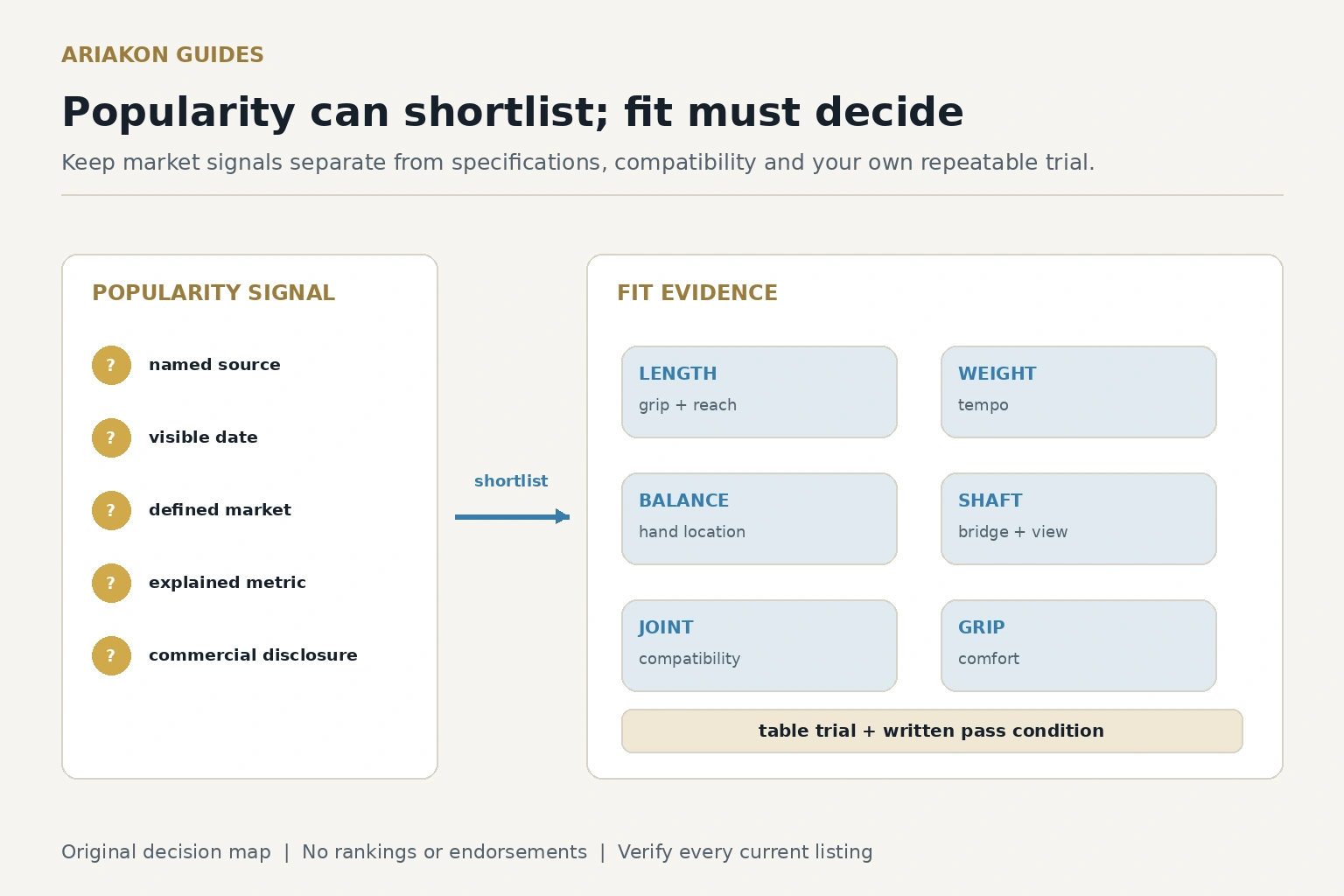
Audit the popularity SIGNAL
The Federal Trade Commission states that advertising claims should be truthful, not deceptive or unfair, and evidence-based. Use that boundary as a consumer question: what exact evidence supports the claim, and does it answer your fit task? A badge without a defined source, date and metric is a signal to investigate, not a specification.
Record the popularity note in its own column. Do not let it fill a blank for condition, dimensions, joint identity, service terms or availability.
| Field | Question | Minimum useful evidence | Fail condition |
|---|---|---|---|
| Source | Who made the claim? | Identified publisher or seller | Anonymous or circular claim |
| Date | When was it measured? | Visible time period | Undated current-sounding language |
| Market | Which store, region or audience? | Defined population | Universal wording from a narrow sample |
| Metric | Sales, reviews, searches or editor choice? | Named measure and method | Best, top or popular with no definition |
| Commercial role | Was stock, placement or payment involved? | Clear disclosure | Commercial influence is hidden |
| Item identity | Which exact configuration? | Current model and variant | Family name stands in for the item |
Know the limited jobs popularity may perform
A well-documented sales or participation signal can identify candidates that many buyers have encountered. It may suggest that owner reports, used examples or technician experience will be easier to find. Each of those possible benefits still requires a direct check in your location and for the current configuration.
Popularity does not establish straightness, undamaged condition, legal use in every event, cue-ball response, warranty coverage or fit. It also cannot substitute for a compatibility check when you plan to reuse a shaft or extension.
Build the FIT sheet before a table trial
The current competition equipment specification supplies broad boundaries, including a minimum cue length, maximum weight and maximum tip width for covered events. Those are eligibility references, not personal-fit targets. Verify the current rules for the event you actually enter.
Write unknown when a current listing or physical inspection does not establish a field. An unknown joint or unexplained condition is a stop, not a reason to let a popularity claim decide.
| Field | Candidate A | Candidate B | Pass condition |
|---|---|---|---|
| Assembled length | ___ | ___ | Grip stays on usable handle |
| Ready weight | ___ | ___ | Comfortable tempo for 24 shots |
| Balance point from bumper | ___ | ___ | No forced squeeze or hand move |
| Shaft diameter and profile | ___ | ___ | Clears normal bridge |
| Verified joint identity | ___ | ___ | Matches the intended shaft plan |
| Grip surface and circumference | ___ | ___ | Stable with dry and warm hand |
| Condition and support | ___ | ___ | No unresolved defect or policy gap |
Run a label-hidden 24-shot TRIAL
When safe and practical, have a helper identify candidates as A and B without naming price, claimed popularity or marketing tier. Each candidate has three eight-shot tasks, 24 strikes; both together allocate 48 strikes. Use A then B for the first task, B then A for the second, A then B for the third, and reverse all orders on another occasion. Keep balls, setup version and task requests matched; log rests and unused slots.
Record legal pots and joint pot-plus-finish flags separately, each out of eight per task. Comfort and grip effort use their own 0–3 notes; pain or unsafe binding is a stop. The purpose is personal repeatability, not a universal product ranking. No tape or target object remains on the cloth during a strike.
Coordinates are centers from the lower-left cushion noses. Scale to actual balls and bed, inspect pockets and clearance, and remove setup aids. Calibrate each request comfortably before scoring; a cut finish is a goal, not a guaranteed tangent-distance result. If the request cannot be repeated safely, hold it and save a different version before comparison.
| Task | Exact setup and finish request | Attempts per candidate | Separate outcomes |
|---|---|---|---|
| Stop | O(6,3), P(8,4), G(5.839003,2.919502), C(4.944576,2.472288); cue-center disk radius 0.18 at G | 8 | Legal pot; legal pot plus disk |
| Follow | Same O/P/G; C(4.586805,2.293403); disk radius 0.18 at (6.375659,3.187830) | 8 | Legal pot; legal pot plus disk |
| Modest cut | Same O/P/G; C(5.122716,1.834636); chosen tangent finish disk radius 0.18 at (5.615396,3.366716) | 8 | Legal pot; legal pot plus disk |
Make a worked decision without inventing a winner
Hypothetical completed trials: A has 20/24 legal pots and 15/24 joint finishes, but the grip hand crowds the bumper on seven shots. B has 19/24 legal pots and 15/24 joint finishes and keeps its hand in the usable handle area. Both pass condition and compatibility checks. Keep the three task rows visible; these totals do not isolate a construction advantage.
The evidence sheet favors resolving A’s repeated grip conflict before buying. B may be the more usable choice for this player, but the one-pot difference does not establish superiority. An unresolved joint, condition or support field holds the purchase until the gap is closed.
Keep this task separate from general cue buying
This worksheet answers one question: how much weight should a popularity signal carry when comparing fit? The complete cue-selection guide covers budget, purpose and broader buying evidence. The measurement guide supplies the exact baseline readings. Keeping those tasks separate prevents a market signal from silently becoming a fit specification.
Use the complete cue selection framework after the popularity signal produces a shortlist.
Record five cue-fit measurements before completing the candidate sheet.
Sources and further reading
References support the specific factual information above. The practical checklists are Ariakon editorial guidance.