
Cue buying · 5 min read
Compare Replacement Pool Shafts With a Five Criterion Worksheet
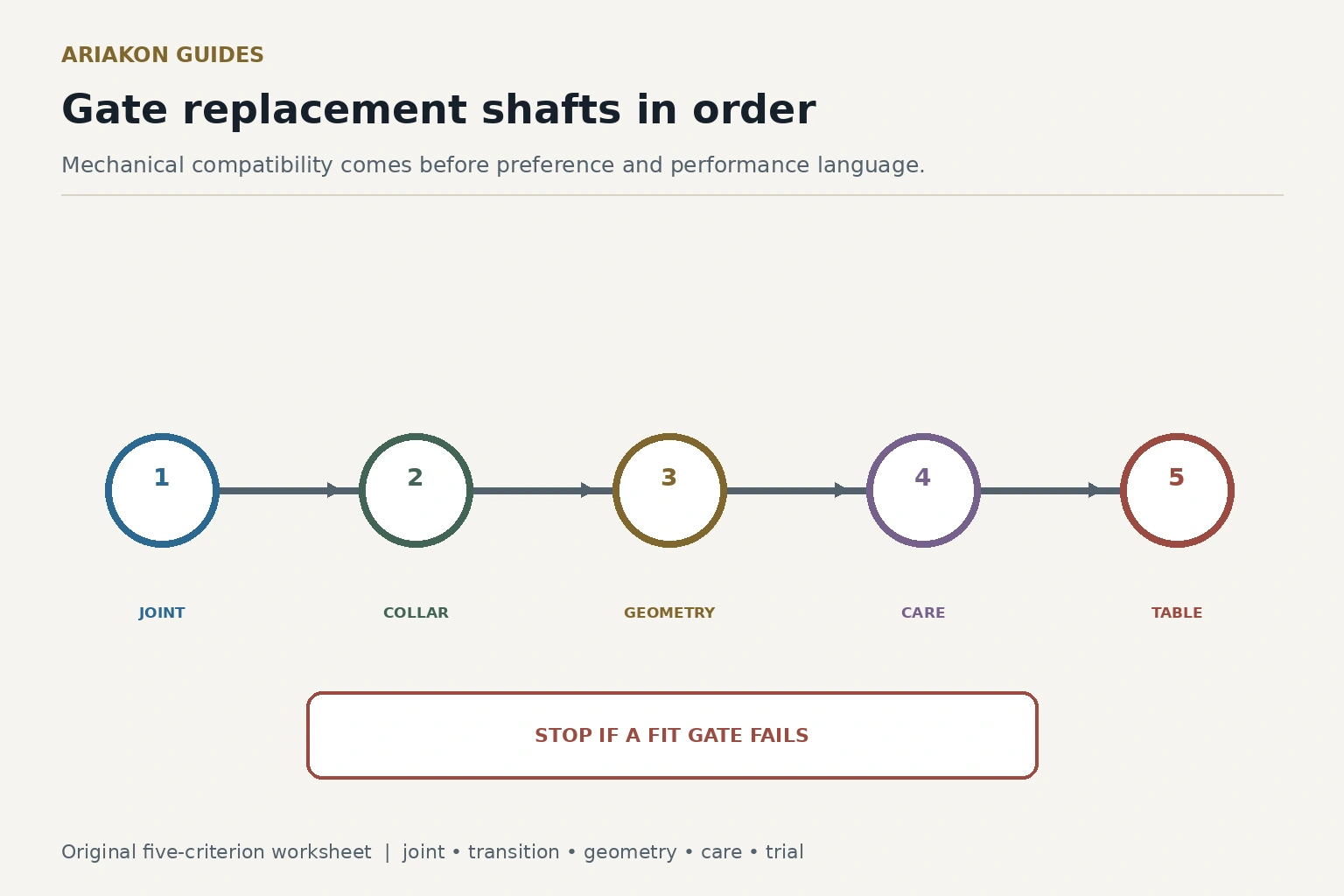
Comparing replacement shafts is an ordered decision: mechanical fit first, usable geometry and care next, then a bounded personal trial. This five-criterion worksheet compares candidates for one existing butt. It does not rank material families, identify an unknown cue, or turn a seller’s performance language into an independent result.
Clear the joint and transition before any scoring
An uncertain joint belongs with the seller or qualified cue technician before assembly. Only make the normal assembly after compatibility is established, stopping at resistance, an unexpected gap or a loose interface. Rings that do not line up are a different issue from a structural mismatch; do not label all visible differences harmless.
Record dimensions with units, locations and method. For a hypothetical 21.35 mm butt collar and 21.60 mm shaft collar, the diameter difference is 0.25 mm and the radial step, if centered, is 0.125 mm. The diameter difference is about 0.00984 inch using the exact 25.4 mm/inch conversion. That is arithmetic, not a universal rejection tolerance or certified measurement.
| Criterion | Evidence | Boundary |
|---|---|---|
| 1 — Joint | Actual pin/insert geometry, pilot details and written fit confirmation for both pieces | No force, thread trial by resemblance or guessed adapter |
| 2 — Collar/face | Actual interface diameters, alignment and intended face contact | No structural gap, binding or unauthorized alteration |
| 3 — Geometry | Selected length, tip diameter, taper and assembled reach | Record actual setup; do not infer from a family name |
| 4 — Care/service | Specific finish, front-end service and permitted cleaning | No borrowed solvent, abrasive or retipping procedure |
| 5 — Table trial | Same butt, fixed layouts, recorded tip condition and declared scoring | Preference observation only after the earlier gates pass |
Identify the actual joint before considering a replacement.
Use the post-fit acceptance checklist when you need the received-item inspection rather than a candidate comparison.
Give each eligible configuration a complete record
Use a row for the baseline and each confirmed-fit candidate. Record shaft identity/variant, length, diameter, taper, joint/transition, tip material and condition, overall cue mass if known, permitted care and observed comfort. The same butt does not hold total mass, balance or tip response constant when the shaft changes.
A candidate with unknown cleaning or front-end service requirements remains an ownership concern even if it fits mechanically. Current Ariakon carbon-care guidance gives bounded soft-cloth care and asks for advice before unfamiliar products; it is not a universal instruction for every wood, composite or carbon surface.
Choose one comparison question, such as whether the new complete configuration requires an acceptable adjustment on familiar straight layouts. This is not the controlled material-family trial and not the audit of a numeric accuracy percentage. Keep manufacturer statements in a documentary column, separate from observations.
Compare material-family configurations for the separate wood/composite/carbon question.
Audit shaft performance numbers before interpreting a percentage as proof.
Use three exact layouts without a guessed cushion route
Use a 100×50-inch playing surface and 2.25-inch balls, with 12.5 inches per coordinate unit. Origin(0,0) is one corner cushion intersection; x follows the long side and y crosses the bed. All layouts use cue C=(5,1), object O=(6,2), real corner pocket P=(8,4) and full-contact cue center G=(6−0.18/√2,2−0.18/√2). The centers and pocket are collinear.
For layout 1, attempt a stop near G; for layout 2, attempt forward travel to F1=(6.5,2.5); for layout 3, attempt farther forward travel to F2=(7,3). Each cue-ball target is a circle of radius 0.125 unit, or 1.5625 inches. Targets are on the bed and do not overlap pocket mouths; no cushion contact is prescribed. Use familiar safe speeds and no side spin. Adjust vertical tip contact and speed to the intended stop or follow outcome, not a demanded maximum offset.
Reset exact ball centers after every attempt. Use only venue-approved temporary practice markings away from ball paths, removing them before matches; do not use chalk as an aiming marker. Call the pocket and target before entering the stance. If a layout requires an uncomfortable reach, use the same suitable support for both configurations or pause the trial.
| Layout | Cue-ball finish center | Scored attempts | Maximum |
|---|---|---|---|
| 1 — Stop | G≈(5.87272,1.87272) | 6 | 6 pots +6 windows=12 |
| 2 — Short follow | (6.5,2.5) | 6 | 6 pots +6 windows=12 |
| 3 — Longer follow | (7,3) | 6 | 6 pots +6 windows=12 |
Alternate configurations and separate attempts from points
First allow two unscored familiarization shots on each layout with each of the two eligible configurations:12 unscored shots total. Then take one baseline attempt and one candidate attempt in rotation at layout 1 until each has six scored attempts; repeat at layouts 2 and 3. First session:36 scored attempts plus 12 familiarization shots=48 total exposures.
Score one pot point for the called object-ball pocket. Score one window point only when that pot succeeds without a scratch and the cue-ball center finishes inside or on the called circle; otherwise window 0. Log scratches, miss side, reach/bridge comfort and unusual sound separately. A structural concern stops the trial immediately and cannot be compensated by points.
Per configuration:18 scored attempts, at most 18 pot points plus 18 window points=36. Two configurations:36 scored attempts and 72 possible points. Keep each column and layout subtotal; a combined score alone can hide the actual adjustment. For a second session, repeat the same 12 unscored plus 36 scored structure but start each pair with the candidate. Across both sessions:24 unscored+72 scored=96 exposures and 144 possible scored points.
Work equal totals that mean different things
Both configurations score 25/36, but the candidate has one fewer pot and one more window. There is no superiority result. Examine the actual misses, support comfort, documented care and setup differences, then run the counterbalanced second session if there is no safety hold.
A different candidate never reached the trial because its transition remained uncertain. Leave that row HOLD, not zero performance points. Missing fit is not evidence of poor playing performance. Likewise, two short sessions do not isolate shaft construction from the different tip, total weight or balance.
| Layout | Baseline pots / windows | Candidate pots / windows |
|---|---|---|
| Stop | 5 /4 | 5 /4 |
| Short follow | 5 /3 | 4 /3 |
| Longer follow | 5 /3 | 5 /4 |
| Totals | 15 /10=25 points | 14 /11=25 points |
Check low-squirt adaptation separately when side-spin aim adjustment is the actual remaining question.
Read the current Ariakon shaft listing if it is the candidate; confirm the exact available variant and ask about the actual butt fit.
Sources and further reading
References support the specific factual information above. The practical checklists are Ariakon editorial guidance.