
Cue service · 3 min read
Inspect a Replacement Cue Shaft After Fitting
Professional fitting can change a collar, face or insert so a replacement shaft mates to one butt. Inspect the delivered assembly before the service handoff closes. The goal is not to diagnose the craft; it is to document whether the agreed fit and function are present.
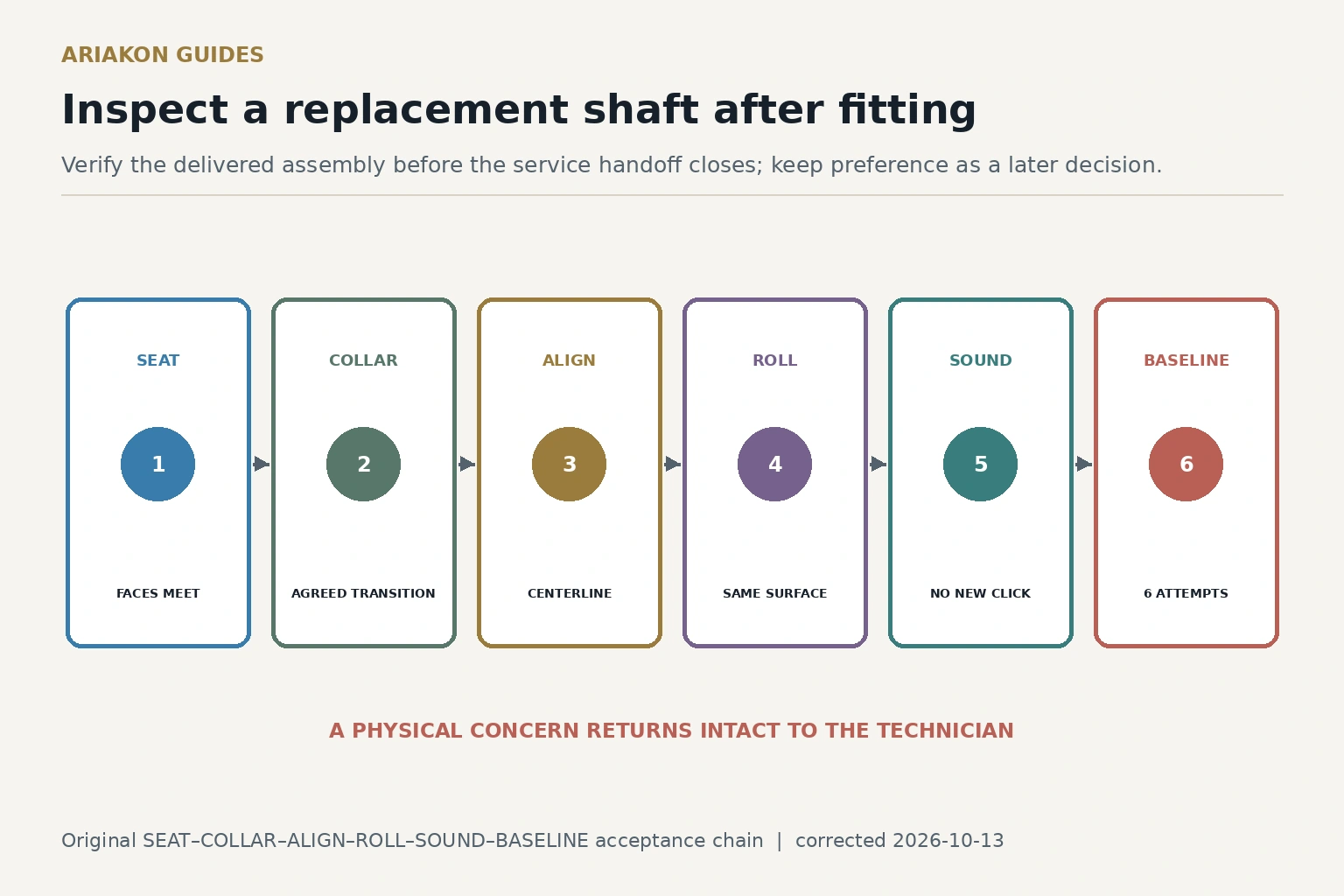
Bring the intake record to pickup
| Field | Check | Stop or question |
|---|---|---|
| SEAT | Faces meet evenly at hand-tight assembly | Gap, rocking, early bottoming or unexpected resistance |
| COLLAR | Transition matches the agreed mechanical and cosmetic tolerance | Sharp edge, interference or unapproved material removal |
| ALIGN | Shaft centerline and ring orientation match the written scope | Visible offset or different delivered configuration |
| ROLL | Butt, shaft and assembly observed on the same known surface | New repeatable lift or inconsistent observation |
| SOUND | No new click, rattle or movement during gentle handling | Any unexplained sound or loose component |
| BASELINE | Bounded center-ball shots after physical clearance | Unsafe condition or result outside agreed acceptance test |
Build a cue service record before work for the intake side of this handoff.
Confirm replacement-shaft fit across seven fields for pre-service candidate screening.
Inspect in a fixed order
Photograph both parts separately, then assemble with fingertips. Inspect face contact and collar transition under even side light. Sight along the assembled cue without flexing it. Repeat the roll observation in more than one starting orientation on the same clean, known surface.
Do not reopen, sand, polish, lubricate or tighten the fitted joint to investigate a concern. Mark the observation and return it to the technician while the delivered condition is intact.
Separate acceptance from playing preference
| Decision | Evidence | Not established |
|---|---|---|
| Service acceptance | Agreed dimensions, seat, collar, alignment, roll and sound | Better cue-ball control |
| Playing baseline | Same butt, same three shots, marked zones and six attempts | Universal shaft ranking |
| Care handoff | Written cleaning, tip and future-service limits | Coverage beyond the actual terms |
| Future record | Invoice, before/after measurements and replaced-part disposition | Original factory configuration |
Run a six-attempt baseline
After every physical field passes, shoot two straight stop shots, two medium follow shots and two familiar off-center position shots. Award one point for the called pocket and one for the marked cue-ball zone. Maximum: 12 points. Record unusual sound or movement separately and stop if either appears.
The score is a handoff baseline, not a performance comparison. Familiarization, cloth and player variation can influence a short set. Retest later before making an equipment judgment.
Worked acceptance: the threads are not the issue
A fitted shaft assembles smoothly and the faces meet, but a sharp collar edge exceeds the written flush-transition request. The physical thread check passes while the service acceptance fails. Photograph the transition and ask the technician to reconcile it with the authorization.
After correction, the collar meets the agreed tolerance, the assembled roll shows no new repeatable lift and the six-attempt baseline has no click or movement. Attach the final measurements and invoice to the cue record.
Sources and further reading
References support the specific factual information above. The practical checklists are Ariakon editorial guidance.