
Equipment reference · 3 min read
Audit Cue-Shaft Performance Claims Before a Trial
A performance percentage can be precise without being decision-ready. Before comparing cue shafts, identify exactly what was measured, what the result was compared with, and whether the method and observations are available. Then keep that evidence separate from fit and from your own bounded playing trial.
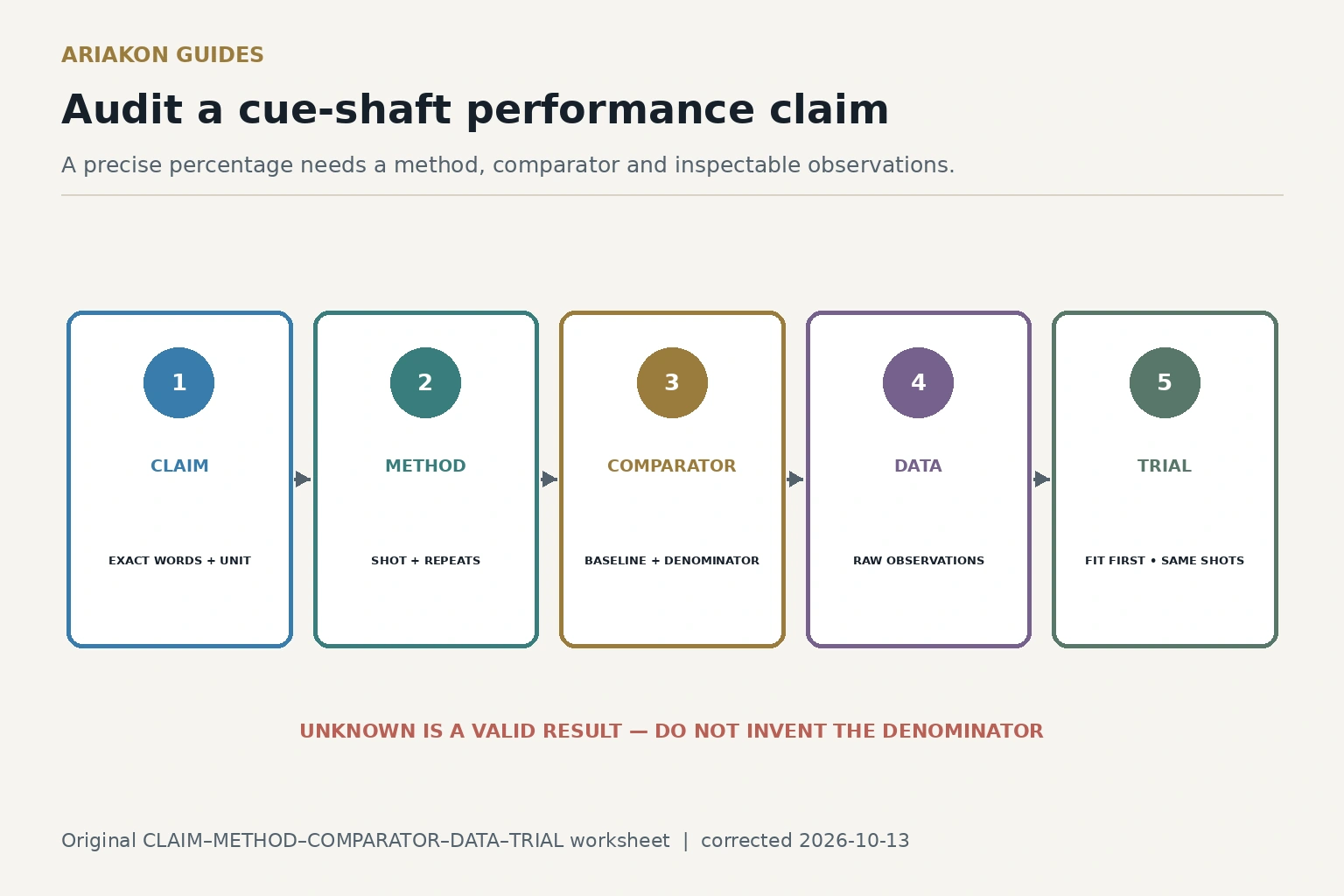
Pass every percentage through five evidence gates
Write unknown when a field is absent. Do not infer a test rig from an illustration, a comparator from a family name or independent confirmation from repeated marketing language.
Treat an objective performance claim as unverified until its actual basis is available. This worksheet records that evidence boundary for a buying decision; it does not determine legal compliance or manufacture a missing test method.
| Gate | Record | Decision rule |
|---|---|---|
| CLAIM | Exact wording, unit, source, date and named item | Do not broaden the statement beyond its source |
| METHOD | Shot, speed, offset, equipment, instrument, repeats and calculation | Missing method means the result cannot be reproduced |
| COMPARATOR | Exact reference shaft, baseline or prior value | A percentage without its denominator is incomplete |
| DATA | Attempt-level observations, exclusions and uncertainty | A summary alone cannot expose variation or cherry-picking |
| TRIAL | Physically cleared candidates, same setup and scored outcomes | Player preference is local evidence, not validation of the original claim |
Separate shaft specifications, claims, fit and service terms when the whole comparison mixes several evidence types.
Compare replacement shafts with a five-criterion worksheet after every candidate has a safe, documented identity.
Check the arithmetic before the conclusion
Worked arithmetic: a reported error measure falls from 10 millimeters to 8 millimeters. The absolute change is 2 millimeters and the relative reduction against the 10-millimeter baseline is 20 percent. If the comparator, unit or calculation is missing, record the original statement but do not recreate a convenient denominator.
A construction drawing or specification can explain dimensions. It does not prove a playing-performance percentage unless the stated method connects that construction to the reported result.
| Question | Why it matters | Safe record |
|---|---|---|
| Percent of what? | A 20% change from 10 units is not the same as 20 percentage points | Write numerator, denominator and unit |
| Compared with what? | A private baseline may not represent another shaft | Identify the exact comparator |
| How many trials? | A small set can swing with one observation | Record repeats and exclusions |
| Which conditions? | Speed, tip offset and ball condition can change the observation | List controlled and uncontrolled variables |
| Who calculated it? | First-party and independent results carry different provenance | Attribute the source; do not upgrade it |
Clear fit before any playing trial
Confirm role, joint thread, pilot, faces, collar, assembled length and safe seating before hitting a ball. Stop for cross-threading, binding, a face gap, rocking, early bottoming or unexplained resistance. Never force a candidate to make a claim test possible.
Measure the present specimen with units and tool resolution. Keep a current measurement separate from a dated published specification because service, wear and replacement parts can change the physical item.
Run a twelve-attempt preference trial
A candidate scores 20/24 and another 18/24, then both score 19/24 on a second day. The evidence does not show a stable scoring advantage. A repeatable comfort preference may still matter, but neither result validates an earlier percentage claim.
Keep the claim worksheet with the trial sheet. Future evidence can update METHOD or DATA without rewriting what the player actually observed.
| Block | Attempts | Score |
|---|---|---|
| Straight stop | Four identical center-ball shots | 1 called pocket + 1 cue ball inside one-ball-radius zone |
| Follow | Four identical rolling shots | 1 called pocket + 1 cue ball inside marked forward zone |
| Familiar position | Four identical moderate-cut routes | 1 called pocket + 1 cue ball inside called zone |
| Controls | Same butt, balls, cloth and rotated starting order | Maximum 24 points per candidate |
Sources and further reading
References support the specific factual information above. The practical checklists are Ariakon editorial guidance.