
Equipment reference · 3 min read
Separate Cue-Shaft Specifications, Claims, Fit and Service Terms
A shaft comparison can look precise while mixing unlike evidence. A measured diameter, a product-page performance statement, a physical fit result, a care instruction and a written service term answer different questions. Keep them in separate lanes before deciding what to trial or buy.
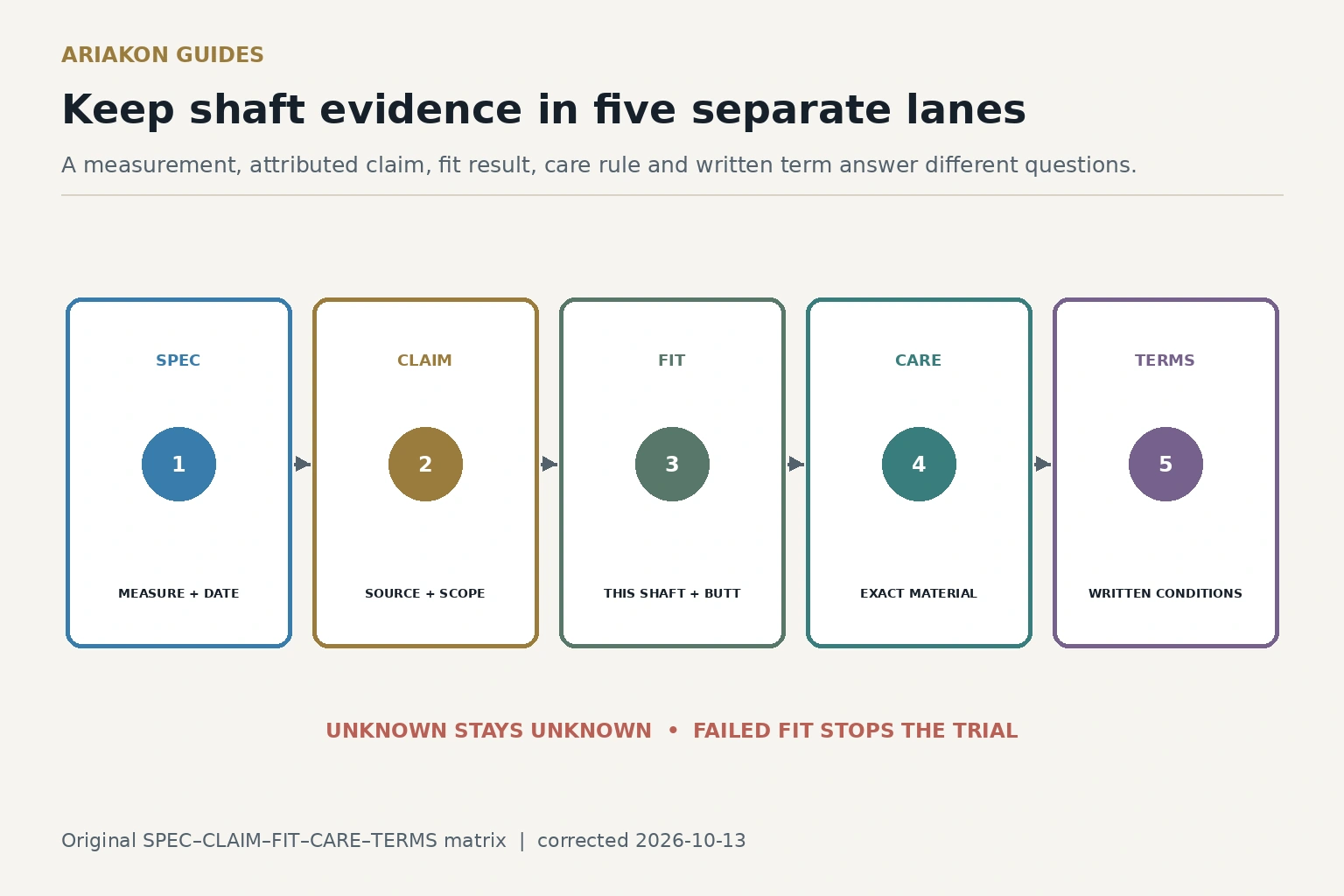
Open one row per candidate
| Lane | Record | Valid conclusion | Stop condition |
|---|---|---|---|
| SPEC | Present length, mass, tip diameter, taper description and construction source | This specimen or dated document states these fields | Measurement method or exact identity is missing |
| CLAIM | Exact attributed wording, source and date | The source made this claim | Claim is rewritten as an independent result |
| FIT | Thread start, pilot, faces, collar and assembled behavior on the intended butt | This pair passed or failed the recorded checks | Any force, gap, bind, rock or early bottoming |
| CARE | Material-specific cleaning, tip and service limits | The documented procedure applies to the identified item | Generic care conflicts with exact instructions |
| TERMS | Seller, owner, proof, duration, exclusions and service route | The dated written terms say what is recorded | A headline is applied to a different item or owner |
Compare replacement shafts with a five-criterion worksheet after the evidence lanes identify two safe trial candidates.
Confirm replacement-shaft fit across seven fields when the physical interface is the unresolved lane.
Tag every cell by evidence type
Use millimeters and grams where practical, and record the instrument resolution. Keep nominal published values beside present measurements rather than overwriting one with the other. A serviced tip, reduced collar or replaced insert can make a current specimen differ from an earlier document.
A patent or technical drawing can disclose a design. It does not identify the construction of an unmarked physical shaft. Record the document and the specimen link separately.
| Tag | Minimum support | Do not upgrade it to |
|---|---|---|
| MEASURED | Tool, unit, resolution, date and specimen | Original factory specification |
| DOCUMENTED | Dated source tied to exact model or part | Present condition after wear or service |
| ATTRIBUTED | Named source and exact scope | Independent test result |
| OBSERVED | Repeatable photo, seat or roll observation | Hidden construction or cause |
| UNKNOWN | Evidence not yet available | A convenient estimate |
Compare service terms without inventing coverage
Copy the written term's owner, seller, proof, duration, included defect categories, exclusions, modification limits and required service route. The Federal Trade Commission's warranty guide emphasizes clear written coverage information; the actual document for the purchase remains controlling.
Do not treat a lifetime headline, transferable wording or service estimate as universal. A used component, altered diameter or different product line may sit outside the stated conditions. Preserve the dated document and ask the warrantor when scope is unclear.
Run the trial only after all safety gates pass
Choose at most two physically cleared playing candidates. Use the same butt, balls, cloth, bridge length and shot order. Alternate candidates after each attempt across one straight stop shot, one follow shot and one familiar off-center position shot, with two cycles per shot for six attempts per shaft.
Award one point for the called pocket and one for finishing inside the marked cue-ball zone. Maximum: 12 points per candidate. Reverse the starting order on another day. The result is this player's bounded preference, not proof of a construction claim.
Worked matrix: five facts, five lanes
A listing states a 12.5-millimeter tip, reduced cue-ball deflection, broad joint compatibility, special cleaning limits and long written coverage. The buyer measures 12.3 millimeters with a stated caliper resolution. Record 12.3 as present measurement, 12.5 as documented or claimed only if its exact source exists, and the performance statement as attributed.
The candidate binds before the faces meet, so the FIT lane fails and no playing trial occurs. The care and terms lanes remain useful records, but neither can turn a failed assembly into a compatible part.
Sources and further reading
References support the specific factual information above. The practical checklists are Ariakon editorial guidance.