
Cue buying · 5 min read
Test a Pool Cue Before Buying: A Repeatable Demo Session
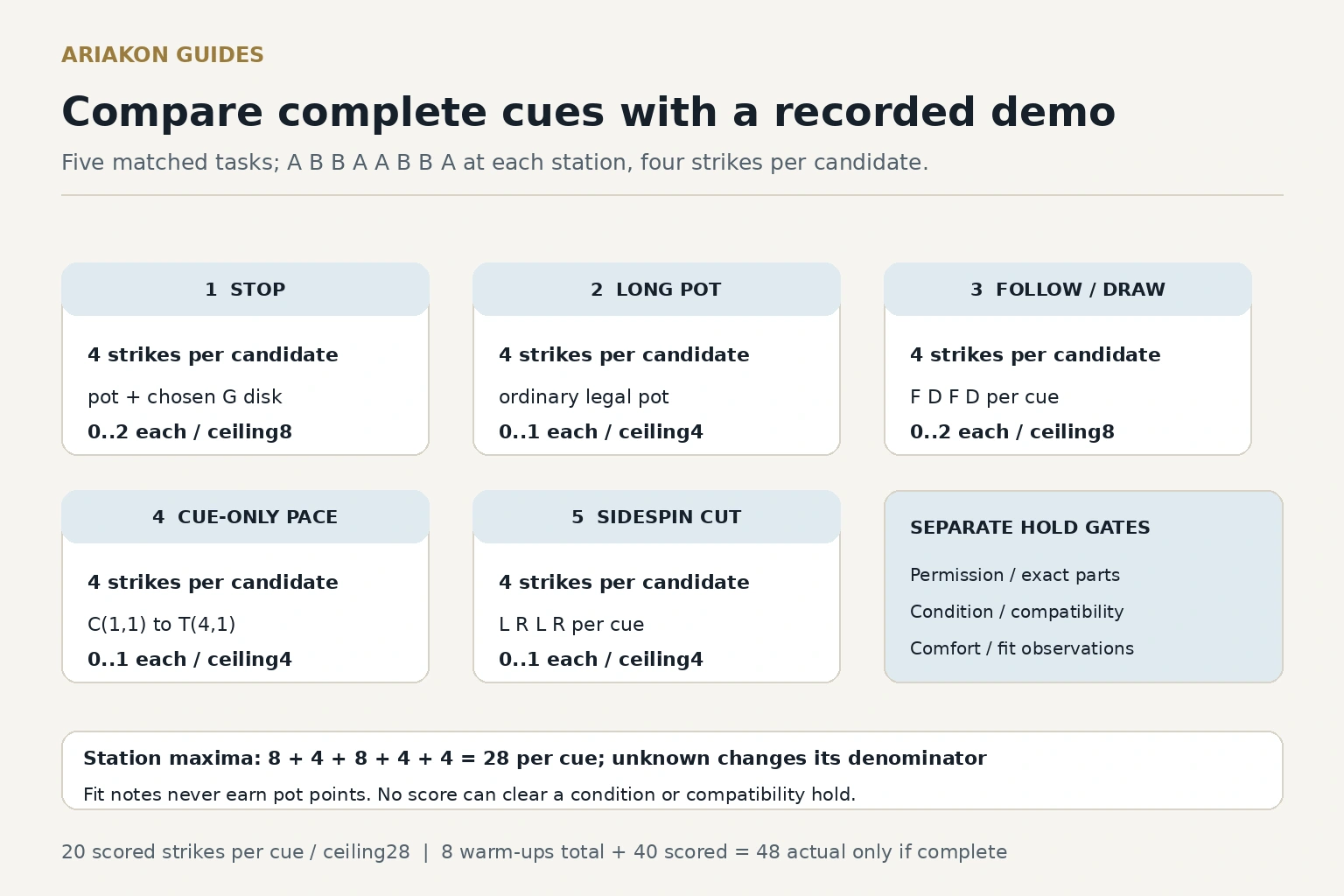
A useful demo records what was tried, in what order and with which complete configuration. It does not turn one pleasant hit or a small score difference into a best-cue claim. This protocol supplies exact ordinary tasks and an A/B ledger while keeping condition, compatibility and personal fit outside the outcome total.
Pass permission, condition and compatibility before scoring
Ask what assembly, chalking, cleaning and play the owner permits. Save the current written trial and return terms; no return-after-play right is assumed. Identify the actual butt, shaft, fitted tip, weight setting, extension and joint. Unknown configuration or a cracked, loose or binding component stops the demo, regardless of a pleasing hit.
Inspect the serviceable tip/ferrule, normally seated joint, shaft surface and comfortable grip/bridge clearance without forcing threads or abrading a borrowed cue. A rolling check needs maker/owner permission and cannot alone certify straightness. Different complete cues do not isolate a shaft material, mass or tip variable.
| Field | A | B | Decision |
|---|---|---|---|
| Permission and terms | Record / unknown | Record / unknown | No permission: no play |
| Exact supplied configuration | Record | Record | Do not compare model labels alone |
| Condition | Pass / concern | Pass / concern | Concern stops testing |
| Joint compatibility | Confirmed / unknown | Confirmed / unknown | Never force a fit |
| Comfortable support | Observed / unresolved | Observed / unresolved | No forced stance |
| Care/service route | Document / unknown | Document / unknown | Resolve before purchase |
Set the broader fit-first purchase brief before asking a demo to decide budget or ownership costs.
Identify the complete joint packet when a future shaft pairing is essential.
Freeze five exact stations
Use ball-center coordinates on an illustrative 100×50-inch bed: x=0..8 along the length, y=0..4 across it, origin at the lower-left cushion-nose corner. One unit is 12.5 inches; equal 2.25-inch balls have radius 0.09 and diameter 0.18 units. Intact-cushion center limits are 0.09..7.91 and 0.09..3.91. Real pockets interrupt the boundary at four corners and (4,0),(4,4). Measure the actual bed, balls and pocket mouths before scaling. Remove measuring aids before shooting and never mark a competition table.
Object O(6, 3), real corner P(8, 4), intended first-contact cue center G(5.839003, 2.919502), cue start C(4.944576, 2.472288). G=O−0.18u, C=G−u, u=(2,1)/√5; the centers are collinear and tangency is one diameter apart.
At the stop station request a cue-center rest disk radius 0.18 at G. At the long-pot station move only the cue start to (4.050149, 2.025074); the goal is a known legal pot, with pace request recorded separately. No pocket-speed threshold is invented.
For follow/draw retain C,O,G,P. Choose radius 0.18 rest disks at F(6.375659, 3.18783) and D(5.302347, 2.651173); four per-candidate attempts alternate F,D,F,D. Use familiar vertical-axis requests with no intentional sidespin; the requested disks are not guarantees of a particular tip height.
For cue-only pace remove all objects, use C(1,1), target T(4,1), radius 0.18, without a required cushion. Cut object O(6, 2), corner P(8, 4), intended first-contact G(5.872721, 1.872721), cue start C(5.562138, 0.71361). The object direction is (1,1)/√2; the incoming direction is (cos 75°,sin 75°), giving a 30° geometric cut. It is a construction reference, not a sidespin-adjusted aim guarantee. For the cut use each candidate’s modest intended left/right requests L,R,L,R, recording the request and observed miss/finish. No predicted side route or quantified delivered spin is claimed.
| Station | Per-strike score | Four-strike ceiling |
|---|---|---|
| Stop | 0 miss/foul;1 legal pot;2 pot plus G disk | 8 |
| Long ordinary pot | 0 miss/foul;1 legal pot | 4 |
| Follow/draw | 0 miss/foul;1 legal pot;2 pot plus called disk | 8 |
| Cue-only pace | 0 outside disk/uncontrolled/scratch;1 inside disk | 4 |
| Modest sidespin cut | 0 miss/foul;1 legal pot; adjustment notes separate | 4 |
Balance candidate order without multiplying the session
Give each candidate four unscored familiar warm-up strikes, using the straight station only, after the safety checks. Then at every station shoot candidate order A,B,B,A,A,B,B,A: eight actual strikes, four per cue. For follow/draw and sidespin, index each candidate’s own attempts 1..4 to its F,D,F,D or L,R,L,R request; the order does not mean four extra shots per request.
Each candidate occupies ordinal slots summing 18 within a station: A1+4+5+8, B2+3+6+7. This balances one simple order effect; it does not remove adaptation, fatigue or differing setup variables. Reset exact centers between attempts and retain the same surface, balls, chalk and selected comfortable pace requests.
Five stations × eight strikes=forty scored strikes, twenty per candidate; eight total warm-ups make forty-eight actual strikes only if complete. On a separately recorded second day reverse to B,A,A,B,B,A,A,B and repeat the same dose. Two complete days would have eighty scored plus sixteen warm-up strikes, not forty or an implied extra A–B–B–A series.
Record the vector of results, not a purchase winner
The five maxima 8+4+8+4+4 sum to 28 per candidate when all relevant outcomes are known. They sample different tasks, so retain the station vector and known denominator for each. Unknown outcomes remain unscored; unused allocations are not misses. Do not convert fit impressions into a third point on a pot or give a cue-only station an object-pot requirement.
Keep drag, grip relocation, comfortable reach, balance impression, noise and unfamiliar sidespin adjustment in separate notes. They are personal observations, not measured vibration, friction or deflection data. A safety/compatibility hold cannot be outweighed by 28 outcome points.
| Field | A | B | Keep separate |
|---|---|---|---|
| Station vector / known maxima | ___ / ___ | ___ / ___ | Five task scores and actual denominators |
| Fit observations | ___ | ___ | No outcome bonus |
| Adjustment request / observed result | ___ | ___ | No hidden measured-spin claim |
| Order and actual attempts | ___ | ___ | Warm-up versus scored |
| Essential unresolved gates | ___ | ___ | Hold rather than average away |
| Next permitted action | ___ | ___ | Repeat priority task or defer |
Work a decision with a visible tradeoff
Hypothetical vectors: A=(6,3,5,3,2) totals 19/28; B=(5,4,6,3,3) totals 21/28. If A fits the normal bridge comfortably while B requires uncomfortable grip relocation, B’s two-point lead cannot clear that fit problem. These are invented bookkeeping numbers, not tested cue rankings or evidence that two points is a statistical threshold.
Repeat the personally important station only as a new dated record, or defer until the exact configuration can be tried safely. If no play is permitted, keep the condition/fit ledger and mark every outcome field not tested. Do not fill them from reviews or advertising.
Run the separate break-weight experiment when the unresolved purchase is specifically break-cue mass.
Check the narrower cue-purchase risk ledger when listing, supplied parts or current terms remain unclear.
Sources and further reading
References support the specific factual information above. The practical checklists are Ariakon editorial guidance.