
Cue anatomy and care · 5 min read
Pool Cue Ferrules: Purpose, Materials and Repair Limits
The visible front end is only part of the cue’s impact assembly. A sleeve can surround a wood tenon, a cap can close the support, or a different shaft design can use a plate-and-pad arrangement. This guide helps you describe the parts and decide when to stop using them; it is not a machining plan or an Ariakon construction specification.
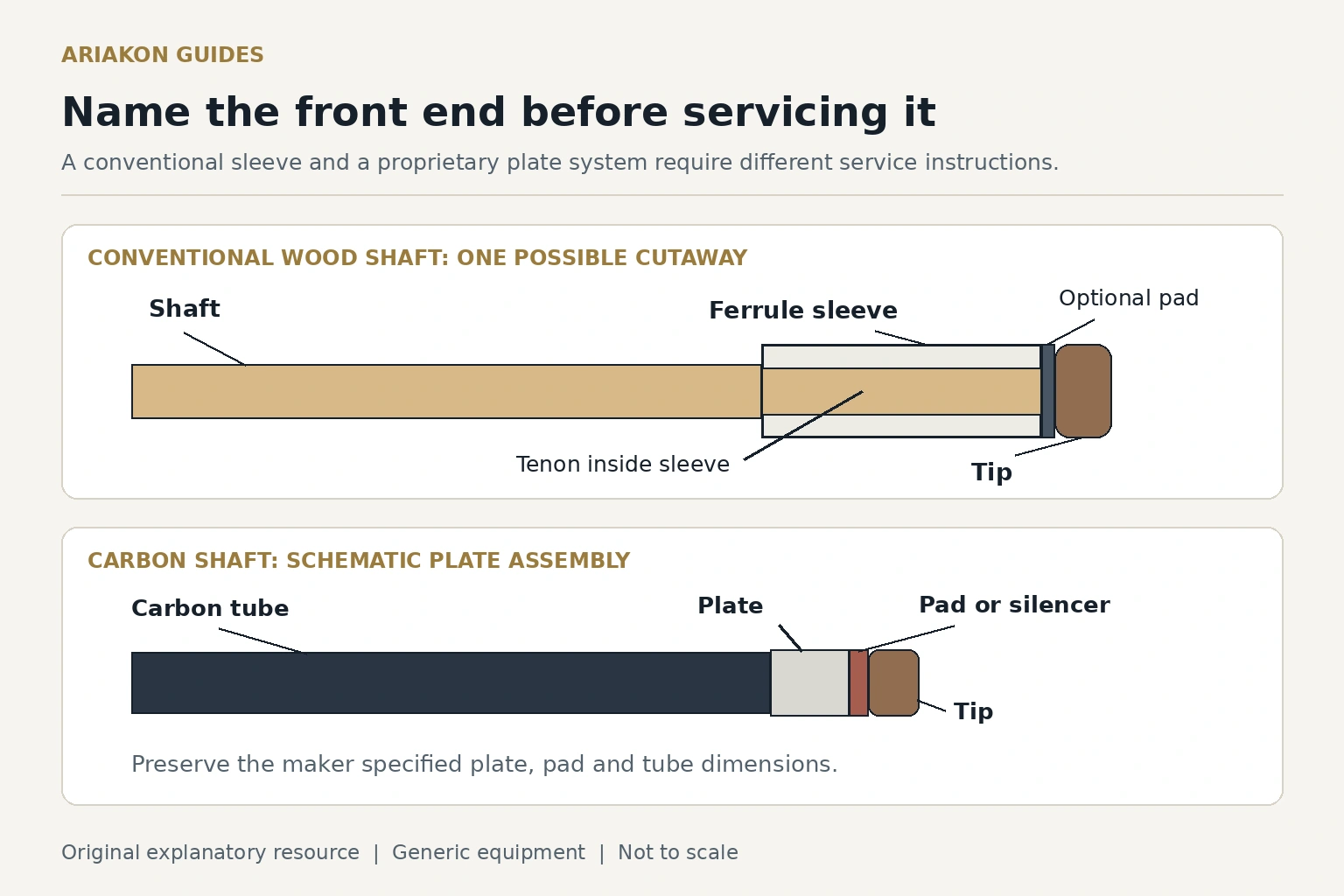
Name the parts without diagnosing hidden construction
The conventional cutaway shows one open-ended sleeve around a tenon with an optional pad; other ferrules may be capped or built differently. The lower plate schematic is a different possible topology, not the design of every carbon shaft. Do not identify a hidden assembly from the color or apparent length of its exposed part.
A ferrule is functional support and protection at the tip end, not merely an aiming stripe. Keep the original intended load path intact. A worn tip and a failed support require different work; replacing leather does not automatically repair a crack below it.
| Part | What it does or shows | What the outside cannot establish |
|---|---|---|
| Tip | Chalked playing surface that contacts the cue ball | Bond quality or exact material from color alone |
| Optional pad | An intermediate layer under the tip in some assemblies | Required thickness, composition or removability |
| Ferrule sleeve | Surrounds and supports a shaft-end tenon in a conventional sleeved design | Whether its bore, cap or bond matches another model |
| Tenon | Reduced shaft-end support inside a conventional sleeve | Dimensions or damage hidden by the ferrule |
| Plate/support assembly | Alternative front-end support in some shafts | Whether a white section is a replaceable sleeve |
Inspect the whole construction sequence for material, alignment and assembly-stage questions.
Use the cue anatomy worksheet when the unknown component is elsewhere on the cue.
Compare material families only within a documented design
These are construction families found in documented equipment, not a preference ranking, strength test or substitution list. Material alone cannot determine how the cue feels or which adhesive, tool, thickness or machining method is safe. Record the design-specific support and repair authority before selecting a component.
No universal ferrule length or pad thickness is supplied here. A small numerical limit on one maker’s assembly cannot be applied to another. Ask for the actual model document and leave the unknown dimension unresolved instead of guessing from the diagram.
| Family or support | Useful documentary question | Care and service boundary |
|---|---|---|
| Polymer or resin sleeve | What exact formulation, bore, cap and bond does this design specify? | Do not substitute by color, outside diameter or a claimed feel |
| Phenolic-based front end | Is it a separate ferrule or an integrated tip/support assembly? | An integrated part is not an ordinary removable leather tip |
| Metal ferrule | Is the metal component specified for this exact cue and game? | Do not transfer another equipment tradition’s part to a pool shaft |
| Composite plate with pad | Which layers are retained and which part is actually replaceable? | Obtain exact authorized service instructions; preserve structural layers |
Perform four views and two interface checks without forcing anything
Support the tip end, then photograph four views spaced approximately a quarter turn apart under steady light. Also record the tip/support interface and the support/shaft interface. These are six observation records, not six destructive tests. Include a wider shaft photo and model markings for context.
Look for a line, chip, lifting edge, gap or sudden step. Do not flex the tip, scrape a seam, sand the ferrule white or apply household glue to improve the photograph. If movement, an opening or structural damage is already visible, stop striking balls and seek qualified inspection. A sudden changed sound after an impact belongs in the report but does not identify the failed part.
If the only concern is staining and the model’s care permits a gentle method, document before and after that method. Ariakon’s current carbon-care FAQ gives a limited clean-soft-cloth starting point and asks users to avoid abrasives and unfamiliar products without guidance; it does not authorize altering the front end.
| Observation | Next action | Do not infer |
|---|---|---|
| Stain only; no visible opening | Check the actual permitted care; save before/after views | Color identifies a crack or proves the assembly sound |
| Line remains after permitted care | Send the unresolved line and model record for assessment | More rubbing will reveal the truth safely |
| Gap, movement, chip or lifting part | Stop use; protect and arrange inspection | A new leather tip repairs the underlying support |
| Unfamiliar plate or integrated support | Get the specific service route before work | The conventional sleeve procedure applies |
Send nine fields before a technician orders parts
Ask the technician to confirm the support topology, replacement identity, retained layers, permitted dimensions and service conditions before machining. Ask what completed-work evidence will be returned. An inspection request does not authorize replacing parts, changing a taper or sacrificing warranty conditions.
A ruler view documents scale, not certified precision. Keep estimated visible length separate from manufacturer dimensions; the hidden bore and tenon remain unknown until assessed by an appropriate professional.
| Field | What to send |
|---|---|
| Identity | Exact cue/shaft marking, version and known repair history |
| Intended use | Playing, breaking or jumping role actually documented |
| Visible support | Sleeve, cap, plate or unknown; do not remove to identify |
| Tip and pad | Known model/material, visible condition and any pad |
| Exposed length | Approximate visible length with units and method; not an internal dimension |
| Symptom and timing | What appeared and when; previous condition if known |
| Incident | Drop, impact or earlier service; unknown when not observed |
| Views | Four around the front end, two interfaces and wider context |
| Actions already taken | Exact permitted care or tool use, including no action |
Work a stain-versus-gap decision and record the return
Hypothetical shaft: a blue line appears at the lower ferrule edge. The six views show no obvious opening. After a permitted gentle wipe, the color fades but a thin line remains. Send both image sets and mark the line unresolved; do not pronounce the ferrule sound from the fading color.
On a different shaft, a visible opening under the tip is already present. Skip the cleaning comparison, stop use and request inspection. Before return to play, obtain the repair description, identified parts and any remaining care limits. Recheck the six views against the report without bending the assembly.
Prepare for tip replacement only after the support and model-specific service route are established.
Keep the shaft condition record without borrowing another material’s cleaner or abrasive method.
Sources and further reading
References support the specific factual information above. The practical checklists are Ariakon editorial guidance.