
Cue selection · 4 min read
When to Upgrade a Pool Cue—and When to Keep Practicing
A new cue can solve a documented fit or service problem, but it cannot substitute for a repeatable stroke. Use four gates in order: SAFE, FIT, BASELINE and MATCHED TEST. Each gate has observable evidence and a stop rule. The goal is not to defend the current cue or justify a purchase; it is to identify the first condition that actually changes the result.
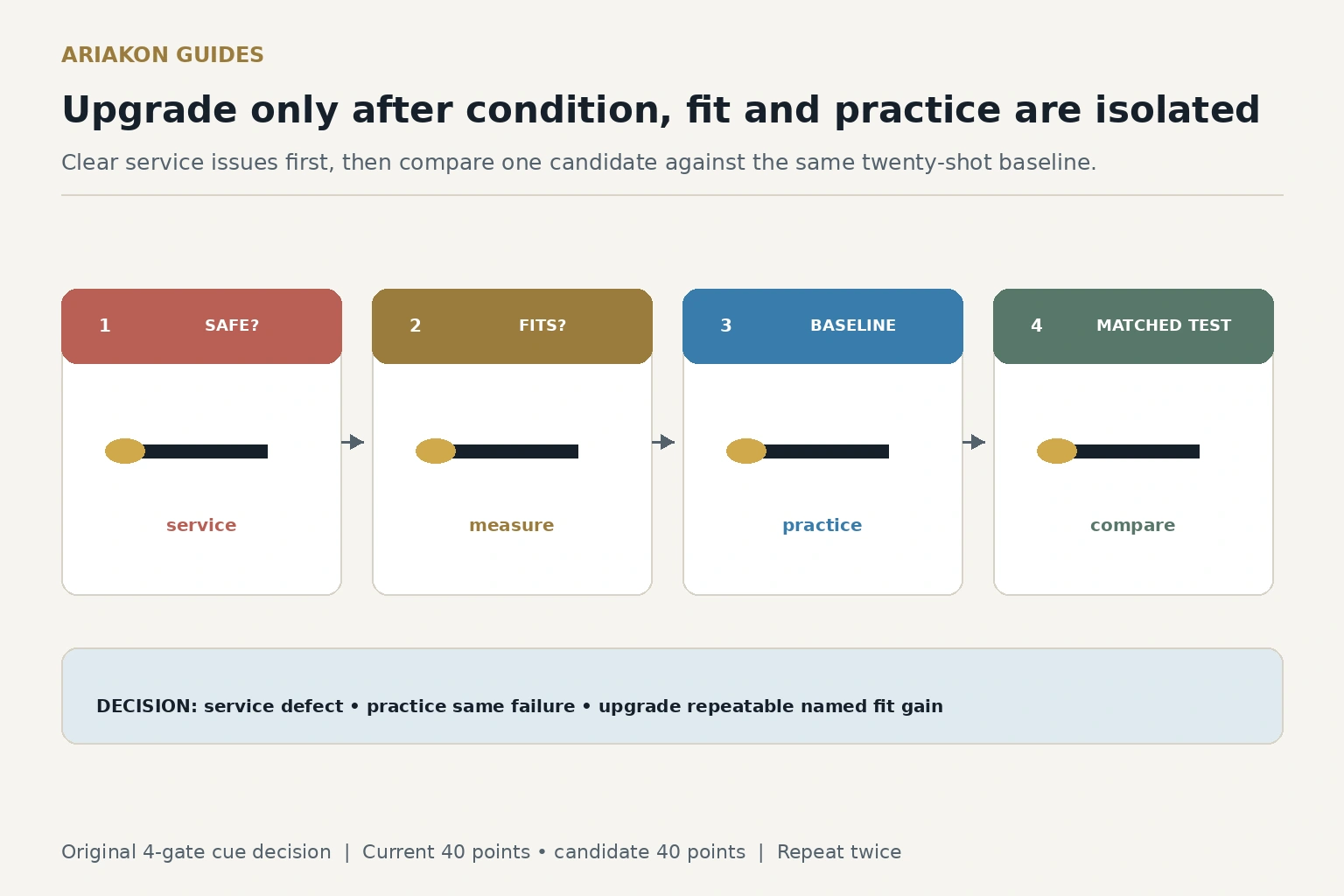
Gate 1 — make the current cue safe and serviceable
A service stop suspends the comparison. Use the exact maker and model instructions or qualified service; unknown construction is not permission to sand, apply chemicals or tighten hidden hardware. Repair evidence belongs in the cue record before the next gate.
| Check | Continue | Service stop |
|---|---|---|
| Tip and bond line | centered, secure, usable shape | loose, split, missing material or open bond |
| Ferrule or front end | intact and centered | crack, movement, sharp edge or unknown protected layer |
| Shaft | clean, smooth and safely straight enough for use | splinter, crack, severe warp or lifted fiber |
| Joint | faces close gently without rock | forced thread, gap, rocking face or loose insert |
| Butt and bumper | secure and free of sharp damage | rattle, loose part, crack or exposed hardware |
Inspect cue straightness without false precision when alignment is the concern.
Use restrained shaft care only with documented material and finish instructions.
Gate 2 — write the fit problem precisely
Write a physical constraint, not a prestige goal. ‘Bridge hand catches on a damaged finish’ and ‘the cue cannot fit my required extension’ are testable. ‘I need a better hit’ is not yet a requirement.
The current international equipment reference provides broad cue boundaries for covered competition, not a personal fit prescription or a quality ranking. Local rules and the candidate's exact documentation still control.
| Field | Current cue | Candidate requirement |
|---|---|---|
| Playing length | ___ | ___ |
| Complete weight | ___ | ___ range |
| Balance observation | ___ | ___ |
| Shaft diameter at bridge | ___ | ___ |
| Taper and bridge comfort | ___ | ___ |
| Joint and shaft compatibility | ___ | documented / not required |
| Specific repeated constraint | ___ | candidate must change this |
Gate 3 — establish a forty-point practice baseline
Coordinates are ball centers on an illustrative 100 by 50 inch bed: x=0..8 along length, y=0..4 across width, origin at the lower left cushion nose. One unit is 12.5 inches. For 2.25 inch equal balls, radius is 0.09 and diameter 0.18 units. Intact cushion center boundaries are x=0.09,7.91 and y=0.09,3.91; pockets interrupt the physical boundary at the four corners and (4,0),(4,4). Measure actual bed, balls and jaws before scaling. Remove every measuring aid before shooting; never mark a competition table. Use O(6,3), real upper right corner P(8,4), intended contact cue center G(5.839003,2.919502) and C(4.944576,2.472288). With u=(2,1)/sqrt(5), G=O minus 0.18u and C=G minus u. The centers are collinear and the equal balls are tangent at G. For the mild cut retain O(6,3),P(8,4),G and use C=G−1.2e with e at 56.565051° from+x, a30° cut relative to u at 26.565051°. The chosen finish is a radius 0.5 disk at G for each layout; it is a requested comparison target, not guaranteed motion.
Shoot ten straight and ten cut attempts with each cue. Score 0 for foul/miss;1 for legal pot;2 for that pot plus a known cue-center rest in the called disk. A known pot with hidden finish keeps its pot record but leaves nested points unknown. Each cue has 40 possible points only for 20 known scores. Observe condition and fit separately; a high score cannot clear an unsafe cue.
| Pattern | First action |
|---|---|
| Same delivery error repeats in both layouts | practice the error before shopping |
| Misses appear only when fit constraint is present | advance to candidate test |
| Cue condition changes during test | return to Gate 1 |
| No stable baseline after two sessions | simplify practice and defer purchase conclusion |
Gate 4 — run a matched candidate test
Use one candidate at a time. Keep the ball set, table, marked centers, pocket, shot order and scoring unchanged. Counterbalance order: current cue first on Day 1, candidate first on Day 2. Allow the same short warm-up but do not change tips or maintenance between scored blocks.
A candidate earns an upgrade case only when it removes the named fit constraint and produces a repeatable gain in the affected evidence without creating a new safety or compatibility problem. A one-day tie, attractive appearance or unfamiliar feel is not a measured gain.
| Measure | Current Day 1 | Candidate Day 1 | Candidate Day 2 | Current Day 2 |
|---|---|---|---|---|
| Straight /20 | ___ | ___ | ___ | ___ |
| Cut /20 | ___ | ___ | ___ | ___ |
| Named constraint present? | ___ | ___ | ___ | ___ |
| New concern? | ___ | ___ | ___ | ___ |
Choose service, practice, keep or upgrade
| Evidence | Decision | Next action |
|---|---|---|
| Condition stop | service | repair or document replacement need |
| No fit problem; repeated process error | practice | train one observable error for three sessions |
| Current cue clears fit and matched result | keep | save baseline for later review |
| Candidate clears named fit and repeats gain | upgrade candidate | record exact configuration and terms |
| Results conflict | no decision | repeat without changing another variable |
Use the first-cue buying guide when no serviceable baseline cue exists.
Build a deliberate practice plan when the evidence points to skill rather than equipment.
Sources and further reading
References support the specific factual information above. The practical checklists are Ariakon editorial guidance.