
Cue selection · 4 min read
Choose a Pool Cue Wrap by Testing Grip and Moisture
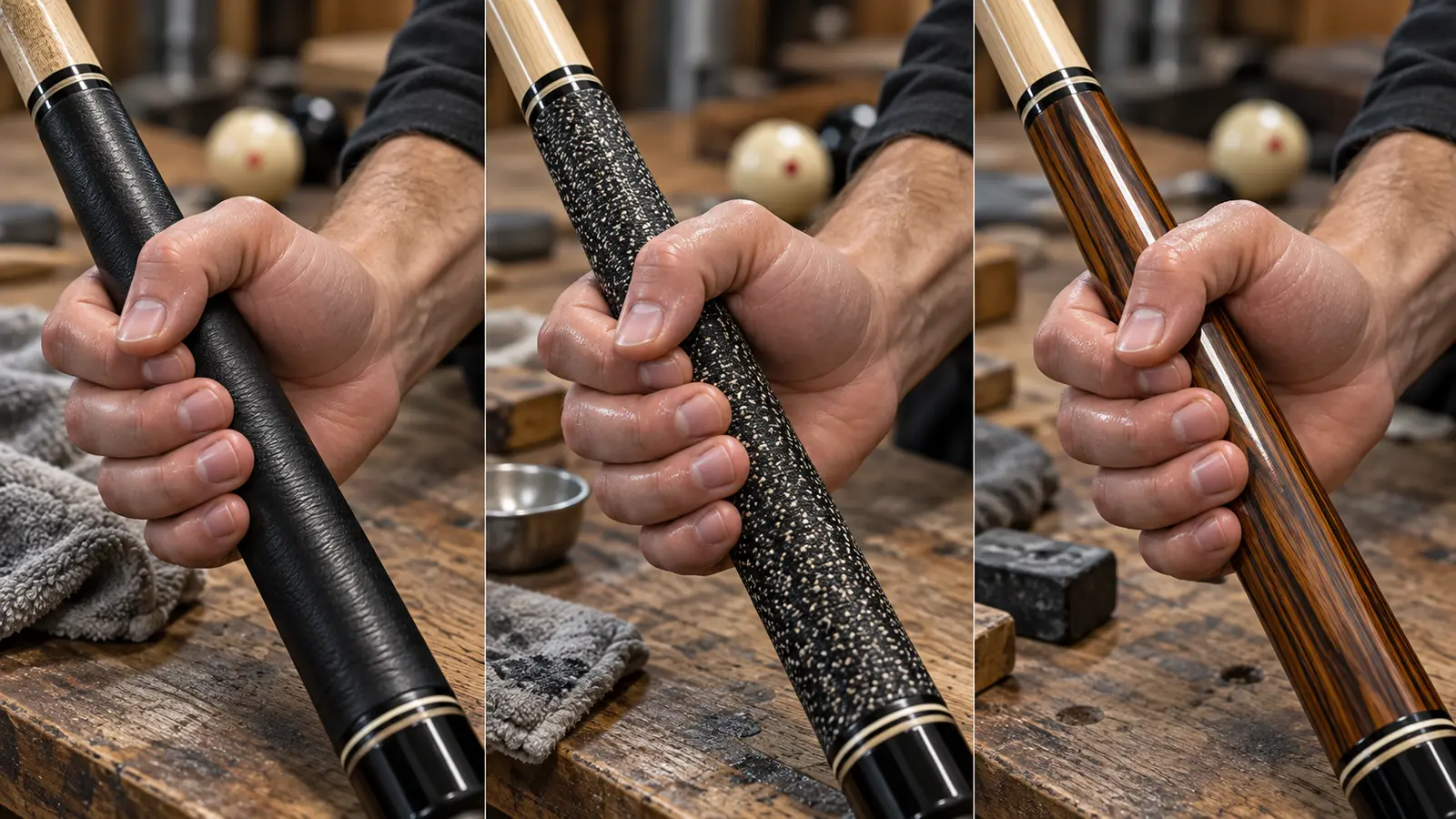
Choose the surface your normal grip can use predictably, not a material category that supposedly suits everyone. Woven, leather-like, coated and smooth handles can differ within the same label. Record the actual surface, finish and cue configuration; then compare release, security and comfort under dry and naturally warmed-session conditions.
Complete six fields before comparing scores
Loose wrap edges, sharp seams, discomfort or unidentified care limits are gates, not score penalties that extra pots can compensate for. Ask permission before trialing a cue. Do not add powder, conditioner or water to manufacture a moisture test.
| Field | Record |
|---|---|
| Release | Does your normal delivery finish without a last-second grab? |
| Security | Any unintended slip, hand repositioning or squeeze? |
| Session change | Difference between the initial dry trial and later natural hand condition |
| Care | Exact permitted cleaning method and finish identity; unknown means no treatment |
| Whole-cue fit | Length, mass, balance, grip diameter, shaft and tip differences |
| Preference | Comfort and appearance after shooting, not fingertip contact alone |
Check cue purchase risks for whole-cue fit and receiving evidence.
Describe the surface instead of assigning a winner
If testing different cues, list every known difference. Similar mass does not equal similar balance, taper or tip. A favorable result is a preference for that tested configuration; it does not isolate the causal effect of its wrap.
| Visible option | Inspect and ask | Do not infer |
|---|---|---|
| Woven surface | Seams, pressing, coating and actual texture; documented fiber identity | A woven appearance guarantees absorption or release |
| Leather-like surface | Surface finish, seams and exact material/care record | All leather or imitation coverings use the same conditioner |
| Coated or molded grip | Texture, tack and attachment integrity | Moisture resistance or durability from appearance |
| Smooth handle | Finish continuity, grip-area diameter and transitions | No wrap means no maintenance requirements |
Use one exact straight layout for three ten-attempt blocks
Use a 100 × 50 inch playing surface with 2.25 inch balls for this example. Coordinates are ball centers in units of 12.5 inches: x runs from 0 to 8 along the length, y from 0 to 4 across the width. Put the cue ball C=(5,1), object ball O=(6,2) and target the real corner pocket P=(8,4). All three are collinear. The contact cue-ball center is G=(6−0.18/√2, 2−0.18/√2), one ball diameter behind O on the same line.
Block one: ten comfortable stop attempts. Block two: ten soft follow attempts toward a circle centered (6.5,2.5), radius 0.25 units. Block three: ten firmer follow attempts toward a circle centered (7,3), radius 0.25 units. The latter is a speed-demand condition, not an instrumented speed measurement. The cue ball must finish on the bed, not in the pocket. No cushion contact is required. Use removable markers only with the table owner’s permission; otherwise measure targets without marking the cloth.
Reset the centers each time. Keep chalking, bridge and preparation consistent, use no side spin and do not force a stroke to chase the target. Record target successes separately from pots: a follow success requires the pot, no scratch and a resting cue-ball center inside its circle; a stop success requires the pot, no scratch and a finish within radius 0.125 of G.
Separate thirty pots from twelve process confirmations
This yields at most 42 points from 30 attempts, but keep the 30 outcome and 12 process subtotals visible. It is a personal log, not a validated wrap rating. For example, 24 pots plus process counts 3+2+3+1 gives 33/42, with 9/12 process confirmations. The one security confirmation means two blocks had slipping; do not let 24 pots conceal that problem. Stop a trial if discomfort or unsafe movement appears.
| Measure | Maximum | Recording rule |
|---|---|---|
| Object-ball pots | 30 | One point per legal target-pocket pot without a scratch |
| Release | 3 | One per block only if no last-second grip grab occurred in its ten attempts |
| Normal pressure | 3 | One per block only if you did not compensate by squeezing |
| Comfort | 3 | One per block only if no discomfort or adverse sensation appeared |
| Security | 3 | One per block only if there was no unintended handle slip |
Repeat naturally, then make a bounded choice
After your normal warm-room session, repeat the same three blocks, provided the equipment remains safe. Record the actual session condition without deliberately wetting hand or handle. That is another 30 attempts and another maximum of 42, not a reason to combine two runs into a misleading single ranking. Alternate which safe cue goes first on a later day to reduce simple order and fatigue effects.
A hypothetical handle has 9/12 initial process confirmations and 6/12 later ones, including security failure in every later block. Keep that deterioration explicit even if pot totals stay similar. A different cue may be comfortable in both sessions, yet shaft differences still prevent a wrap-only conclusion. Choose the tested fit you can care for; if a showroom cannot support a shooting trial, label the decision provisional.
Plan material-specific care before sharing cloths or applying a handle treatment.
Sources and further reading
References support the specific factual information above. The practical checklists are Ariakon editorial guidance.