
Cue buying · 4 min read
A Pool Cue Buying Worksheet for Comparing Three Actual Options
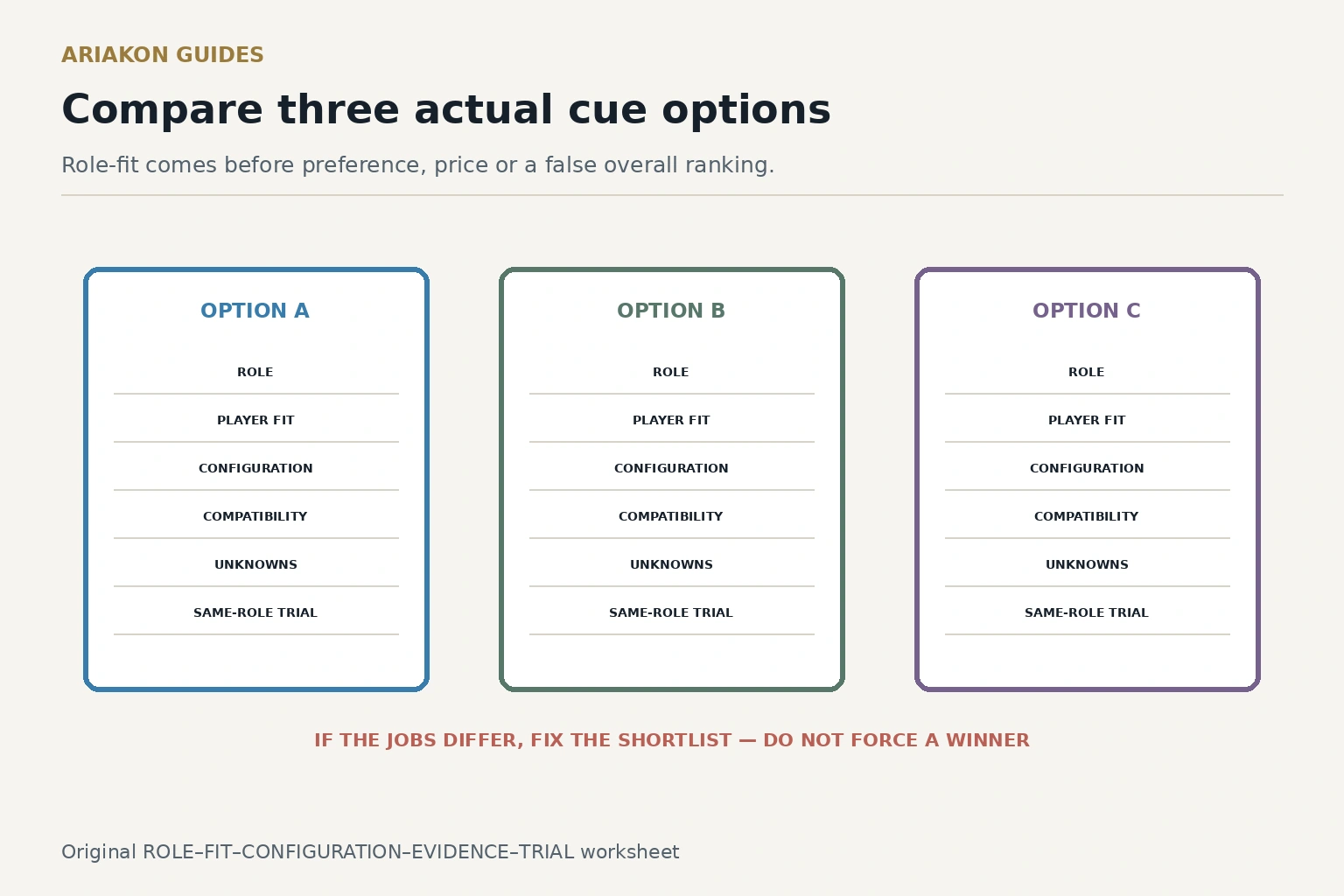
A three-cue comparison fails when a playing cue, break/jump cue and dedicated jump cue are ranked as though they solve the same job. Start with intended use, then document fit, configuration, compatibility and evidence. The worked example uses three current Ariakon product records to show the method; it does not claim inventory, universal superiority or independently tested performance.
Define the job before filling the columns
A current product page is evidence for the configuration it actually states, not every unit ever sold under the name. Save the date, selected variation and return/warranty terms separately. Price and availability can change and must be checked at the moment of purchase.
If the three options have different primary roles, the worksheet should eliminate mismatches rather than manufacture a winner. A dedicated jump cue can be the correct tool for a jump requirement and still be irrelevant to a playing-cue decision.
| Field | Option A | Option B | Option C |
|---|---|---|---|
| Exact product and dated page | Name + URL + check date | Name + URL + check date | Name + URL + check date |
| Primary role | Playing / break / jump / break+jump | Playing / break / jump / break+jump | Playing / break / jump / break+jump |
| Player constraint | Reach, bridge, weight, transport or rules | Same constraint | Same constraint |
| Published configuration | Length, weight, tip, shaft and joint actually documented | Documented fields only | Documented fields only |
| Compatibility | Included parts and verified replacement ecosystem | Do not infer from brand | Do not infer from thread name alone |
| Unknowns | Unpublished or unverified cells stay blank | Keep uncertainty visible | Ask maker/seller before purchase |
| Trial evidence | Same-role shots and written score | Only compare like use | No score if a safe/legal demo is unavailable |
Start with the complete cue-selection guide for length, weight, tip and budget context.
Measure five fields before buying so fit requirements are written before comparison.
Worked example: three Ariakon cues with different jobs
This comparison does not put three cues into one performance ranking. A player seeking a primary playing cue should keep Atlas One in the role-matched column and compare it against two other playing cues. A player seeking break/jump versatility can compare Apocolyte against two other break/jump options. AirLyft belongs in a dedicated-jump shortlist.
The current local catalog evidence supplies the listed roles and configurations. Reopen the live product page before purchase to confirm selectable variations, current terms and availability; this article does not promise any of them.
| Field | Atlas One | Apocolyte | AirLyft |
|---|---|---|---|
| Published role | Full carbon-fiber playing cue | Full carbon-fiber break/jump cue | Dedicated carbon-fiber jump cue |
| Published length | Record the selected current product-page configuration | 58 inches | 42 inches |
| Published weight | Adjustable weight system; verify chosen setup | 20 oz default; listed 17–22 oz with optional kit | 11 oz listed |
| Published tip/shaft | StrikePoint 1.0 standard; supports listed MasterShot interchange | Energon or Armageddon tip options | 14 mm shaft with Armageddon tip |
| Correct shortlist use | Primary playing-cue need | Break plus jump versatility | Dedicated jump need |
| Not established here | Current stock, ideal player or universal performance | Best break weight or superiority | Jump success for every technique/table/ruleset |
Review the Atlas One product page for the current playing-cue configuration.
Review the Apocolyte product page for current break/jump options.
Review the AirLyft product page for the dedicated jump configuration.
Use elimination gates before preference scoring
Worked example: the buyer needs one primary playing cue and initially lists Atlas One, Apocolyte and AirLyft. Gate 1 removes the latter two from that shortlist because their documented roles are break/jump and jump. The correct next step is to add two actual playing cues—not award Atlas One an uncontested performance victory.
Keep the completed sheet with screenshots or dated links. If a variation, term or product page changes, update only that evidence cell and rerun the relevant gate.
| Gate | Pass rule | If it fails |
|---|---|---|
| 1 — Role | Option performs the job being purchased | Remove it from this shortlist |
| 2 — Rules and safety | Configuration is legal for intended play and can be tested safely | Verify rules or do not demo |
| 3 — Physical fit | Length, weight range, grip and bridge clearance fit the player | Choose another configuration |
| 4 — Compatibility | Required shaft, extension, tip or case fit is documented | Request exact written confirmation |
| 5 — Evidence | Every material specification and term has a current source | Leave cell unknown; do not copy a reseller claim |
| 6 — Same-role trial | Twelve repeatable shots against a role-matched baseline | Do not turn feel alone into a universal claim |
| 7 — Ownership cost | Current price, service, return and replacement-part implications are acceptable | Compare total decision, not sticker price alone |
Sources and further reading
References support the specific factual information above. The practical checklists are Ariakon editorial guidance.
- Ariakon — current Apocolyte product record, checked October 12, 2026
- WPA — recommended equipment specifications, checked October 12, 2026
- World Pool Association: Rules of Play, effective September 15, 2025, January 2026 file
- Ariakon — current Atlas One product record, checked October 12, 2026
- Ariakon — current AirLyft product record, checked October 12, 2026