
Cue buying · 4 min read
Verify a Collectible Cue Story With an Object and Provenance Ledger
A cue can resemble a design seen on screen without being the object used in a production. It can also be a genuine older cue without the ownership history claimed by its seller. Treat design, object identity, custody and playing fit as separate questions. A compelling story does not fill a missing evidence link.
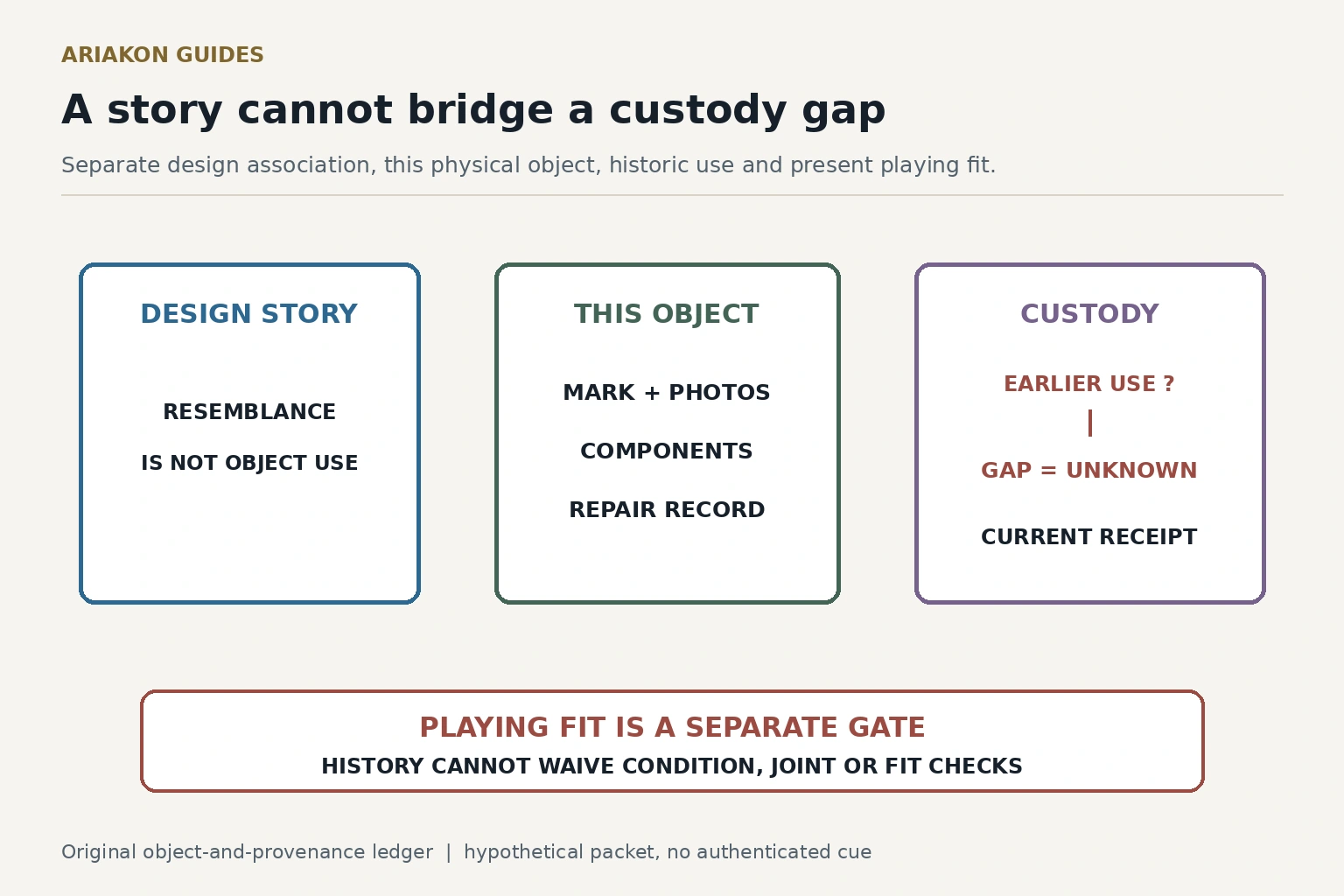
Write the claim narrowly before researching it
Save the exact listing, date, photographs and the seller’s stated claim before asking questions. Do not quietly upgrade associated design to screen-used, or previously owned to used in competition. Ask the seller to identify which statement is actually being made.
For this ledger, provenance means the documented ownership and use history of this physical object. Record each evidenced link and each gap from creation to the current sale. This original worksheet is not an authentication service or appraisal.
| Claim offered | What would support it | What is not enough |
|---|---|---|
| Similar or tribute design | Documented description of this builder’s own item | Resemblance does not prove original manufacture |
| Current model associated with a film-style design | Dated maker record for that current model | It does not identify a historic physical prop |
| An older physical cue from a stated workshop | Records and distinguishing features tied to that object | An undated decorative pattern or seller memory |
| This exact cue was used on screen or had a notable owner | Object-specific production/custody evidence with gaps disclosed | A modern receipt, nickname or matching colors |
Tie documents to one physical object
Photograph only normally accessible features. Do not cut, sand or open glued parts to reveal an identifier. Keep an uncertain mark as uncertain. A certificate is useful only to the extent its issuer, method, date, object identification and supporting evidence can be evaluated.
| Field | Record | Conflict to preserve |
|---|---|---|
| Identifier | Accessible mark or serial; clear photo; exact position | Missing, altered or inconsistent mark |
| Distinctive exterior | Point/inlay/ring patterns and dimensions, with dated views | Similar design is not an exact-object match |
| Components | Shaft, joint, tip and later replacements | A new shaft does not inherit the old shaft’s history |
| Condition | Wear, repairs and finish changes | Restoration can obscure earlier identifying features |
| Document link | Why this record identifies this exact cue | Generic catalog page or unrelated certificate |
Identify the physical cue before ordering parts for the separate replacement-compatibility task.
Inspect present straightness and condition because historical interest cannot waive a current defect.
Build a dated custody chain with explicit gaps
A photograph can be one item of evidence but resemblance alone cannot establish the chain. Record exact and approximate dates honestly, preserve conflicts and retain the source file or document reference. Never draw a continuous arrow through a period for which no record exists.
The playing decision stays outside the custody chain. Length, weight, actual shaft, joint condition and a permitted table trial assess present use; they cannot make a historical assertion more true.
| Event date | Object-specific evidence | Transfer/use statement | Status |
|---|---|---|---|
| Creation or supply ___ | Invoice, workshop or production record ___ | What object was supplied and to whom ___ | Supported / unknown ___ |
| Claimed production use ___ | Object identifier, dated record, verifiable scene evidence ___ | Use of this object, not merely this design ___ | Supported / unknown ___ |
| Later custody ___ | Dated transfer and object link ___ | From previous custody to next custody ___ | Supported / gap ___ |
| Current sale ___ | Exact offered object and disclosed changes ___ | What transfers now, with included components ___ | Supported / conflict ___ |
Work a modern-replica offer without inventing history
Hypothetical offer: the seller supplies a current purchase receipt, clear photographs tied to the same mark, and disclosed replacement-shaft work. The story says it is a film-style cue, but no production record or earlier custody record is provided.
The five object fields might be sufficiently documented for ordinary condition inspection. In the four custody rows, creation/current sale have evidence while production use and intervening history remain unknown: two supported rows and two unresolved rows. Do not call the packet 50% authentic; count completeness separately from truth.
The defensible description is a current cue with a claimed design association and a disclosed later shaft. No screen-use premium is established. The buyer can decline the story premium, request object-specific evidence or arrange independent specialist review. This example describes no real cue, production or person.
Make separate collectible and playing decisions
This ledger does not appraise value, promise a refund or authenticate a collectible. It keeps an object-specific custody burden separate from general cue selection and a used-shaft listing audit. No named film, performer, builder, competing brand or branded product claim is needed to perform that task.
- For the story: list each supported claim, each gap and any conflict.
- For the object: identify the exact included components and present condition.
- For a high-value assertion: seek a qualified independent specialist whose method and scope are clear.
- For ordinary play: complete fit, straightness, joint and trial checks regardless of the story.
- Before payment: retain the exact seller terms, return conditions and communications.
Choose a cue for present playing fit after separating that decision from collectible interest.
View Ariakon playing-cue information as a current playing-equipment destination, not a collectible or screen-use claim.
Sources and further reading
References support the specific factual information above. The practical checklists are Ariakon editorial guidance.