
Cue construction · 4 min read
Separate Cue Joint-Face Material From Thread Fit and Feel
A joint construction label can refer to the mating faces while saying very little about the fastening system. Wood-faced contact, a metal pin, a receiving insert and an outer collar can coexist. Describe each component separately before making a fit or feel claim. This resource interprets the material label; the identification packet and pilot worksheet answer different purchase questions.
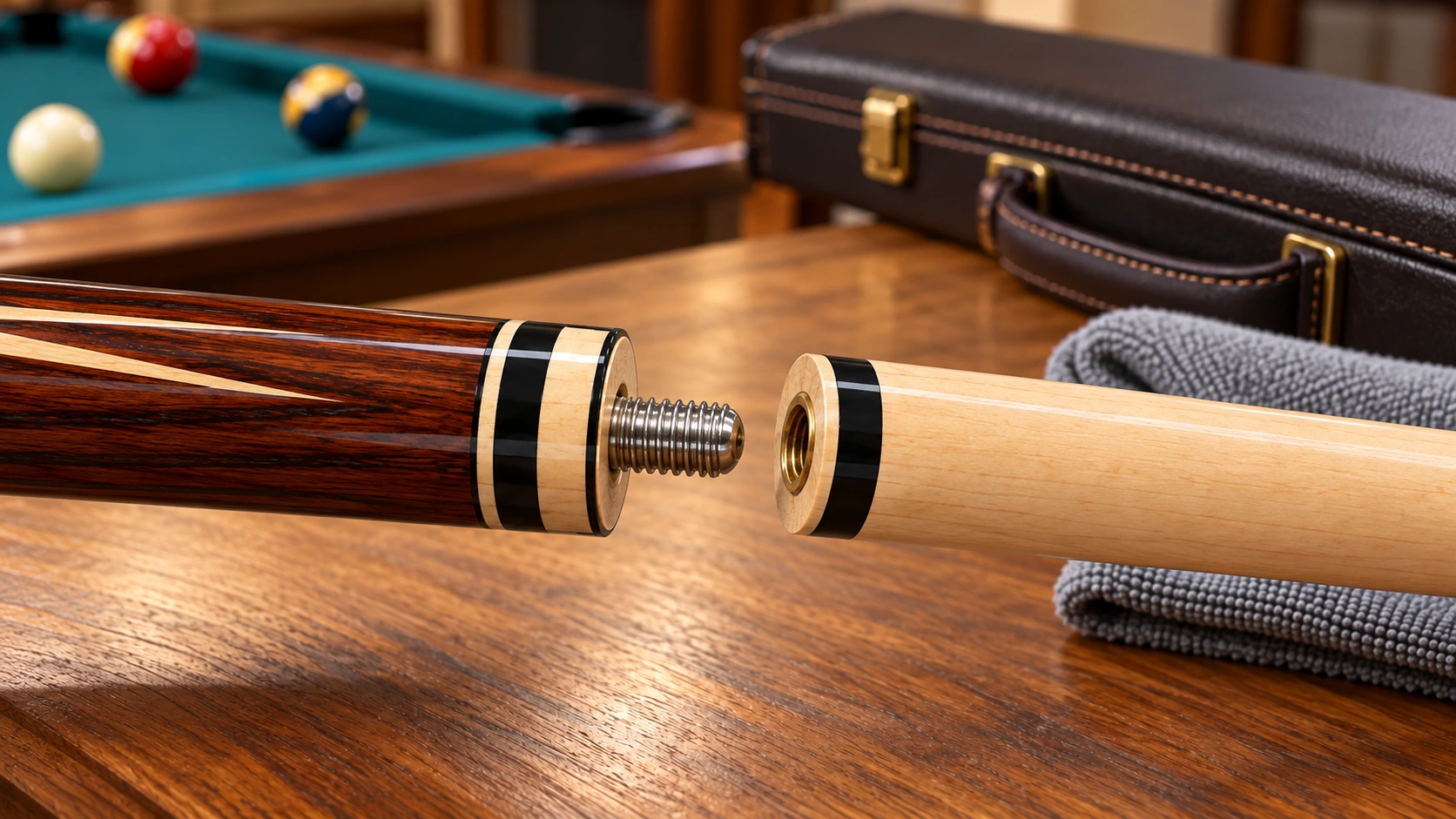
Name the surface and component, not the whole joint by one material
The broad faces are the surfaces intended to meet when the matched assembly is seated. The pin and receiving threads fasten it. A locating pilot, if present, has its own mating geometry. An outer collar can frame the assembly without being the entire contact surface. A photograph of an assembled collar cannot show all of these interfaces.
Visible wood on the exterior does not prove that the mating faces are wood. A finish, hidden insert, ring or unfamiliar construction can make the material uncertain. Keep uncertainty in the record; do not scrape a face, remove a ring or cut the cue to satisfy a label.
Name the component boundaries before writing a material description.
Compare three possible construction descriptions
The illustration shows the first possible arrangement. It does not portray a manufacturer’s model, a universal joint layout or an exact internal thread. Its broad faces are wooden, unlike a steel-faced example; the small central insert is a fastening component rather than a broad metal mating face.
A face-material description cannot establish a common thread family, interchangeable replacement or required lubricant. Those are separate documented facts. The second arrangement does not grant permission to cut threads or turn a pin into an unfamiliar receiving part.
| Description | What can coexist | What is still unresolved |
|---|---|---|
| Wood faces with a metal receiving insert | Metal pin and insert inside broad wood annuli | Exact thread and intended seating |
| Wood faces with direct receiving threads | Metal pin and threads cut in a receiving material | Thread condition and exact pair identity |
| Visible wood outside, face material unknown | Outer wood with hidden rings or receiving parts | The material at actual mating contact |
Build fifteen evidence fields
There are fifteen descriptive fields, not fifteen points of quality. Mark unsupported fields UNKNOWN or CLAIM ONLY. A worked packet can have ten documented fields, two observed fields and three unknown fields: 10+2+3=15. If one unknown is an essential fit field, assembly and ordering remain on hold.
Material evidence, fit evidence and a feel statement are deliberately separate columns. Do not turn a dated marketing statement into a controlled result merely because the material description is documented.
| Component | Material evidence | Fit evidence | Claim and its limit |
|---|---|---|---|
| Mating faces | Documented surface ___ | Intended contact and seating ___ | Feel statement/method ___ |
| Pin | Documented material ___ | Full designation and condition ___ | No strength inference from appearance ___ |
| Receiving threads | Documented insert or direct threads ___ | Exact matched pair ___ | No universal compatibility ___ |
| Collar | Documented outer construction ___ | Diameter and transition ___ | No automatic deflection claim ___ |
| Pilot, if present | Documented locating feature ___ | Shape, depth and intended contact ___ | No clearance assumption ___ |
Resolve the complete ordering identity when the thread or pair is unknown.
Evaluate documented pilot geometry if locating contact remains unresolved.
Keep subjective preference separate from a causal claim
A player can prefer one complete cue’s sensation without proving which component caused it. Tip construction, front-end mass, shaft stiffness, taper, length, balance, grip and assembly condition can all differ between cues. A joint-face material by itself does not provide a universal ranking for spin, accuracy, power or cue-ball deflection.
For a preference comparison, record the exact complete cues and use the separate demo protocol with the same shot setups. Call the result a whole-cue preference. To isolate a joint-material effect would require an appropriately controlled comparison; this article supplies no experiment or measured finding of that kind. Never disguise a copied named exercise as an Ariakon test.
Use the separate whole-cue demo worksheet and preserve its controlled setup and outcome limits.
Protect the intended faces and threads
Use only the normal matched assembly instructions, clean padded support and material-specific care. Stop for an opening bond, visible damage, looseness, unusual resistance or a persistent seating gap. Keep the faces free of unapproved abrasive, wax, oil or solvent. A label containing wood does not authorize a generic wood-care recipe on a precision joint.
For Ariakon carbon equipment, the published FAQ calls for a clean soft cloth and avoiding abrasive cleaners, excessive heat and modifications. Ask support before an unfamiliar product. For other materials, obtain the actual instructions rather than transferring that recipe. Preserve the photographs and exact service question; a qualified technician can identify hidden interfaces without a destructive home trial.
Inspect a confirmed received replacement as a separate assembly and alignment task.
Sources and further reading
References support the specific factual information above. The practical checklists are Ariakon editorial guidance.