
Cue-ball control · 3 min read
Troubleshoot Pool Speed Errors: Long, Short and Wrong Route
A cue ball can finish too long or short on the correct route, or it can take the wrong route before distance is meaningful. Treating all three as a speed problem creates bad corrections. This worksheet identifies the first failed checkpoint across a straight roll, an object-ball transfer and a one-rail position route.
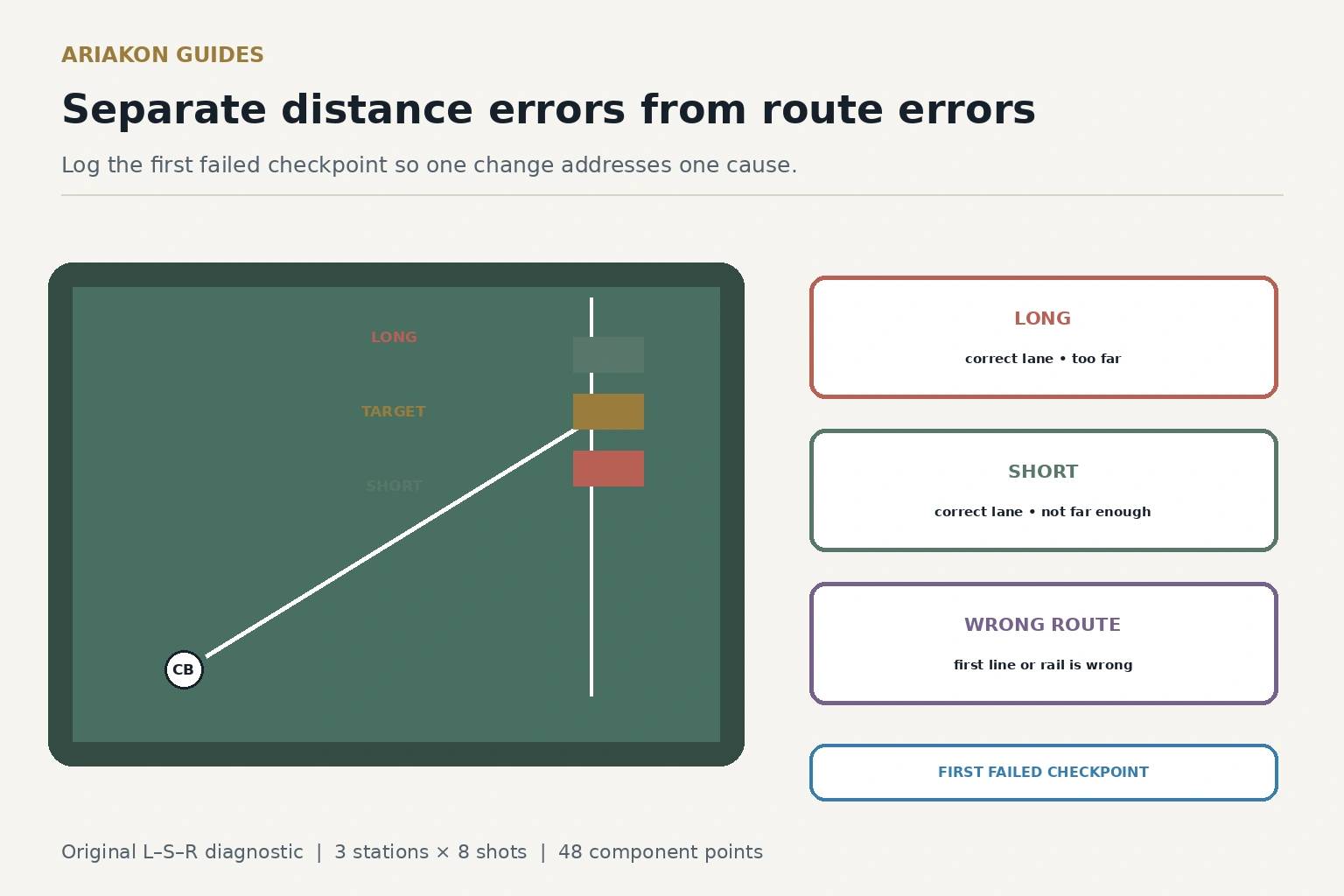
Define the three error labels
Call a target band at least one diamond long before every attempt. Use S, H, L or R in the log: short, hit, long or wrong route. A mishit gets M and remains in the denominator.
If the route is wrong, stop at that checkpoint. Do not estimate where the cue ball might have finished on the intended line.
| Label | Observable evidence | Do not conclude |
|---|---|---|
| Long | Correct lane; cue-ball center passes the target band | That the stroke was mechanically bad |
| Short | Correct lane; center stops before the band | That more sidespin is needed |
| Wrong route | Wrong first line, collision or cushion entry | That distance is ready to score |
Calibrate speed and sidespin on the current table for the broad warm-up reference.
Build four straight rolling-speed zones when line and distance both scatter.
Station A: straight roll for pure distance
Place the cue ball on the head spot and mark a one-ball-wide center corridor toward the foot rail using visual diamonds or removable guides outside the path. Call a one-diamond-long finish band before each shot. Use a rolling vertical-axis hit and complete eight attempts.
Score one point for staying in the corridor and one for the called band; maximum sixteen. A short or long ball inside the corridor is useful speed evidence. A ball outside the corridor is a route error and sends the next practice block to center contact and delivery.
Station B: transfer speed through an object ball
Place an object ball one diamond from a corner on a straight line and the cue ball two diamonds away. Call a broad cue-ball finish band beyond the collision-center region along the forward line. Shoot eight rolling follow shots with the same pocket and vertical-axis contact.
Score one for the pocket and one for the finish band only when the pocket and intended route were also completed. Mark the first error: object-ball line, cue-ball route or distance. This prevents a miss at the pocket from being recorded as a speed-control result.
Station C: add one natural cushion route
Set a modest cut into a corner so the cue ball naturally crosses to the opposite long rail and returns toward table center. Mark a half-diamond first-cushion window and a one-diamond landing band. Use no intentional sidespin for eight attempts.
Score one for the first-cushion window after a legal target-ball shot and one for the landing band only after that correct window; maximum sixteen. If the first cushion varies, the route is wrong even if the cue ball happens to stop in the band. Once six of eight entries reach the window, short and long finishes become actionable speed evidence.
Choose the next block from the first failure
A hypothetical set scores 15 of 16 at Station A, 13 at Station B and 7 at Station C. Five Station C attempts miss the cushion window on the same side. The evidence does not support a speed change; the next block keeps delivery size and repairs cut contact.
Retest the full three-station set only after the selected block improves. Conditions may change across tables, so keep the date and table with the score rather than treating one delivery label as universal.
| Pattern | Next eight shots |
|---|---|
| Six or more short with stable route | Same setup; one small delivery increase |
| Six or more long with stable route | Same setup; one small delivery decrease |
| Fewer than six correct routes | Keep speed; repair line or contact |
| Straight station good, collision station poor | Practice pocket plus finish separately |
| Only rail station poor | Stabilize cut and first-cushion entry |