
Cue ball control · 4 min read
Learn Pool Speed Control With a Four Zone Rolling Drill
Speed control becomes trainable when a finish is defined before the stroke. This drill creates four broad distance bands on one table and asks the cue ball to stop in each band with a rolling, center-axis hit. The zones are personal table references, not universal stroke speeds. Cloth, balls, cushions and table level can change the result, so calibrate the bands whenever conditions materially change.
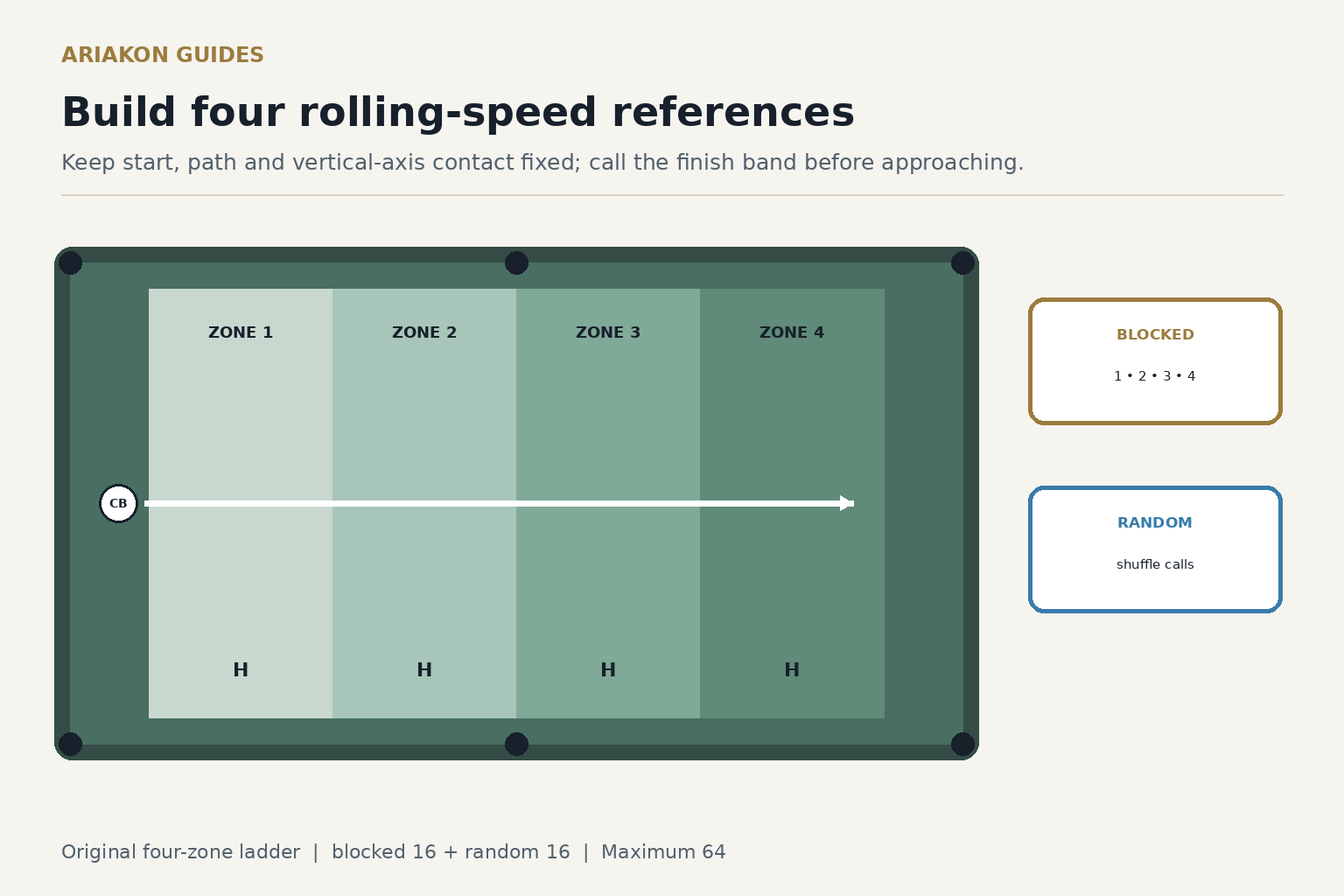
Build four equal target bands
Place the cue ball on the head spot or another repeatable centerline start. Roll it toward the foot rail without contacting an object ball. Divide the remaining length into four equal bands measured along the table: Zone 1 ends nearest the start and Zone 4 ends at the foot cushion. Use flat edge markers outside the playing surface or visual diamond references; never leave loose objects where the cue ball can hit them.
Use a level-as-practical cue and strike on the vertical centerline above geometric center so the cue ball is rolling before it enters the scored bands. The objective is distance, not maximum slowness. If the cue ball wobbles or curves, pause the speed exercise and check center contact and delivery.
Find and strike center cue ball before treating sideways drift as a speed error.
Calibrate speed and sidespin on any table after four straight rolling references are stable.
Calibrate without inventing a stroke scale
Take eight unscored attempts, two to each zone. Name the zone, use the normal routine and observe where the cue-ball center stops. You may adjust stance or bridge for comfort, but do not attach clock speeds or percentages to the strokes. Your Zone 2 delivery is simply the repeatable delivery that stops in Zone 2 under today's conditions.
If a band is narrower than one cue-ball diameter on a small table, combine visual landmarks into four practical bands instead. Record the table and date. The comparison is valid only when the start, path and target definitions remain the same.
Shoot a blocked and random thirty-two-ball set
Score the cue-ball center, not the leading edge. A center exactly on a boundary earns the farther zone but misses the called band unless that is the called zone. Record S for short, H for hit and L for long. Do not replay a mishit; mark it M so delivery problems are not hidden.
| Block | Attempts | Call order |
|---|---|---|
| A: blocked | 16 | Four at Zone 1, then 2, then 3, then 4 |
| B: random | 16 | Shuffle four cards of each zone; call before approaching |
| Total | 32 | Same start, line, cue and vertical-axis contact |
Score distance and line separately
| Point | Requirement |
|---|---|
| 1 | Cue-ball center stops in the called band |
| 1 | Cue ball stays inside a one-ball-wide corridor around the centerline |
| Maximum 64 | Thirty-two attempts; mishits earn zero but remain in the denominator |
Worked example: distance improves before random choice
Blocked play scores 14 of 16 distance points and 15 of 16 line points. Random play scores 10 of 16 distance points and 15 of 16 line points. The cue ball is mostly straight, but five of eight Zone 3 and Zone 4 calls finish short when the requested zone changes between attempts. The evidence points to speed selection, not cue-path steering.
The next action is an eight-shot contrast block alternating only Zones 2 and 4. If at least six centers reach the called bands, repeat the full random block. If line points fall, return to center-contact work before adding position shots.
Transfer the references through an object ball
Place an object ball on the foot spot and the cue ball one diamond away on a straight line to a corner. Mark four broad cue-ball finish bands beyond the cue-ball center at object-ball contact, forward along the straight object-ball-to-pocket line. Keep every band clear of pocket jaws and within the remaining bed; shorten the bands if necessary. Shoot twelve rolling follow shots, three calls to each band in shuffled order. Score one for pocket, one for called band and one for centerline corridor; maximum thirty-six.
This transfer adds collision and pocketing, so do not compare its raw distance score directly with the no-object-ball baseline. Use it to see whether the four calls survive a real shot picture. In racks, call a broad landing zone rather than trying to reproduce a named stroke strength.