
Practice · 2 min read
Translate Common Pool Coaching Advice Into Measurable Tasks
Advice such as ‘stay down’ or ‘play percentages’ can help only after the player and coach agree on an observable job. Translate the phrase before repeating it. The beginner terms guide defines table language; this worksheet turns coaching language into a measurable assignment.
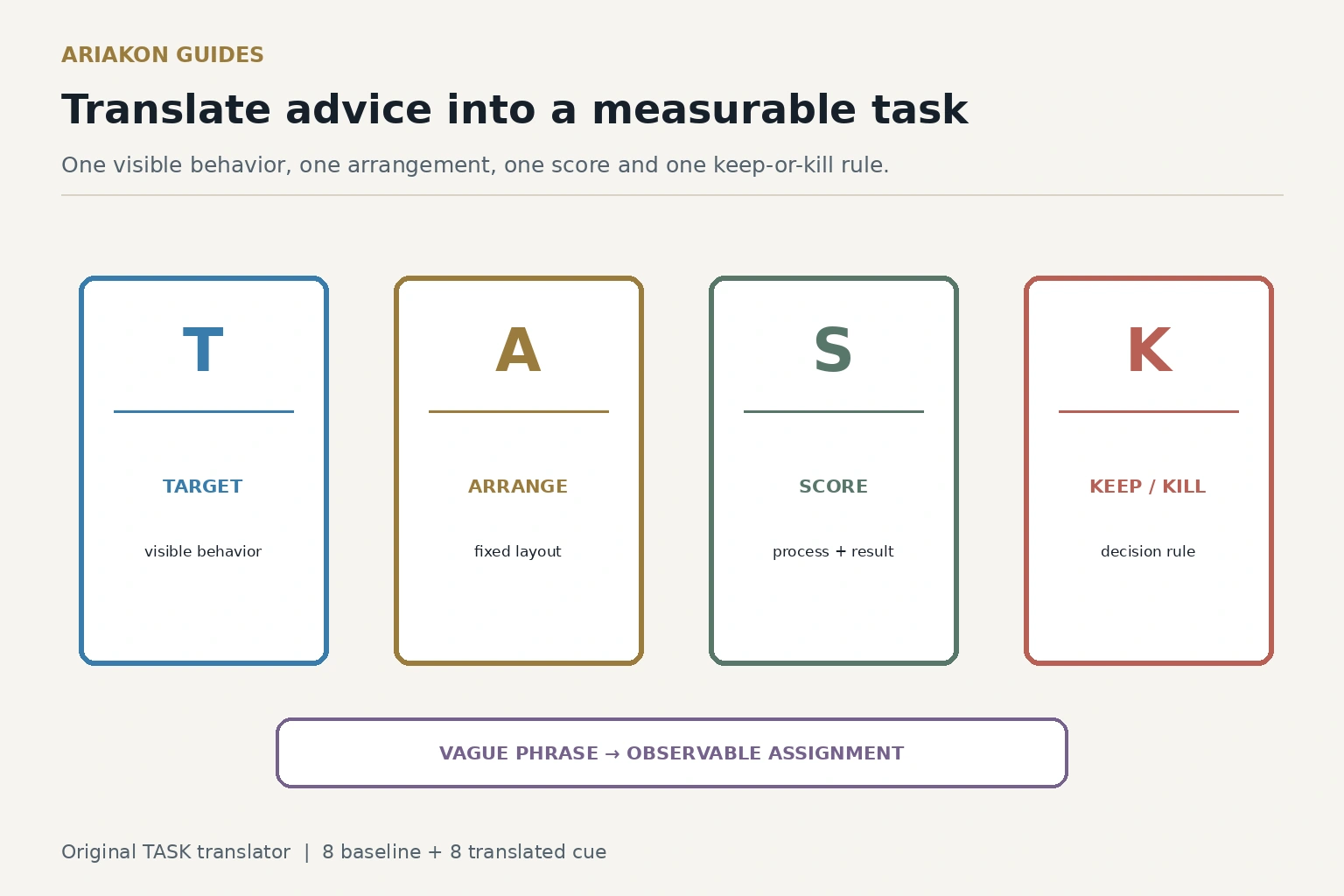
Put every cue through four fields
| Field | Write | Reject when |
|---|---|---|
| T — Target behavior | One action visible to player, partner or camera | It is a personality label |
| A — Arrangement | Fixed balls, pocket, speed and conditions | The layout changes every attempt |
| S — Score | Outcome and one process component | Success means only ‘felt good’ |
| K — Keep or kill | Retest, narrow or stop rule | Every result justifies more repetition |
Learn practical pool vocabulary when the words themselves are unfamiliar.
Test advice before changing your game for a broader source-and-transfer check.
Translate four common phrases
These are translations, not universal technique laws. A player may need a different visible cue because body, skill, shot and equipment differ. Keep the result component alongside the process component so form is not rewarded while performance disappears.
| Phrase | Observable task | Two-part score |
|---|---|---|
| Stay down | Hold head and cue finish for two counts on a fixed straight shot | Pocket + finish hold |
| Smooth stroke | Use one named backswing count without a visible transition jerk | Cue-ball corridor + count completed |
| Play percentages | Name make, miss cost and safety before lowering | Decision named + result leaves planned side |
| Use less English | Compare center-ball and one-tip route on identical marks | Pocket + target-zone finish |
Run a paired sixteen-attempt check
Shoot eight baseline attempts using the familiar routine, then eight with the translated cue. Use the same marks and score both components after every shot. Do not accept a partner's rating unless the observable standard was agreed before the block.
If the phrase contains two instructions, split it. ‘Stay down and follow through’ becomes two separate tests on different days. This preserves the ability to learn which cue changed the result.
Worked example: translate stay down
A hypothetical player scores 10/16 component points in baseline: six pockets and four two-count finishes. With the translated cue, the score is 13/16: six pockets and seven finishes. The process changed while pocketing held steady, so the cue earns one retention block.
If finish points rise but pocketing falls from six to two, the next action is not more forceful stillness. Review whether the count creates tension or delays normal recovery, then shorten or reject the cue.
Use a clear next-action rule
| Evidence | Action |
|---|---|
| Process and result both improve | Retest after a break, then transfer |
| Process improves, result falls | Revise or reject the wording |
| Result improves, process does not | Do not credit the cue yet |
| No clear difference | Keep the familiar routine and collect more matched evidence |