
Billiards basics · 3 min read
Pool Terms Beginners Should Know at the Table
Pool vocabulary is useful when it makes rules and decisions clearer. The same informal word can mean different things across rooms, so use the published rules for the game you are playing and ask before the break. These terms give beginners a practical starting language, not a substitute for an event's player guide.
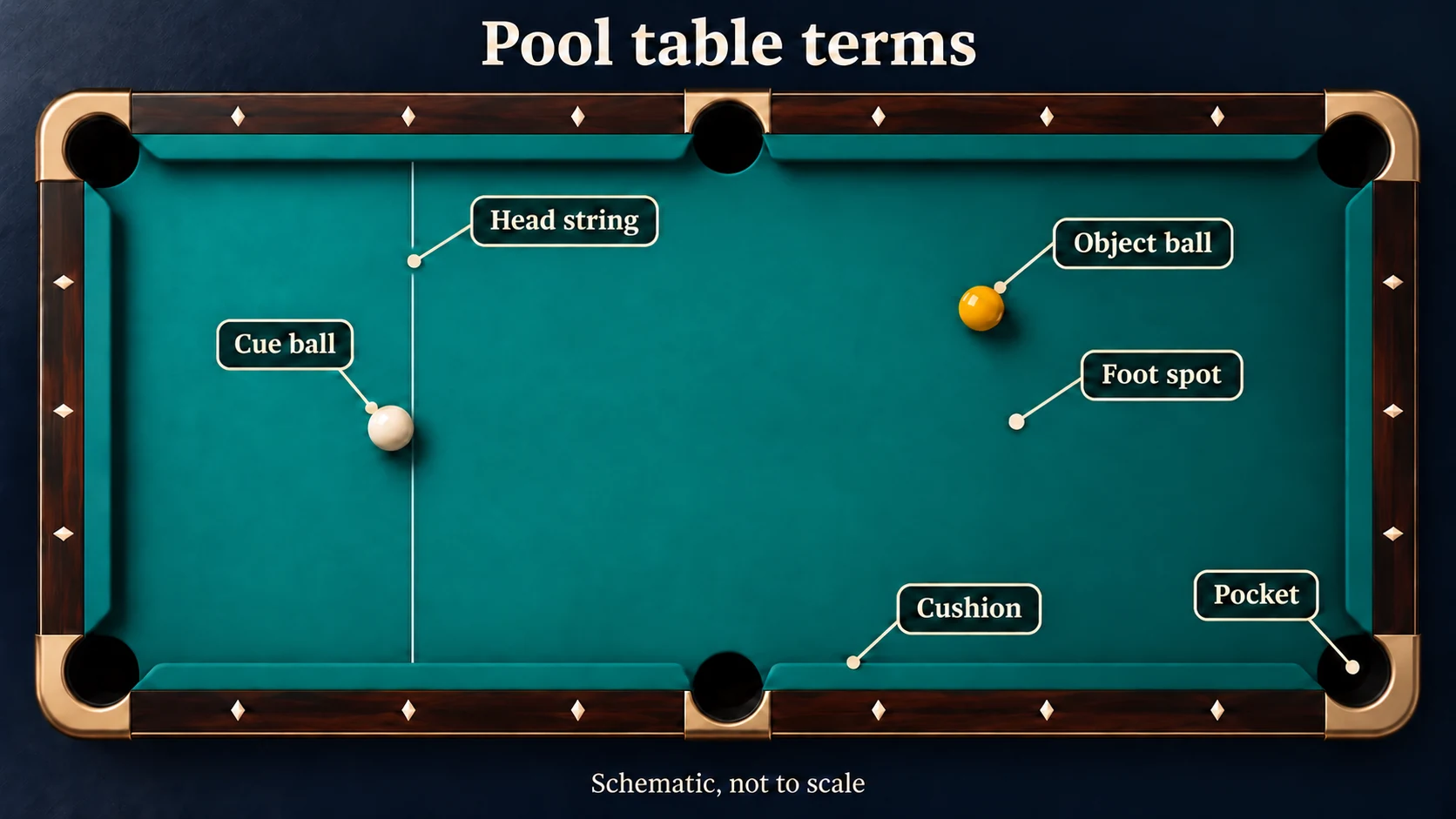
Name the table and balls
The cue ball is the ball struck by the cue. Object balls are the numbered or colored balls the cue ball contacts. The cloth-covered table bed is bounded by cushions; players often call the cushion and its wooden top assembly a rail in ordinary conversation.
The head string crosses the table near the breaking end. The foot spot is the marked point near the racking end where specified balls are placed. 'The kitchen' informally means the area behind the head string, but published rules usually use head string language.
Understand rack, break and inning
A rack is both the arranged group of balls at the start and, in many match formats, one game within the match. The break is the opening shot. An inning is a player's turn at the table, although a ruleset may use more specific language.
A race ends when a player reaches the agreed number of rack wins. Hill means that player needs one more rack to reach the target; hill-hill means both players need one.
Separate a legal shot from a made ball
Pocketing a ball does not automatically make the shot legal. The shooter must first contact the ball required by the game's rules and then satisfy the applicable pocket or cushion requirement.
Call-shot disciplines may require the intended ball and pocket to be indicated when they are not obvious. Ten-ball under current WPA rules is a call-shot discipline; casual house rules may differ, so name the ruleset.
Know foul, scratch and ball in hand
A foul is a rule violation. A scratch commonly means the cue ball was pocketed, but players sometimes use the word loosely for other cue-ball fouls. Ball in hand lets the incoming player place the cue ball as the governing rules allow.
Do not assume every foul produces the same placement. Some local rules limit placement behind the head string; current WPA rules often provide cue ball in hand anywhere for standard fouls, subject to game-specific provisions.
Use shot and position language
A cut sends the object ball away from the cue ball's initial line. A bank sends the object ball to a cushion before the pocket; a kick sends the cue ball to a cushion before the object ball. A combination uses one object ball to pocket another, and a carom sends the cue ball or object ball from one ball into another target.
Follow, stun and draw describe cue-ball behavior after contact. English usually means sidespin. Shape or position means leaving the cue ball for the next shot. A safety prioritizes leaving the opponent without a favorable legal shot.
Ask five questions before the break
- Which game and published or house rules are in use?
- Is the game call shot, call pocket or slop allowed?
- What constitutes a legal break?
- What happens after a foul or scratch?
- How many racks win the match and who breaks next?
Sources and further reading
References support the specific factual information above. The practical checklists are Ariakon editorial guidance.