
Equipment guides · 3 min read
Choosing a Replacement Cue Ball for Your Table and Practice
Replacing only the cue ball is narrower than choosing a complete set. The replacement must work with the table, match the playing set closely enough for the intended use and provide the kind of visual feedback you want. Use four gates in that order; a dotted or training pattern cannot rescue a compatibility failure.
Clear the return-system gate first
A table can distinguish the cue ball by a system-specific physical property. The visible color does not reveal that property. Record the table model, operator guidance and accepted replacement identity whenever they are available.
| Table evidence | Next action | Do not assume |
|---|---|---|
| Drop pockets | Confirm size and set match | Every white ball matches the object balls |
| Automatic return with documented model | Use the maker/operator's compatible identity | All separators use the same method |
| Shared or coin-operated table, model unknown | Ask the operator before ordering | A magnetic label alone proves compatibility |
| Replacement already fails to return | Stop and document the failure | Repeated play will fix it |
Confirm nominal size without inventing precision
The current World Pool Association equipment document specifies a 2¼-inch competition ball for sanctioned play, while also limiting its scope. A home or commercial table can differ. Confirm the exact item specification instead of applying the competition number automatically.
NIST length guidance supports unit conversion: 2.25 inches equals 57.15 millimeters because one inch is exactly 25.4 millimeters. That conversion does not establish the tolerance, weight, material or return compatibility of a listing. Record those fields only when the source documents them.
| Field | Existing set | Candidate | Result |
|---|---|---|---|
| Published identity | ___ | ___ | match / unknown |
| Nominal diameter | ___ | ___ | match / mismatch |
| Material or range | ___ | ___ | match / unknown |
| Return requirement | ___ | ___ | pass / fail / unknown |
| Condition | ___ | ___ | usable / quarantine |
Choose markings for one feedback task
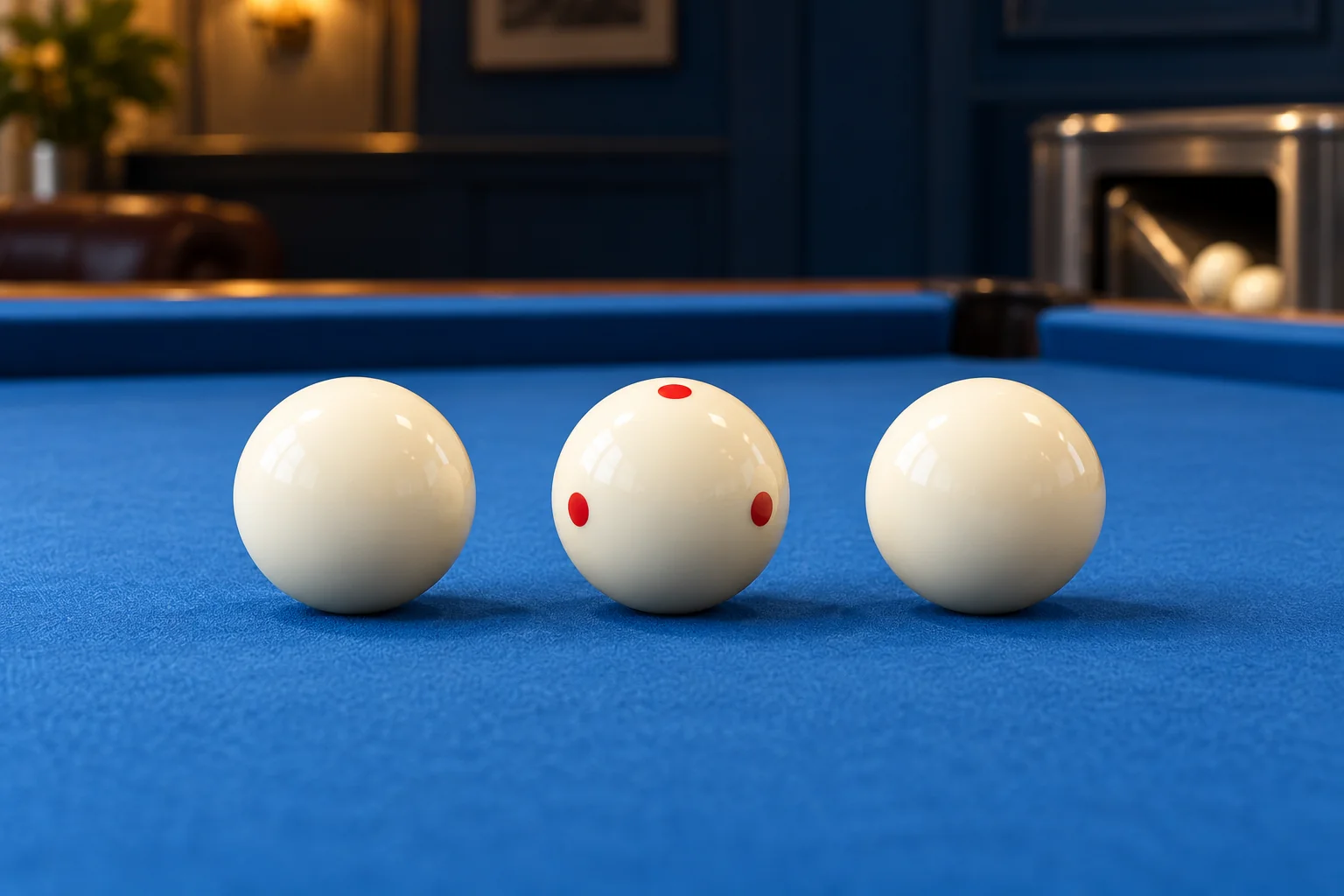
Choose one surface for the task you will actually practice. Event equipment and organizer rules still control competition preparation. A feedback ball is a practice aid, not a promise of more spin, improved aim or automatic stroke correction.
| Surface | Useful observation | Limit |
|---|---|---|
| Plain | Familiar uncluttered view | Rotation is harder to see |
| Dotted | Direction and persistence of visible rotation | Dots do not measure spin rate |
| Training grid | Intended tip-contact reference | Pattern does not verify actual contact by itself |
Run a twelve-shot familiarization block
Use one clean ball for the full block and mark ball centers with removable table references. The score describes familiarization on this table; it is not a product test and does not isolate the ball from aim, stroke, cloth or cleanliness.
If comparing two compatible candidates, alternate complete blocks and keep the layout, speed call and ball condition similar. Record preference separately from objective return or damage failures.
| Shots | Setup | Record |
|---|---|---|
| 1–4 | Straight center-ball stop attempt | Pocket result and final cue-ball center |
| 5–8 | Straight rolling follow at the same distance | Pocket result and visible forward rotation |
| 9–12 | Comfortable moderate cut at one speed | Pocket result and cue-ball finish side |
Inspect the delivered ball before accepting it
- Match the package identity and nominal size to the order.
- Inspect the full surface for chips, cracks or a sharp edge.
- Confirm return compatibility with the table operator where applicable.
- Keep packaging while the compatibility check is incomplete.
- Follow the documented care process for the identified material.
- Quarantine and report a damaged, mismatched or incompatible ball.
Keep this decision separate from a full-set purchase
Worked example: the venue identifies an accepted cue-ball model for its automatic return, the object-ball set identity is known, and a dotted option is available in the matching specification. RETURN and SIZE pass first; dots then become a feedback choice. If the venue cannot identify its separator or accepted ball, the correct worksheet result is unknown—not a guessed purchase.
When several object balls are damaged, mismatched or unidentified, use the full-set buying worksheet. Replacing only the cue ball cannot make the other fifteen balls a documented matched set.
Use the complete pool-ball buying worksheet when the condition or identity of the whole set is in question.
Find center cue ball for a separate center-contact practice method.
Sources and further reading
References support the specific factual information above. The practical checklists are Ariakon editorial guidance.