
Practice planning · 3 min read
Test Pool Advice Before Changing Your Stroke
Pool advice can sound authoritative because it worked for a strong player, carries a famous name or produces one immediate good shot. None of those proves it fits your body, equipment or error. A useful test keeps the change reversible, measures the same task before and after, and checks retention and transfer before replacing a stable stroke.
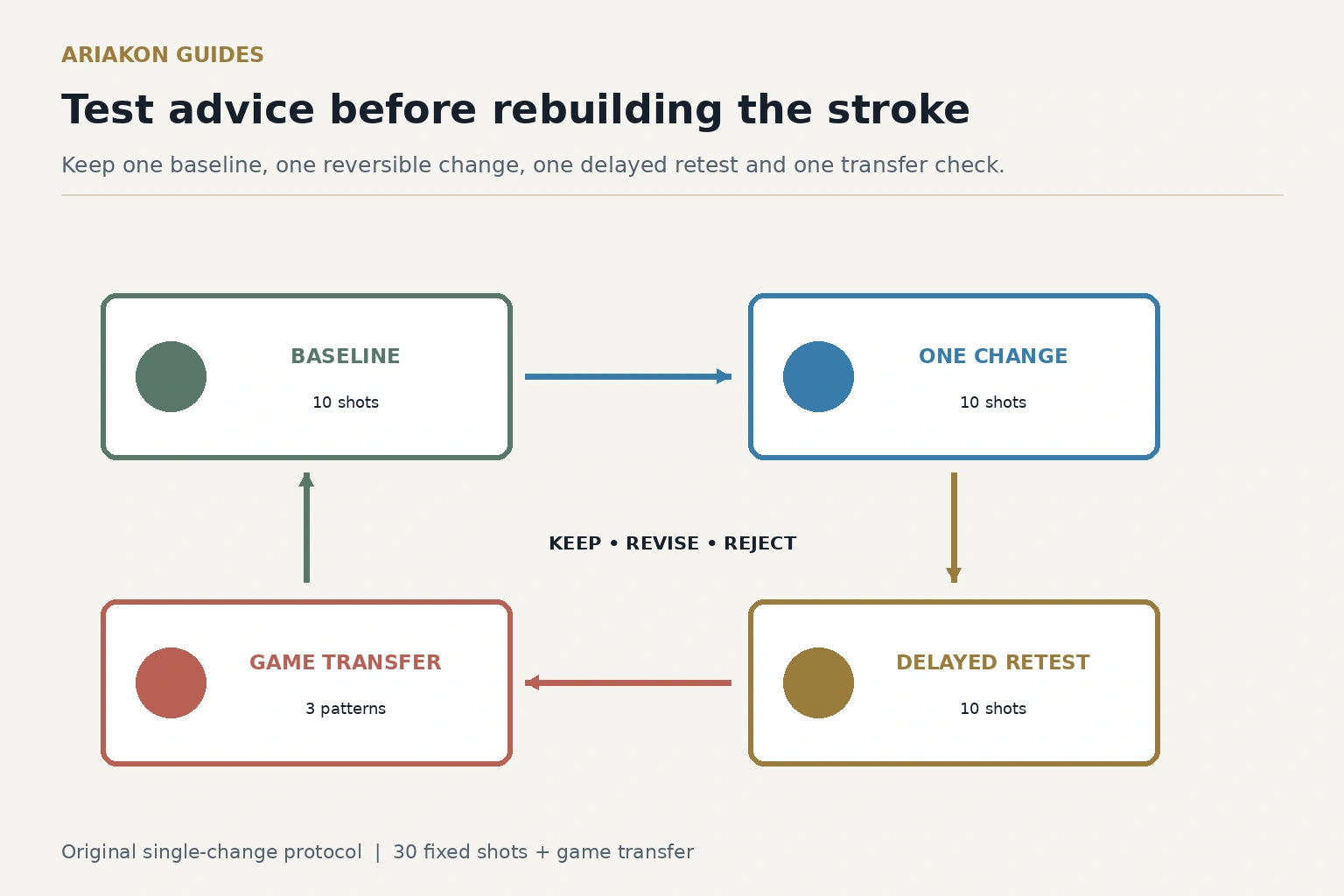
Screen advice before trying it
| Question | If no |
|---|---|
| Is the claimed change observable? | Rewrite it as one visible behavior |
| Is it safe and legal for the shot? | Reject or obtain qualified instruction |
| Can it be reversed after the test? | Do not alter equipment or mechanics permanently |
| Does it target a measured problem? | Collect a baseline first |
| Can every other variable stay reasonably fixed? | Narrow the test |
Use limited feedback when coaching beginners rather than stacking advice.
Build a stroke observation baseline before selecting one change.
Create a thirty-shot reversible trial
Use a straight shot with the object ball one diamond from a corner and the cue ball two diamonds away. Mark both centers and use pocket speed with vertical-axis contact. Film from the same safe rear position. The test has ten baseline shots, ten single-change shots and—after at least one normal practice block or the next day—ten delayed retest shots.
Write the advice as one cue, such as slow the final transition or shorten the bridge by one hand width. Do not combine stance, grip, bridge and finish changes. If pain, equipment risk or loss of basic control appears, stop and restore the baseline.
Score outcome and process separately
| Point | Observable requirement |
|---|---|
| 1 | Ball centers reset correctly |
| 1 | Chosen behavior is visible on video |
| 1 | Cue stays inside the rear-view corridor |
| 1 | Cue ball shows no obvious unintended side rotation |
| 1 | Object ball reaches the called pocket |
| Maximum 50 per block | Compare baseline, trial and delayed retest |
Use a keep, revise or reject rule
| Evidence | Decision |
|---|---|
| Process and outcome improve, then hold after delay | Keep for a game-transfer test |
| Immediate score rises but delayed score returns to baseline | Revise or continue as a short experiment |
| Pocket score rises while cue-line evidence worsens | Do not keep without resolving the tradeoff |
| No measured change | Reject the cue for this problem |
| Pain, strain or unsafe behavior | Stop and seek qualified help |
Worked test and transfer
A hypothetical player is told to lengthen every follow-through. The baseline scores 42/50. The trial scores 46/50, but rear video shows a second shoulder push after contact. The delayed block scores 41/50. The advice is rejected as written; the player keeps the original stroke and instead tests a smoother transition in a later, separate experiment.
For transfer, place three easy object balls that require different speeds and play the pattern three times with the retained cue. One better block does not show that the change will persist or transfer. Repeat the registered task after a delay and then in a varied pattern before replacing a stable stroke. This measures the player’s response; it does not certify or discredit the adviser.