
Practice · 3 min read
Build Pool Confidence With a Three-Shot Ladder
Useful confidence is not a promise that every shot will fall. It is evidence that you can run a familiar process under increasing difficulty. A three-shot ladder makes that evidence visible: one reliable foundation shot, one developing shot and one pressure version, all scored from fixed positions.
Choose three connected shots
Start with a shot you can make about eight times in ten while controlling the cue ball. Build a second version by adding distance, angle or a larger position requirement. Make the third a pressure version of the same family rather than an unrelated trick shot.
Keep the object-ball path recognizable across the ladder. When difficulty rises one variable at a time, a miss tells you more than three completely different layouts would.
Fix the setup before you score
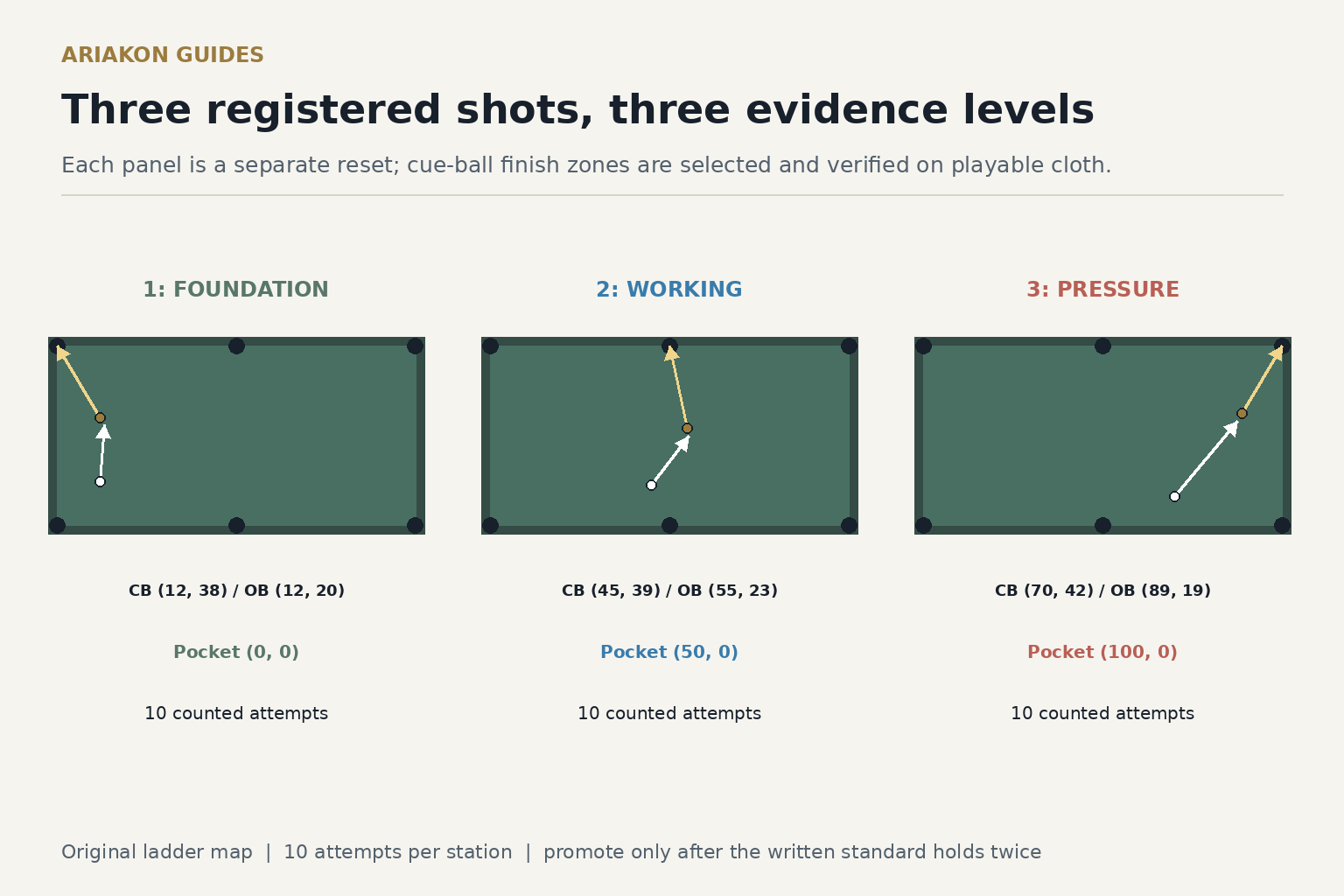
Use a normalized 100-by-50 table map measured between cushion noses. Station 1 uses cue ball (12,38), object ball (12,20) and the upper-left corner; Station 2 uses cue ball (45,39), object ball (55,23) and the upper side pocket; Station 3 uses cue ball (70,42), object ball (89,19) and the upper-right corner. Mark a one-diamond cue-ball finish zone for each station and keep it fully on playable cloth.
Shoot ten attempts at each station with the same rules. Reset fully between attempts instead of leaving a favorable accidental angle. The object ball must travel in a straight line after contact; if the setup does not point to its called pocket, correct the marks before scoring.
Earn the right to move up
Set a promotion standard before practice begins: for example, eight of ten at the foundation station and six of ten at the working station on two separate days. The exact number matters less than using the same standard consistently.
If the first station falls below its standard, return to it without judgment. That is calibration, not failure. Confidence becomes durable when the score tells you what to practice next.
Add pressure without rushing
At the third station, use one deliberate pressure condition: a single attempt after a short wait, a must-make final ball, or a scored race against your previous best. Do not add noise, punishment or unsafe distractions.
Use the same pre-shot routine and normal stroke tempo. The purpose is to rehearse commitment after a decision, not to prove that tension can be ignored.
Review patterns, not isolated misses
Record make, scratch and cue-ball finish for every attempt. A camera can help if the room permits it, but the scorecard should still stand on its own.
After the set, look for a repeated miss direction or speed error. Change only one variable in the next set. A single miss does not justify rebuilding your aim or stroke.
Use a simple practice card
- Name the foundation, working and pressure shots.
- Mark exact ball positions and the cue-ball target zone.
- Write the scoring and scratch rules before shooting.
- Complete ten attempts at each station.
- Promote a station only after meeting its standard twice.
- Keep the card so the next session begins with evidence.