
Practice · 3 min read
Set Quarterly Pool Skill Goals With Baseline Scores
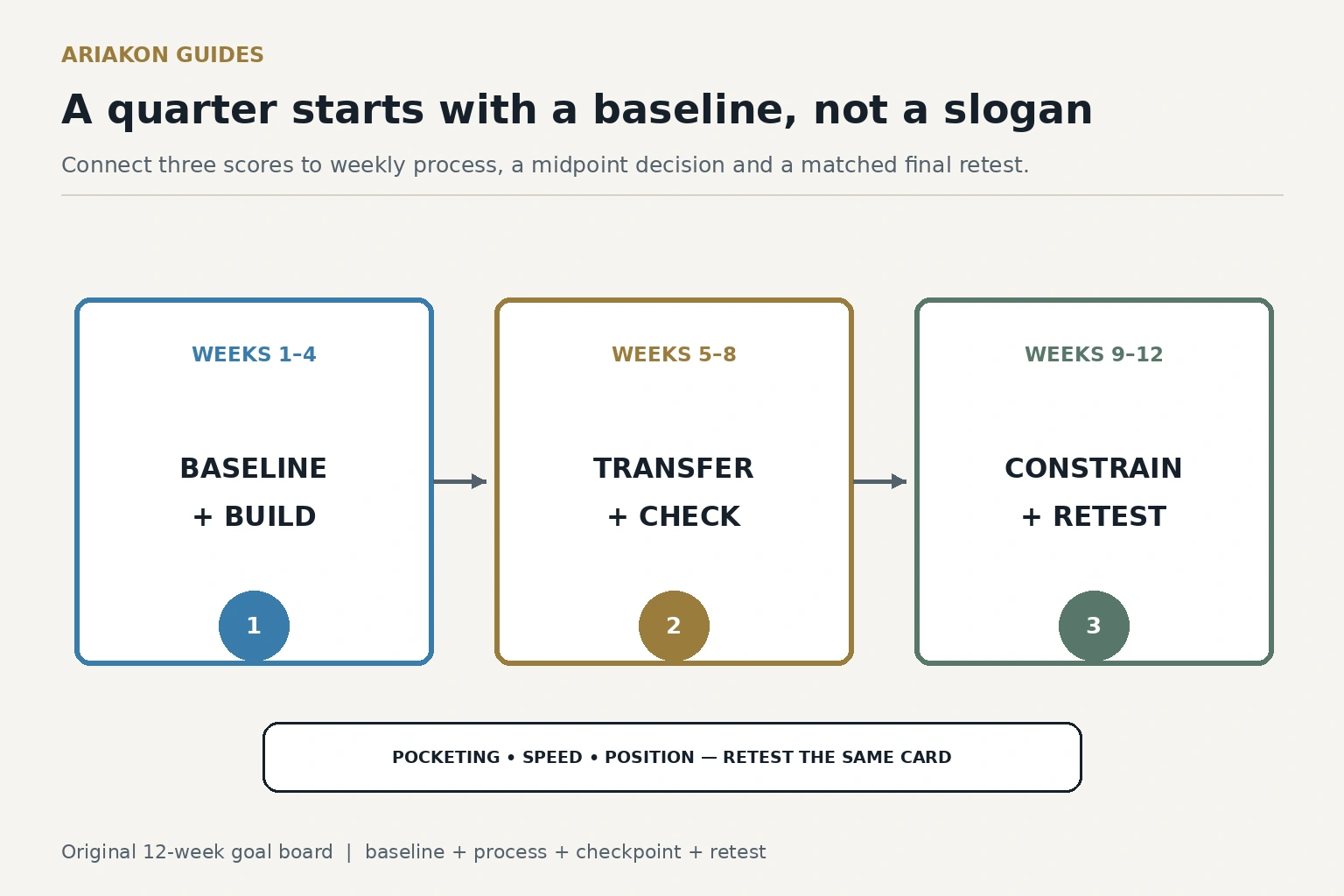
A goal such as “play better this season” cannot tell you what to practice Tuesday or whether the work helped. The broad measurable-goals guide explains how to make one target observable. This worksheet adds a quarterly operating rhythm: register three baselines, choose one primary constraint, schedule twelve weeks of practice and change the plan only at defined checkpoints.
Register three baselines before setting a target
Warm up first, then complete the tests without coaching between attempts. A baseline is a starting description, not a judgment. If the setup cannot be rebuilt from the card, it is not yet a useful baseline.
Make ability visible through defined tasks and separate component scores. This original local card records pocketing, speed and position; it does not reproduce a proprietary examination or predict an official rating.
| Skill lane | Fixed test | Recorded result |
|---|---|---|
| Pocketing | Twenty center-ball shots from one registered distance and cut | Makes, miss side and pocket-entry zone |
| Speed | Twelve lag attempts to a one-diamond landing zone | Zone hits, short misses and long misses |
| Position | Six attempts at the same three-ball pattern | Balls completed and first failure |
| Conditions | Same table, balls, setup marks and session date | Anything that prevents a fair retest |
Write one measurable pool goal before expanding it into a quarterly plan.
Measure pocketing by distance and cut when pocketing is the chosen constraint.
Build one twelve-week cycle
Association for Applied Sport Psychology guidance emphasizes specific, observable goals, time constraints, regular monitoring and short-range goals that support a longer plan. The calendar is therefore a review structure, not a promise that improvement follows a fixed timetable.
| Weeks | Main job | Evidence |
|---|---|---|
| 1 | Baseline and choose one primary constraint | Three scores plus one written priority |
| 2–4 | Practice the primary skill twice per week | Attempts, component score and one observation |
| 5–6 | Add a related transfer task | Primary test remains; one game-like variation is added |
| 7 | Midpoint retest under baseline conditions | Keep, simplify or replace one practice task |
| 8–10 | Continue the weakest observable component | Weekly trend without changing every variable |
| 11 | Pressure or random-order transfer | Routine completion and decision quality |
| 12 | Final retest and next-quarter decision | Baseline comparison plus written next action |
Write a goal that includes the work
Keep outcome goals such as winning a league set on a separate line. They matter, but they depend on opponents, formats and opportunity. The practice goal should remain largely under the player’s control.
| Field | Required entry | Example |
|---|---|---|
| Baseline | Score, setup and date | 6/12 lag-zone hits |
| Twelve-week target | Moderately difficult observable score | 8/12 on two retests |
| Process | Frequency and exact task | Two twelve-attempt blocks each week |
| Constraint | One variable held constant | Same landing zone and lag direction |
| Checkpoint | Date and decision rule | Week 7: change only if component score is flat |
| Transfer | Where the skill must appear in play | One speed-first safety per practice rack |
Worked quarter: improve lag-speed evidence
A hypothetical player records 15/20 on the pocketing test, 6/12 lag-zone hits and 12 total balls across six three-ball patterns. Speed is the clearest constraint. The player sets a target of at least 8/12 zone hits on two baseline-condition retests and schedules two short speed blocks per week.
At Week 7 the retest is 7/12, with four long misses and one short miss. The plan does not add a new aiming system. It keeps the task and makes the next three weeks about finishing inside the back half of the zone. Week 12 scores of 9/12 and 8/12 satisfy the written target; the next quarter can transfer that speed to safeties.
Reset the plan without erasing the evidence
If a score falls once, record conditions and continue. If the same component is flat at two scheduled checkpoints, make one smaller task change while preserving the original baseline test. Injury, pain or loss of access pauses the schedule; it does not become a failed quarter.
Archive the card with date, table and setup. The useful output is not a motivational slogan but a traceable choice: continue, narrow the constraint, transfer the skill or collect a new baseline.
Sources and further reading
References support the specific factual information above. The practical checklists are Ariakon editorial guidance.