
Practice · 3 min read
Sequence Pool Learning From Basic Contact to Position Decisions
Position play becomes confusing when pocketing, cue-ball direction, speed and route choice are all treated as one skill. This thirty-two-attempt ladder keeps one marked shot while adding one job at a time. It is narrower than the adult-learning guide: the deliverable is a scored prerequisite sequence that tells you where the chain first breaks.
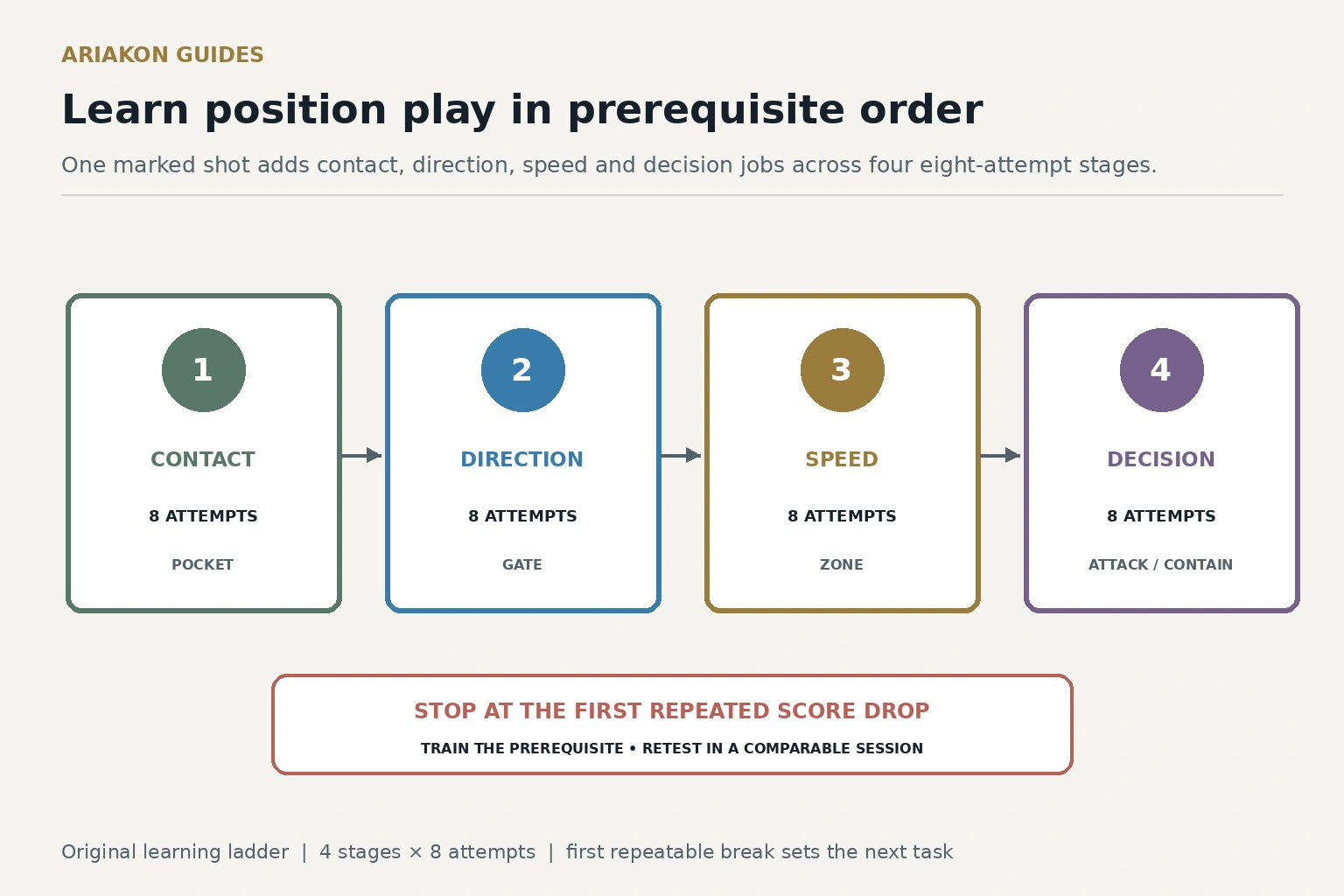
Register one shot and four evidence marks
Place the object ball one diamond from a corner pocket on the pocket centerline. Put the cue ball two diamonds away on a moderate cut. Mark both ball centers, the called pocket, a hand-width cue-ball direction gate after first contact and a one-diamond finish zone beyond that gate. Use vertical-axis contact and the same comfortable medium speed except that Stage 3 may adjust delivery speed to call the near or far half of the same zone.
Warm up before scoring. Then complete four blocks of eight attempts without moving the marks. A legal pocket is evidence about contact; the cue-ball gate is evidence about direction; the finish zone is evidence about speed. None of those results alone proves a stroke cause.
Learn pool as an adult for the broader approach to feedback, difficulty and useful session endings.
Build a practical training week after this ladder identifies the next priority.
Climb CONTACT, DIRECTION, SPEED and DECISION
Stages 1–3 each offer eight component points. Stage 4 offers three per attempt: one for using the written decision rule, one for the intended pocket or containing leave and one for completing the normal routine, maximum twenty-four. These are personal training scores, not ability grades.
| Stage | Eight-attempt job | One point when |
|---|---|---|
| 1 — CONTACT | Call the pocket and use center-axis contact | Object ball is legally pocketed |
| 2 — DIRECTION | Call which edge of the cue-ball gate it will cross | Pocket plus correct gate |
| 3 — SPEED | Call near or far half of the finish zone | Pocket plus called zone half |
| 4 — DECISION | Choose attack or containment before stance | Decision rule, pocket/leave and routine are recorded |
Use a decision card instead of guessing
Containment can be a legal safety, a larger leave or another rules-permitted low-cost option. Verify the current game rules before using the card in competition.
| Before stance | Attack when | Contain when |
|---|---|---|
| Name object-ball entry | Pocket route is inside the Stage 1 range | Contact is outside the demonstrated range |
| Name cue-ball corridor | Direction gate is clear | A scratch or blocked gate dominates |
| Name finish tolerance | Large zone preserves a next shot | Only a narrow untested zone works |
| Commit or stand up | All three answers agree | The picture or plan changes |
Worked example: find the first broken link
A hypothetical player scores CONTACT 7/8, DIRECTION 6/8 and SPEED 3/8. In the DECISION block, five of eight choices demand the far half of the zone even though that speed result appeared only once. The useful finding is not ‘bad position play.’ Contact and direction are currently more repeatable than speed, and the decision rule is asking for evidence the player does not yet have.
The next session keeps the same marks and runs sixteen speed attempts: eight to the full zone, then eight to one half only if the first block holds. Stage 4 returns after two comparable speed blocks.
Graduate by repeatability, not one best block
| Evidence | Next action |
|---|---|
| A stage holds in two comparable sessions | Add the next stage |
| The first score drop repeats | Practice only that prerequisite |
| Scores alternate widely | Recheck marks, speed name and rest |
| Pain, repeated miscues or equipment damage | Stop and seek appropriate help |