
Technique · 3 min read
Recognize When Excess Sidespin Shrinks Your Pool Shot Margin
Sidespin may solve a rail route while making the shot less tolerant of aim, speed and delivery error. Instead of asking for a universal maximum, compare several registered contact points on one fixed shot and find the smallest offset that completes the route. The deliberate-sidespin guide explains when spin can be useful; this test measures when added spin stops buying enough margin.
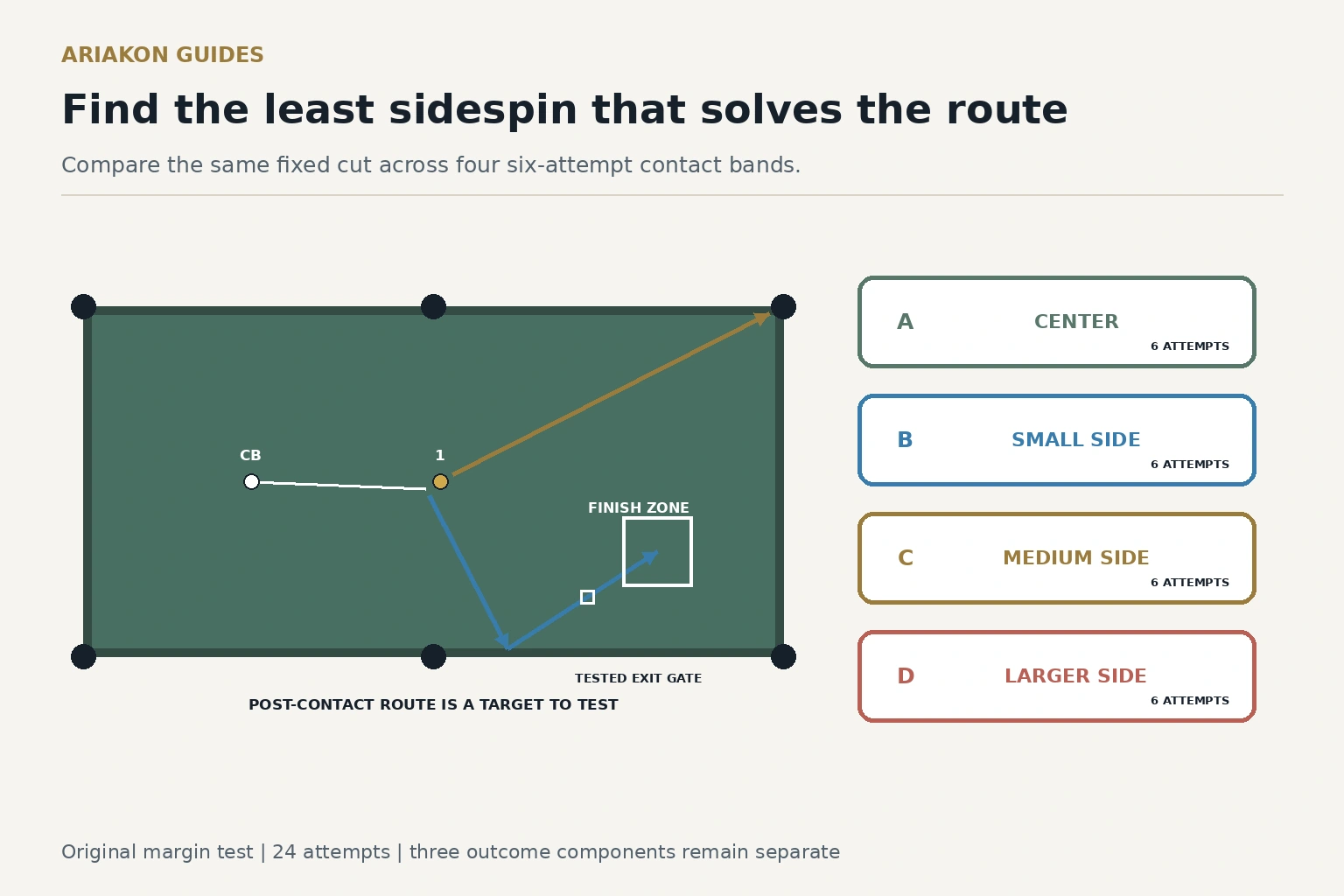
Register one moderate cut and three result gates
Use a measured 100 × 50-inch cushion-nose map with 2.25-inch balls. Place the cue-ball center at (24,25), the object-ball center at (51,25), and call the upper-right corner at (100,0). The object-ball direction is u=(49,-25)/√3026 and the contact cue-ball center is G=O−2.25u≈(48.996,26.023). A stun departure follows the perpendicular toward the lower cushion, reaching its ball-center contact plane y=48.875 near x=60.65. Use that continuous cushion region as the initial rail reference. Mark an exit gate centered near (72,41.5) and a finish zone centered near (82,35), fully on the bed. These are route targets to test, not a claim that every contact band produces the same rebound.
Use the same cue, clean balls, cue elevation and named medium speed. Do not measure tip offset beyond the miscue limit you already control. Stop immediately for pain, equipment damage or repeated miscues.
Decide when sidespin is actually needed before running an offset comparison.
Calibrate center-ball speed if the finish zone is unstable without sidespin.
Shoot four six-attempt bands
Tip-width language is an approximate registration tool, not a universal physical measurement. Photograph the contact cue for your own repeatability. Randomize left and right on mirrored layouts in a later session rather than assuming the result transfers automatically.
| Band | Contact point | Route rule |
|---|---|---|
| A — Center | Vertical axis | Record the natural one-rail path |
| B — Small | About quarter-tip running side | Same speed and elevation |
| C — Medium | About half-tip running side | Same marks and route |
| D — Larger | About one tip running side | Stop if miscues or control fails |
Score three margins on every attempt
Each band has eighteen available points. Keep pocket, path and position subtotals; a combined total alone can hide a route that gains position while losing too much pocket margin. This is a player-specific comparison under registered conditions, not a laboratory measurement of geometric margin.
| Point | Award when | Miss code |
|---|---|---|
| Pocket margin | Object ball is legally pocketed in the called pocket | Thick, thin, jaw or miss |
| Path margin | Cue ball crosses the rail-exit gate | Inside or outside gate |
| Position margin | Cue ball finishes in the one-diamond zone | Long, short, left or right |
Worked result and miss diagnosis
A hypothetical player scores Center 14/18, Small 16/18, Medium 12/18 and Larger 7/18. Small side reaches the path gate on five of six attempts and the zone on four, while Medium gains no additional zone finishes and adds two thin misses. Larger adds a miscue and three outside-gate finishes.
The selected match contact is Small because it is the least offset that solves the route. The repeated thin miss at higher offset does not prove one cause: squirt, swerve, throw, speed and delivery can interact. Freeze the setup and test one variable or work with a qualified instructor instead of compensating by feel across every shot.
Transfer the minimum-use rule to a game
| Question | Action |
|---|---|
| Does center-ball or vertical-axis spin reach a playable zone? | Use it; preserve the larger margin |
| What is the smallest tested side that clears the route? | Use that registered band |
| Does the layout require an untested offset? | Choose a wider zone, different route or safety |
| Did table conditions change? | Treat the old score as context and recalibrate |