
Technique · 3 min read
Choose a Pool Stroke Tempo You Can Repeat at Different Speeds
Useful tempo is a repeatable relationship among planning, warmups, the final transition, delivery and finish—not a universal metronome number. Compare your own visible cadence across three speed bands while the shot stays fixed. This is separate from a broad stroke-drill collection because it produces one personal tempo reference and a speed-specific failure diagnosis.
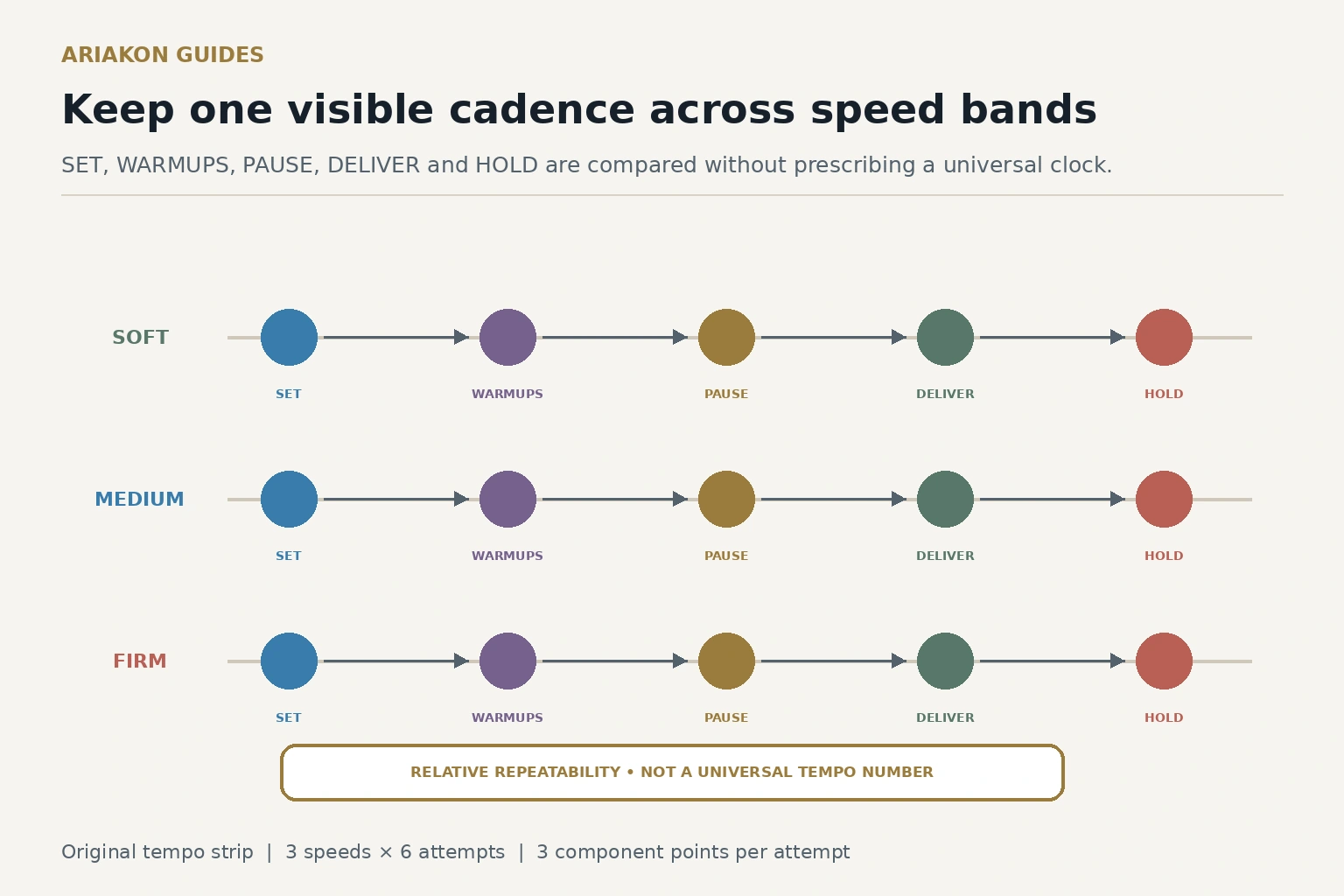
Register one straight shot and three speed windows
Place the object ball one diamond from a corner pocket and the cue ball two diamonds behind it on the pocket centerline. Mark a soft cue-ball window within one ball of the object-ball spot, a medium window one to two diamonds up-table and a firm window two to three diamonds up-table. Adjust those windows during warm-up so they are safe and reachable on the table in use.
Use vertical-axis contact. Complete one unscored baseline and then three six-shot blocks: soft, medium and controlled firm. Firm does not mean maximum power. Stop for pain, repeated miscues, cue-ball launch or loss of safe control.
Use one comfortable low vertical-axis contact offset for all three blocks and place every finish window behind the collision point along the return line, entirely on playable cloth. Register the three reachable draw windows during warm-up; do not change contact height to manufacture the speed result. If the far window requires a cushion, shorten it. This is a draw-speed demand used to compare cadence, not a claim that center-ball contact alone returns the cue ball.
Practice advanced stroke drills for the wider stroke curriculum around this tempo test.
Coordinate the final look and forward stroke when visual timing is the specific next question.
Define tempo with five visible landmarks
| Landmark | Observable question | Do not prescribe |
|---|---|---|
| SET | Was the plan complete before lowering? | A universal stance time |
| WARMUPS | Did the ordinary rhythm band appear? | An exact warmup count for everyone |
| PAUSE | Was the final transition visible? | A forced pause duration |
| DELIVER | Did acceleration look continuous to contact? | A universal backswing ratio |
| HOLD | Did the cue finish before the player rose? | A posed follow-through length |
Score three components in each block
Each six-shot block offers eighteen points. Record pocket, speed and tempo separately. Review video only after the block, from a fixed safe side view with permission. Self-counting can label relative rhythm, but do not claim millisecond precision from ordinary footage or memory.
| Component | One point per attempt |
|---|---|
| Object ball is legally pocketed | |
| Speed | Cue ball finishes in the named window |
| Tempo | All five landmarks stay inside the baseline pattern |
Worked example: speed changes the wrong landmark
A hypothetical player scores soft 13/18, medium 17/18 and firm 12/18. Pocket scores are 5, 6 and 5. Tempo scores are 3, 6 and 2: soft attempts show an extra slow-down before contact, while firm attempts often lose the final transition. The finding is not that one tempo number is correct. The medium block currently preserves the player's full landmark sequence.
The next session alternates six soft and six firm attempts while retaining the medium SET–WARMUPS–PAUSE relationship. Speed changes come from the planned delivery and finish window, not by adding a last-second jab or steer. A qualified instructor should evaluate persistent delivery questions.
Choose and transfer one personal tempo cue
| Evidence | Next action |
|---|---|
| Landmarks hold at all three speeds | Use the same cue in a six-shot cut-shot block |
| Soft block decelerates | Widen the zone; rehearse continuous delivery |
| Firm block rushes transition | Reduce speed demand and restore the baseline |
| Camera and feel disagree | Keep both notes and collect another fixed block |
| Pain or uncontrolled elevation appears | Stop and obtain appropriate help |