
Technique · 3 min read
Play Pool With Clammy Hands Without Changing Your Stroke
Clammy hands can increase friction at the bridge or make a player tighten the back hand. The first job is to manage the contact surfaces safely, not rebuild the stroke mid-match. Use this fixed-shot comparison only when the condition occurs naturally. It is separate from general competition composure because it tests bridge glide, routine and outcomes under one physical condition.
Start with safety, room rules and health boundaries
Keep a clean absorbent towel available and dry both hands completely before touching the cue or table. Do not deliberately induce sweating, apply an unfamiliar chemical during play or put powder on the cloth. Follow the room, event and equipment-maker rules for gloves, towels, hand products and shaft cleaning.
Frequent or heavy sweating can have medical causes. The American Academy of Dermatology recommends tracking triggers and consulting a board-certified dermatologist when sweating interferes with daily activities. Pool practice cannot diagnose or treat hyperhidrosis.
Build calm competitive composure when tension and pace also change during the condition.
Choose and fit a billiard glove before using a glove as a repeatable bridge interface.
Register one stop shot and preserve the stroke
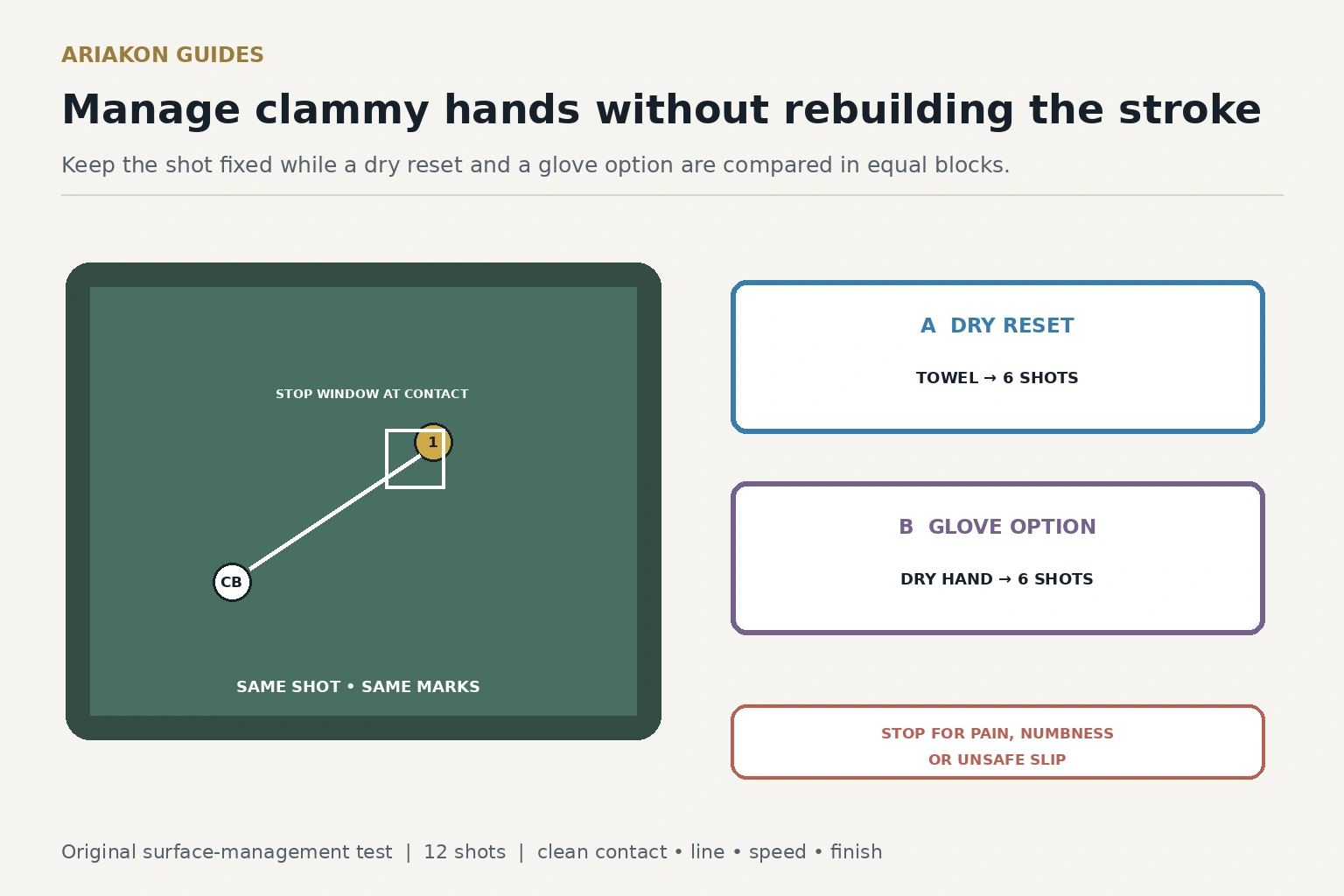
Place the object ball one diamond from a corner and the cue ball two diamonds behind it on the pocket centerline. Mark a two-ball-wide stop corridor. Use the same cue, open or closed bridge, bridge length, vertical-axis contact, named pocket speed and ordinary grip cue for every block.
Warm up before scoring. If the cue slips in the back hand, the bridge binds sharply or the setup becomes unsafe, stop rather than forcing the attempt. Never sand or improvise a shaft treatment during this drill.
Compare two surface-management blocks
If you do not own or ordinarily use a glove, repeat Block A in a later naturally clammy session instead of borrowing an unknown fit. A comparison should not introduce skin irritation, contamination or another player's equipment without permission.
| Block | Six-attempt setup | Keep fixed |
|---|---|---|
| A — Dry reset | Dry hands and shaft only as maker permits; towel between attempts | Bridge, grip cue, shot and speed |
| B — Clean fitted glove | Use a clean, dry, correctly fitted glove if already allowed | Bridge geometry, grip cue, shot and speed |
Score glide, routine and result separately
Each six-shot block offers twenty-four points. Mark unknown when glide cannot be observed. The result subtotal cannot prove that one surface method caused the difference.
| Component | One point when |
|---|---|
| Bridge glide | Shaft moves without visible bind or bridge collapse |
| Back hand | Ordinary grip cue remains unchanged |
| Routine | Plan and delivery sequence are completed |
| Result | Ball pockets and cue ball finishes in the stop corridor |
Worked diagnosis and game transfer
A hypothetical player scores Dry reset 17/24 and Clean glove 21/24. Pocket totals are both 5/6, but bridge-glide matches rise from 3/6 to 6/6 and the normal grip cue returns on five attempts. The next action is a second glove block on another day, not a tighter grip or shorter bridge.
For game transfer, play one six-ball pattern with the chosen surface routine. Dry or check the glove only between turns, keep equipment clear of the table and score whether the normal routine and bridge glide survive position shots. Stop if skin irritation, unsafe slipping or equipment contamination appears.
Sources and further reading
References support the specific factual information above. The practical checklists are Ariakon editorial guidance.