
Technique · 2 min read
Repair a Draw Practice Plan That Has Stopped Progressing
A stalled draw score does not automatically mean the stroke needs more force. The practice task may be too easy, too hard, badly measured or disconnected from game routes. Keep one diagnostic baseline stable, then change only the practice design. The contact-and-speed log identifies first-failed events; this worksheet repairs the plan around that evidence.
Audit the plateau before changing technique
| Check | Evidence |
|---|---|
| Comparable setup | Same ball marks, table and cue when practical |
| Enough attempts | At least three dated blocks, not one bad session |
| Stable contact | Intended-versus-actual tip region recorded |
| Stable object-ball result | Pocket and cut accuracy remain separate |
| Useful target | Draw zone is neither automatic nor desperate |
| Transfer | Skill appears in a route, not only a straight drill |
Diagnose draw distance with a contact-and-speed log before redesigning the practice plan.
Work your way out of a pool slump when the plateau affects several skills rather than draw alone.
Keep an eighteen-shot anchor test
Place the object ball one diamond from a corner and the cue ball two diamonds behind it on the pocket centerline. Mark three return zones: half-diamond, one-diamond and one-and-a-half-diamond draw. Shoot six attempts per zone with the same centerline and ordinary bridge.
Score pocket, intended contact region and cue-ball zone separately for fifty-four possible component points. The total is a personal reference, not proof of exact tip offset, speed or spin.
Choose one repair lever
| Plateau pattern | Change one variable |
|---|---|
| Near zone is automatic | Add a small cut while keeping distance |
| Far zone collapses contact | Shorten distance or reduce target depth |
| Scores swing with fatigue | Use smaller blocks with full rest |
| Straight drill improves, games do not | Add a next-ball route and choice |
| Every set invites a new stroke thought | Keep one external result cue for the block |
Use a three-session repair cycle
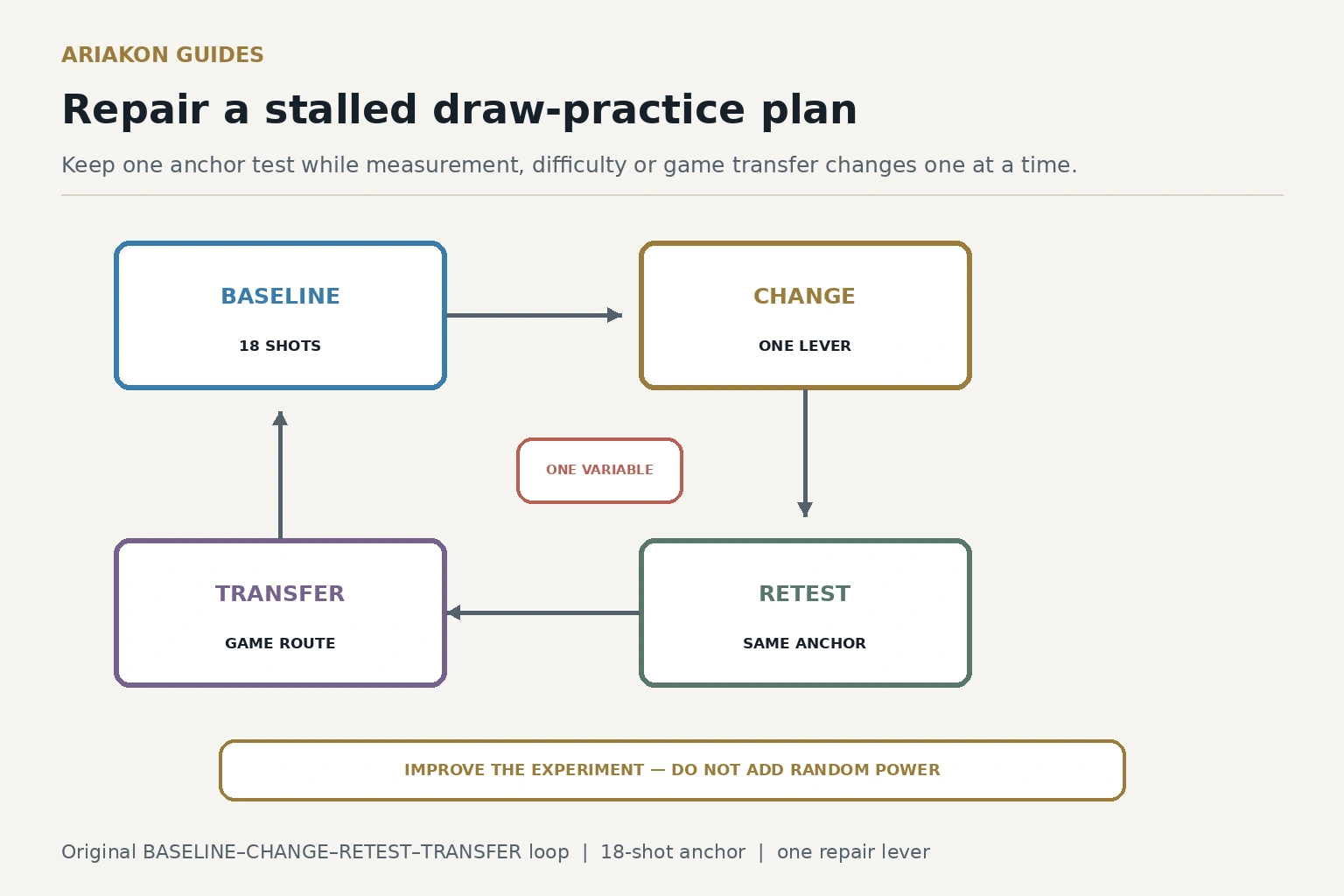
Keep the lever only when the retest or transfer evidence improves without a new contact failure. Do not stack tip, cue, bridge, grip and aiming changes in the same cycle.
| Session | Work |
|---|---|
| 1 — Baseline | Run the unchanged eighteen-shot anchor |
| 2 — Change | Run three six-shot blocks with one repair lever |
| 3 — Retest | Repeat the original anchor after warm-up |
| Transfer | Play four three-ball layouts requiring short or medium draw |
Worked repair: distance improved but transfer stopped
A hypothetical player holds 45–47 of 54 anchor points across three sessions, yet avoids draw in patterns. The straight score is not the bottleneck. The repair lever adds a second object ball and requires choosing a half-diamond or one-diamond return before stance.
After four layouts twice, route-choice completion rises from 3/8 to 7/8 while contact remains stable. The next plan keeps one weekly anchor retest and spends the other draw block on game routes. Persistent unexpected contact, pain or equipment damage is a stop for qualified help, not an invitation to hit harder.