
Technique · 3 min read
Shoot Accurately When the Cue Ball Is on the Rail
A cue ball tight to the cushion changes the stroke before it changes the aim. The rail limits bridge height and access to the cue ball, so the cue is often elevated and the available contact area becomes small. Reliable execution begins by accepting those constraints instead of forcing a normal-table stroke into the space.
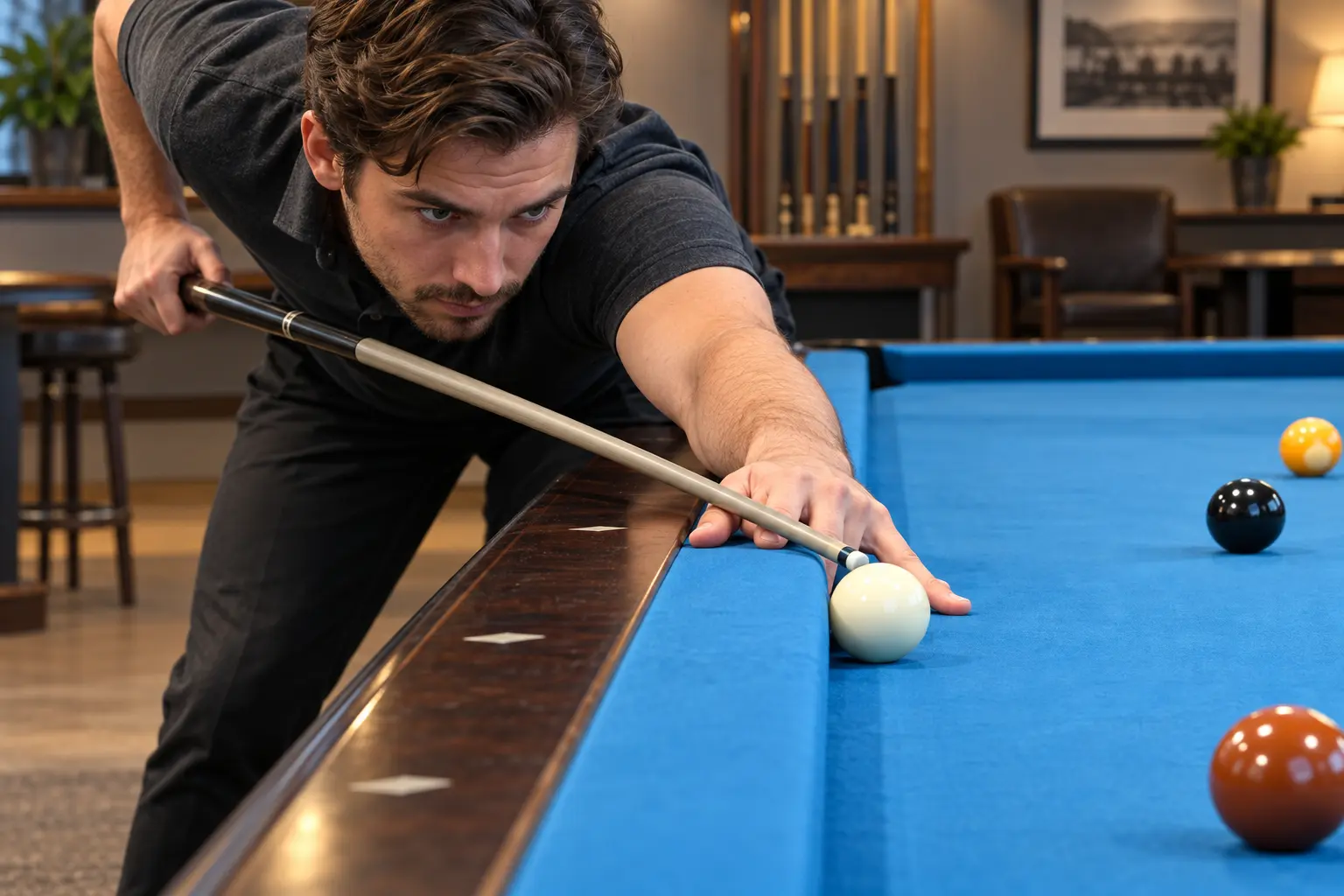
Build the bridge on the rail
Place the bridge hand securely on the cushion with the cue supported by the fingers rather than balanced loosely on the rail edge. Keep skin and clothing clear of the moving shaft.
Use the shortest comfortable bridge that still allows a smooth delivery. A long bridge magnifies small steering errors when the cue is already elevated.
Accept the elevated cue
The rail prevents a fully level cue, so raise the butt only as much as necessary. Extra elevation can make the cue ball curve, hop or react differently from a level stroke, especially with sidespin.
Aim near the accessible upper portion of the cue ball without crowding the top edge. If the intended spin requires a contact point you cannot reach confidently, change the shot.
Shorten and quiet the stroke
Use a compact backswing, a deliberate pause and a controlled forward motion. Let the cue pass through the available line without lifting the bridge or dropping the elbow into the rail.
Medium or soft speed usually gives more contact confidence than a forced power stroke. When speed is essential, favor center-ball accuracy over ambitious spin.
Choose the percentage shot
- Prefer a simpler pocket when position demands are similar.
- Use a containing safety when the pocketing margin is poor.
- Avoid unnecessary sidespin from the elevated cue.
- Plan cue-ball travel with a larger landing zone.
- Check nearby balls for double-hit risk.
- Ask for a frozen-ball ruling when competition conditions require it.
Respect frozen-ball rules
Under current WPA terminology, a ball touching a cushion is not counted as driven to that cushion unless it leaves and returns. A referee or player may need to establish whether the ball is frozen before the shot.
The cue ball being close to an object ball creates a separate double-hit concern. Do not confuse a rail-bound cue ball with permission to push through a nearby ball.
Practice three rail distances
Place the cue ball touching the long rail and an object ball one diamond away, then repeat at two and three diamonds. Begin straight, add a small cut and record which bridge length remains stable.
Finish by playing position into a broad zone with center, slight follow and slight draw. The goal is not maximum action; it is a dependable shot family for an uncomfortable starting position.
Sources and further reading
References support the specific factual information above. The practical checklists are Ariakon editorial guidance.