
Cue ball control · 4 min read
Use Sidespin Only When the Shot Needs It
Sidespin is valuable when it solves a route problem that center-ball contact cannot solve with enough margin. It also introduces squirt, swerve, throw and speed-dependent cushion changes. The practical question is not whether you can apply English. It is whether the position benefit is large enough to justify those extra variables.
Start with the center-ball alternative
Before moving the tip sideways, trace a center-ball route using natural roll, stun or draw. If that route reaches a generous position zone without crossing traffic, use it. Simpler shots are easier to reproduce across unfamiliar tables.
Choose sidespin when it creates a meaningfully wider landing window, avoids a blocker or changes the cushion angle in a way that speed alone cannot. That decision turns English into a tool rather than a default style.
Read the illustrated vertical-axis reference before changing side
Coordinates are ball centers on an illustrative 100 by 50 inch bed: x=0..8 along length, y=0..4 across width, origin at the lower left cushion nose. One unit is 12.5 inches. For 2.25 inch equal balls, radius is 0.09 and diameter 0.18 units. Intact cushion center boundaries are x=0.09,7.91 and y=0.09,3.91; pockets interrupt the physical boundary at the four corners and (4,0),(4,4). Measure actual bed, balls and jaws before scaling. Remove every measuring aid before shooting; never mark a competition table.
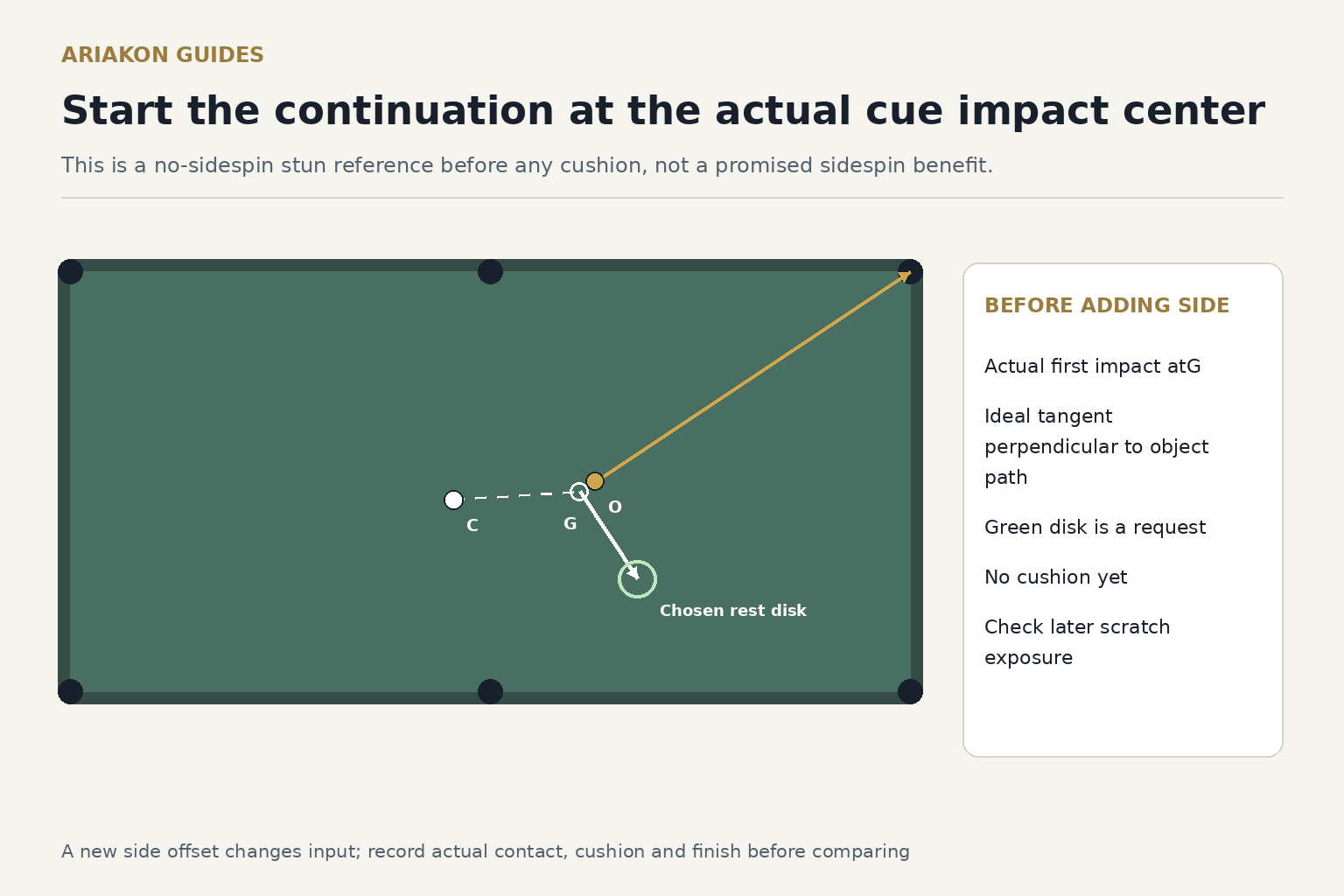
The diagram uses O(5,2), real upper-right P(8,4), object direction n=(3,2)/sqrt(13), cue-center contact G=O−0.18n. Incoming direction is 30° clockwise from n, with C1.2 units behind G. The drawn postcontact cue direction t=(2,-3)/sqrt(13) is perpendicular to the object line; the chosen green disk radius 0.18 is centered at G+t. These are ideal stun inputs before any cushion.
This correction starts the white continuation at G, not at the original cue start or object center. It demonstrates contact geometry, not a claim that sidespin materially bends the cue along an arbitrary pre-cushion route. The later three route families still require their own actual cushion and finish observations.
Shot one: widen a one-rail position route
When the cue ball reaches a cushion after contact, running sidespin can open the rebound in the direction of travel. This can help the cue ball travel around the center of the table instead of dying behind a ball. Use only enough spin to clear the problem and enter the position zone.
Practice the same shot with center ball first. Then move the tip a small measured amount and keep speed constant. The difference in the second cushion line is your table-specific evidence; a memorized angle from another table is not.
Shot two: hold a route near a cushion
Reversing sidespin can shorten or hold a cushion rebound. It is useful when a natural route runs past the next-shot window. The tradeoff is that slow speed, cloth friction and the exact rail contact can change how much spin remains at the cushion.
Aim for a broad zone rather than an exact point. If the held route demands maximum side and perfect speed, look again for a stun or two-rail alternative with more tolerance.
Shot three: escape around a blocker
On a kick or recovery shot, sidespin can alter the cue ball's cushion path enough to clear an obstructing ball. It can also help send the cue ball away after legal contact. Because the first-rail aim and post-contact result both change, this is a calibration shot, not a diagram to memorize.
Begin with a modest comfortable repeatable offset request rather than a universal tip-width prescription. Large offsets raise miscue risk and magnify compensation errors. Keep the cue as level as practical so unintended swerve does not replace the route you planned.
Account for the full spin system
An off-center hit can deflect the cue ball initially, curve its path later and change object-ball throw at contact. Speed and cue elevation influence the balance. A successful result does not prove you aimed at the geometric contact point.
Build one reliable reference for your cue and stroke: fixed layout, fixed speed, then center, a small left offset and a small right offset. Mark where the cue ball contacts the cushion and where it finishes. Expand only after those three references group consistently.
Use a five-question spin check
- What problem does sidespin solve that vertical-axis contact does not?
- What is the smallest tip offset that creates a useful route?
- Where is the position zone if the cushion reacts slightly longer or shorter?
- Can I reproduce the speed and elevation used in practice?
- If the compensation feels uncertain, which simpler route still leaves a makeable next shot?
Sources and further reading
References support the specific factual information above. The practical checklists are Ariakon editorial guidance.