
Practice · 3 min read
Use Quick-Fire Pool Practice Without Training Carelessness
Faster practice should reduce indecision, not remove the pre-shot routine. A useful quick-fire block uses familiar shots, a generous outcome target and a fixed time or attempt limit. You keep the setup, pause and finish intact while learning to recognize patterns sooner.
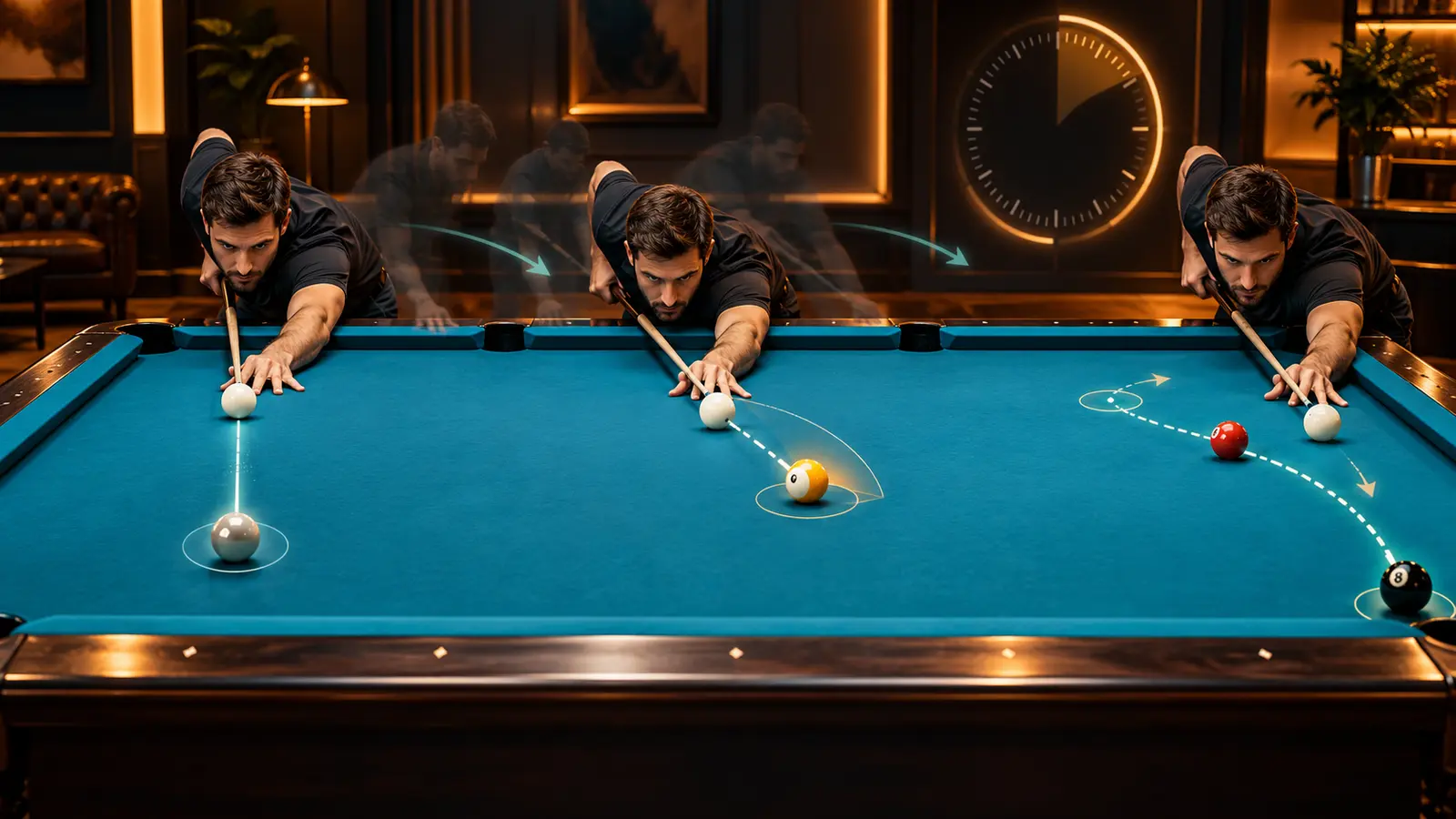
Decide what the timer measures
Use time to constrain the whole drill, the standing decision or the reset between attempts. Do not race the cue through impact. A shot clock in competition limits decision time; it does not reward a rushed delivery.
Do not assume that a faster block improves learning. This test measures only the observed pace, routine completion and shot results in the current session. Retest after a break and on another day before claiming improvement.
Choose familiar, low-complexity shots
Start with stop shots, short cut shots or one simple position route. Use the same ball spacing for a complete block so recognition becomes quicker without forcing a new solution on every attempt.
Keep the target generous enough to complete the routine. If the layout requires maximum power, extreme spin or a difficult bridge, it belongs in deliberate technical practice first.
Protect three non-negotiable actions
Approach on the chosen line, pause when the cue is set and finish the stroke before standing. These actions stay even when the decision window is shorter.
If you reach the table without a decision, stand up and record an over-time attempt. Do not convert uncertainty into a moving, steering stroke.
Score process and outcome separately
Give one point for completing the routine and one for the required ball result. A made ball with a rushed setup earns the outcome point only. A well-executed shot that misses by a small margin still reveals useful process stability.
Record total attempts in the time block. More attempts matter only when routine completion and accuracy remain stable. Stop when both collapse.
Progress from fixed to variable
Earn a harder distance or angle after a successful block rather than moving balls randomly after each shot. Record the progression rule before the block so a single lucky make does not change the task.
Finish with a short variable block in which two or three layouts are mixed. Name the pattern before getting down. This tests recognition without turning the session into uncontrolled shooting.
Run a twelve-minute session
- Warm up for two minutes without a timer.
- Shoot a three-minute fixed stop-shot block.
- Rest and record routine and outcome scores for one minute.
- Shoot a three-minute cut-and-position block.
- Use two minutes for mixed layouts and verbal decisions.
- Spend the final minute naming one technical issue for slower practice.