
Practice · 2 min read
Practice Pool Away From the Table Without Pretending It Replaces Table Time
You cannot calibrate speed, cushions or contact without a real table. You can still improve the quality of your next session by observing decisions, rehearsing a familiar routine and writing specific tests. Off-table work should support physical practice, not become evidence that an untested technique works.
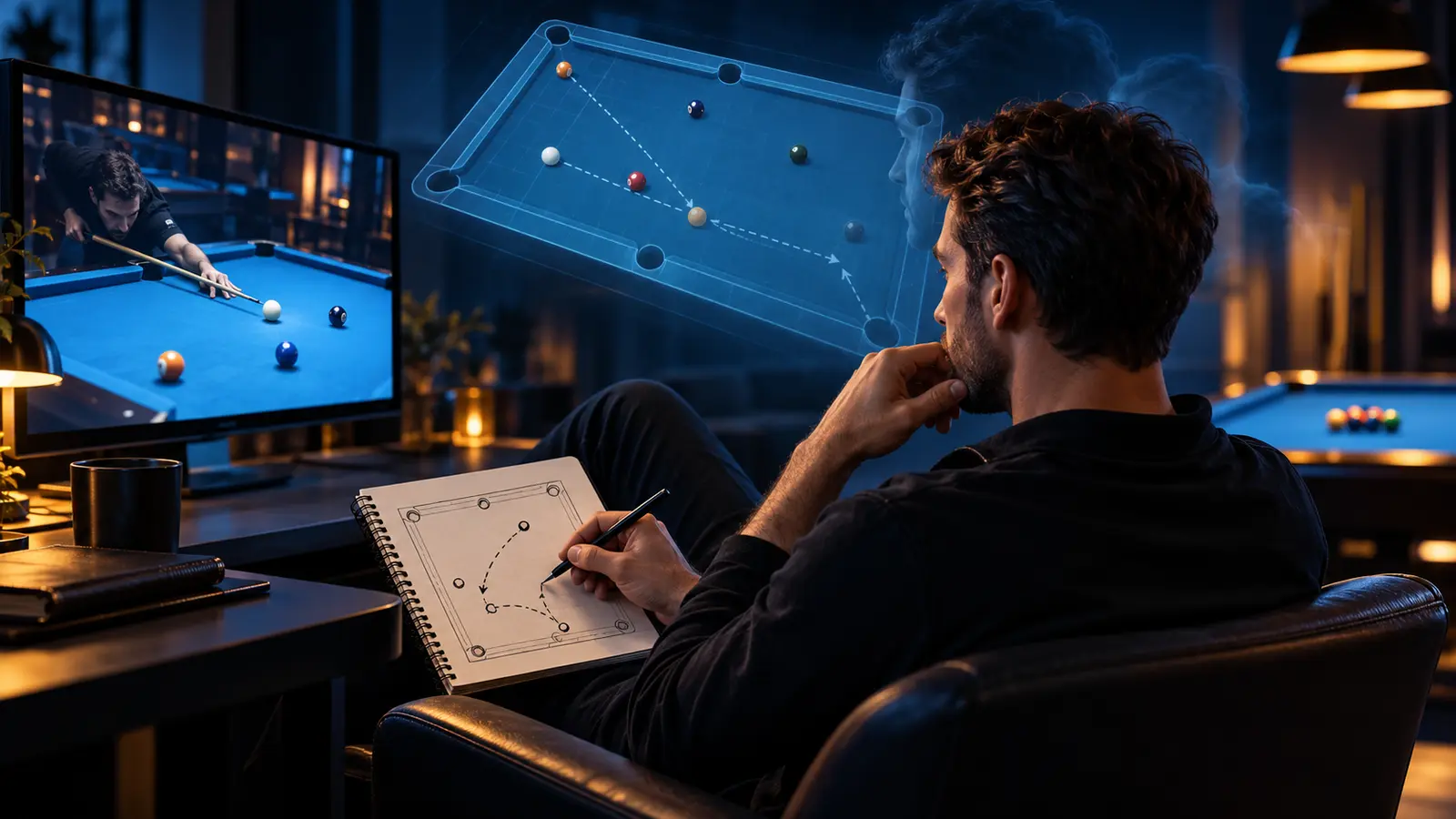
Observe one decision at a time
Watch a complete rack and pause before each shot. Name the likely pocket, cue-ball route and defensive alternative before seeing the player choose. Then compare the actual decision and outcome.
Avoid turning the session into highlight consumption. Five carefully predicted decisions produce better questions than fifty disconnected shots.
Use imagery for familiar actions
Mental rehearsal is preparation for a later table test. In this protocol, imagery earns no physical-performance points and is not evidence that contact, cushions or speed have improved. Any such change must be checked in the next real practice block.
Picture a familiar shot from your normal viewpoint: standing decision, approach, bridge placement, cue delivery and observed finish. If you cannot form the route clearly, simplify the shot rather than inventing perfect sensations.
Rehearse the standing routine
Without a cue, practice the sequence of naming the objective, selecting speed and spin, committing and taking one ordinary breath. Stop before mimicking a full stroke in a crowded or unsafe space.
Keep the verbal cue short and observable. The goal is to arrive at the table with a stable decision sequence, not to rebuild mechanics without ball feedback.
Turn notes into table tests
Write one layout, one variable and one success measure for the next session. For example: 'same thin cut, three speeds, record cue-ball rail contact.'
Bring no more than three tests to the table. Complete them before opening another video or adding another technique. This protects physical practice from becoming a collection of unfinished ideas.
Prepare equipment and references
Review the rules for the game you plan to practice, charge recording equipment if needed and confirm that cue, tip and accessories are serviceable. Preparation removes avoidable interruptions; it does not substitute for warm-up.
Use the last table-session record to choose the next skill area and prepare a reproducible setup. Keep the score definition stable so the next session can be compared with the previous one.
Use a fifteen-minute off-table block
- Predict five decisions from one complete rack.
- Rehearse three familiar shots mentally from setup through finish.
- Write one unresolved rule or strategy question.
- Choose one measurable drill for the next table session.
- Prepare the required equipment and stop.