
Strategy · 3 min read
Play a Safety When the Table Offers No Easy Runout
A safety is not a confession that the player cannot run out. It is a shot chosen because the current offensive path has no reliable completion or carries an unnecessary loss cost. This worksheet makes that decision before the bridge lands, then scores the legal contact, cue-ball cover, object-ball leave and opponent's best reply separately.
Screen the runout with four questions
The two-no rule is an original practice trigger, not a universal match law. Score, inning, game rules and player strengths can change the decision. Its purpose is to interrupt automatic offense when the pattern has already broken down.
| Question | Yes evidence |
|---|---|
| Is the current ball makeable at a practiced percentage? | Clear pocket, aim and speed plan |
| Can the cue ball reach a useful next-shot zone? | Named zone and entry line |
| Are clusters and traffic resolved? | Specific route or breakout with insurance |
| Does a miss leave an acceptable reply? | Opponent lacks an easy starter or ball in hand |
| Decision | If two answers are no, compare a safety before addressing |
Build a safety with three controls for legal contact, cover and distance.
Practice switching from offense when the original route collapses mid-rack.
Build one fixed no-runout layout
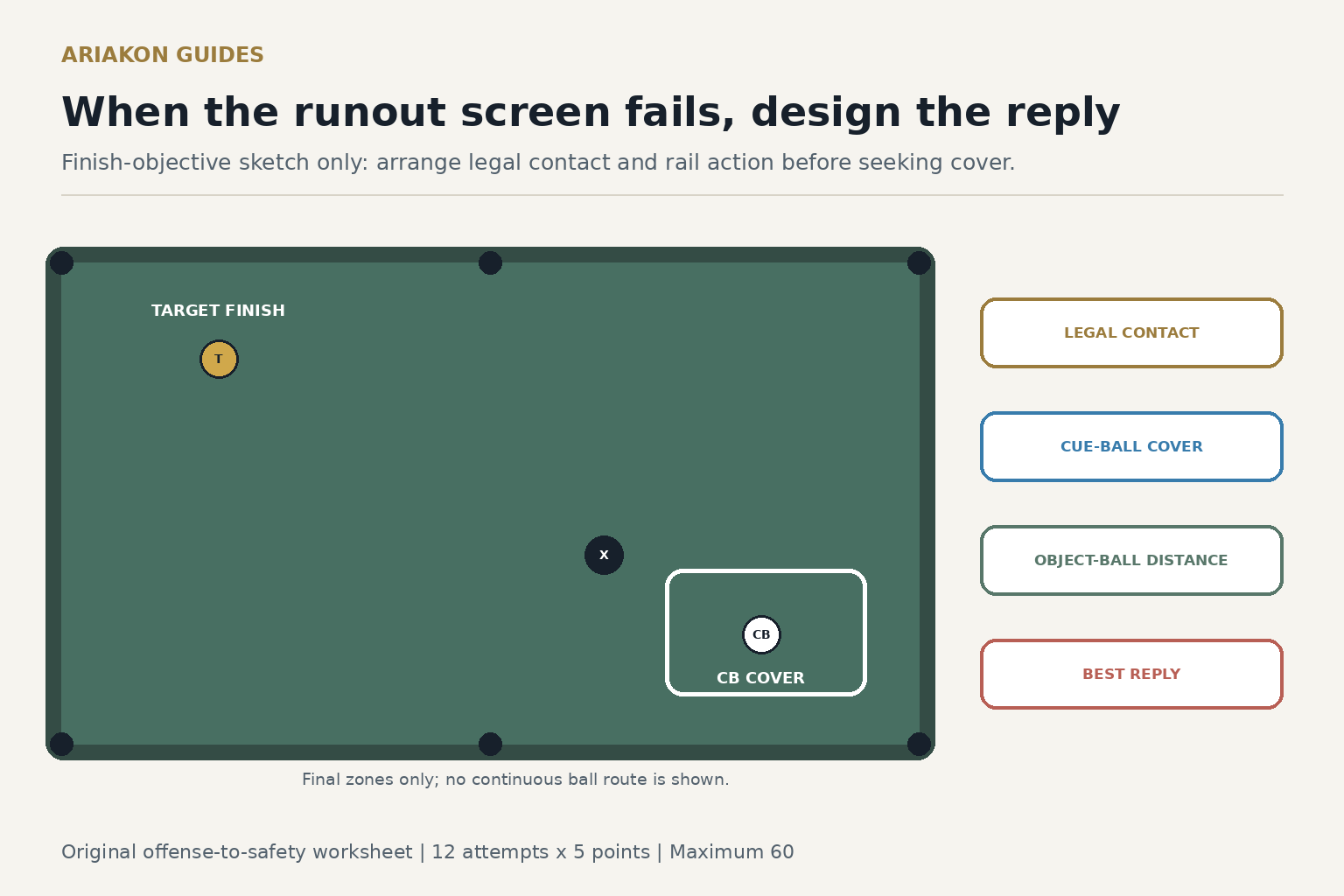
Choose the legal object ball for the selected game. Put it one diamond from a side rail near the table center. Place a blocker ball between the cue ball's likely finish and the opponent's direct return line. Put the cue ball about two diamonds from the target on a route that allows a thin legal hit. Mark every center.
The intended safety sends the cue ball into a one-diamond cover zone behind the blocker while the object ball travels toward the opposite end rail. Confirm that the first contact and rail requirements are legal under the active rules. Never assume a house rule when practicing for an event.
Score twelve safety attempts
After every attempt, take the opponent's chair and identify the best legal reply: direct shot, kick, bank or return safety. Record it before resetting. A hidden cue ball is not enough if an easy kick leaves control or the object ball sits beside a pocket.
| Point | Requirement |
|---|---|
| 1 | Runout screen and safety intention called before bending |
| 1 | Legal first contact and required rail are achieved |
| 1 | Cue ball finishes fully inside the cover zone |
| 1 | Object ball reaches the called distance zone |
| 1 | Opponent has no direct full-ball shot at the target |
| Maximum 60 | Four attempts each at soft, medium and firm safety speed |
Diagnose the two balls separately
| Failure | Next action |
|---|---|
| Illegal contact or no rail | Increase target-ball fullness before adding cover difficulty |
| Cue ball misses cover; object ball good | Change cue-ball speed or contact thickness |
| Cue ball hidden; object ball near pocket | Add object-ball distance or choose a different safety |
| Both balls travel too far | Reduce delivery speed; do not add sidespin first |
| Opponent has an easy reply | Plan from that reply backward before repeating |
Worked example and rack transfer
A hypothetical player scores 45/60. Legal contact passes eleven times and cue-ball cover nine times, but object-ball distance passes only six. The next block records whether object-ball misses are short or long. For long misses, test lower speed with contact fixed; for short misses, test a little more speed with contact fixed. Do not assume fuller contact shortens object-ball travel or add blocker difficulty before the distance is controlled.
For transfer, play three racks against a partner or the table. When the screen produces two no answers, record the best offense, best safety and likely opponent reply. Shoot the lower-regret option and score the same five points. The goal is not to choose safety every time; it is to make the choice before commitment.
Sources and further reading
References support the specific factual information above. The practical checklists are Ariakon editorial guidance.