
Cue ball control · 4 min read
Learn Your First Pool Draw Shot at Short Distance
Your first useful draw shot should be short, straight and measurable. The immediate goal is not a dramatic return. It is a clean low-center hit that pockets the object ball and brings the cue ball backward across a visible reference line. Short distance reduces the time for backspin to wear off and makes contact errors easier to read. Stop immediately if the tip, ferrule, shaft or cue ball appears damaged.
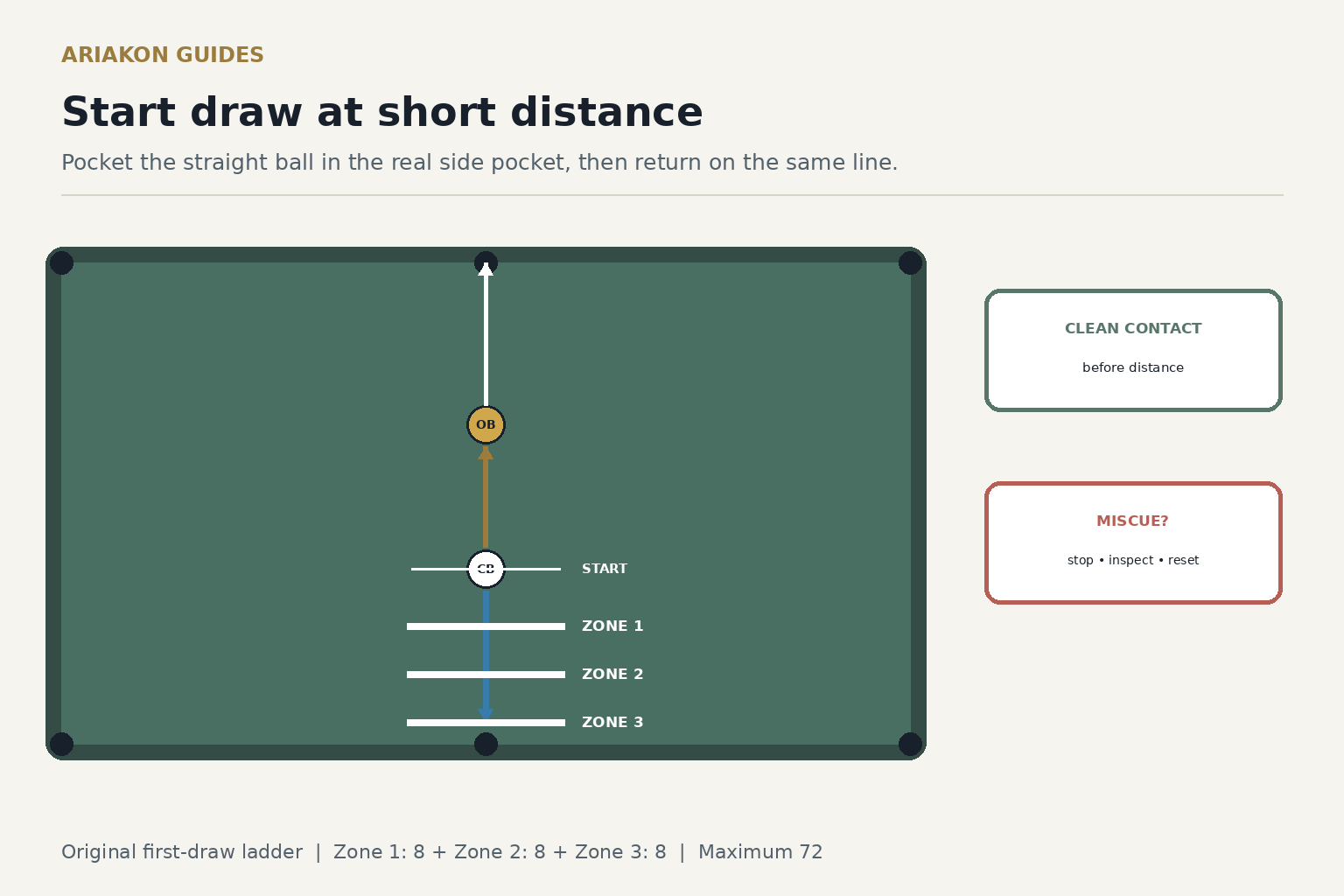
Set one short straight station
Use a side pocket. Place the object-ball center about one diamond straight below the pocket center and the cue-ball center about one diamond farther down the same vertical line. Confirm that all three centers share one line. Mark both ball centers with removable reinforcements and remove any loose marker before shooting. Behind the cue-ball start, mark three return bands perpendicular to the shot line: one ball width, two ball widths and four ball widths.
Chalk the tip without grinding it into the center, keep the cue as level as the rail and stance permit, and aim on the vertical centerline below geometric center. Low does not mean at the edge of the ball. Use a smooth delivery and allow the cue to finish naturally; jabbing or lifting the grip does not create reliable backspin.
Build precise pool draw after a short straight return is repeatable.
Chalk a cue tip without grinding before repeating low-center contact.
Prove stop before asking for return
Shoot six straight stop shots from the same marks. The object ball must be pocketed and the cue ball must remain inside a one-ball-wide window around the cue-ball center at object-ball contact, one ball diameter behind the object-ball center on the straight pocket line. This establishes that the station is straight and your cue delivery is not producing a large sideways error.
If the cue ball follows forward, the hit may be above the intended point or backspin may be gone by impact. If it moves sideways, recheck alignment and off-center contact. Do not move the tip lower until the straight stop baseline is stable.
Climb a three-zone draw ladder
Change only one variable between stages. First keep the same comfortable speed and move contact slightly lower within a safe, chalked area. If clean contact no longer produces more return, restore the last reliable contact and add a small amount of speed. Never count a miscue as evidence that the next stage is close. Return to the previous contact and inspect the tip.
| Stage | Attempts | Advance when |
|---|---|---|
| Stop baseline | 6 | At least 5 pockets and 4 stop-window finishes |
| Zone 1 | 8 | At least 6 pockets and 5 cue balls cross the one-ball line |
| Zone 2 | 8 | At least 6 pockets and 5 finish in or beyond Zone 2 |
| Zone 3 | 8 | At least 6 pockets and 5 finish in or beyond Zone 3 without a miscue |
Score pocket, return and corridor separately
| Point | Requirement |
|---|---|
| 1 | Object ball is pocketed in the called side pocket |
| 1 | Cue ball returns across the stage line |
| 1 | Cue-ball center stays inside the one-ball-wide return corridor |
| Maximum 72 | Twenty-four draw attempts; baseline scored separately |
Worked example: fix the contact before adding power
A beginner pockets seven of eight Zone 1 attempts, but only four cue balls cross the line and three roll forward. Slow-motion video from the side shows the cue tip arriving near center rather than low center. The player restores the stop-shot picture, shortens the bridge slightly for comfort and repeats Zone 1 without swinging harder. Six cue balls then cross the line inside the corridor.
Zone 2 scores 16 of 24 points with two sideways returns. The next action is another Zone 2 block focused on vertical-centerline contact. Zone 3 waits; longer return is not useful while direction changes unpredictably.
Diagnose the finish, not the feeling
| Cue-ball evidence | Next check |
|---|---|
| Stops instead of returning | Contact height, tip chalk and whether backspin survives to impact |
| Follows forward | Unintended high contact or too little backspin at impact |
| Returns sideways | Off-center tip contact, aim line or steering |
| Miscues | Stop, inspect/chalk tip, raise contact and reduce force |
| Draw varies while pocketing is stable | Freeze speed and compare exact contact height |
| Pocketing also varies | Return to the straight stop baseline |
Use a contact-and-speed draw log when short draw works but distance remains inconsistent.