
Strategy · 3 min read
Play the Percentages Without Playing Scared
Playing the percentages does not mean always refusing a difficult shot. It means comparing complete outcomes: the chance of making the ball, the position that follows, the cost of a miss and the quality of the available safety. A good decision can be aggressive or defensive; the table and score decide.
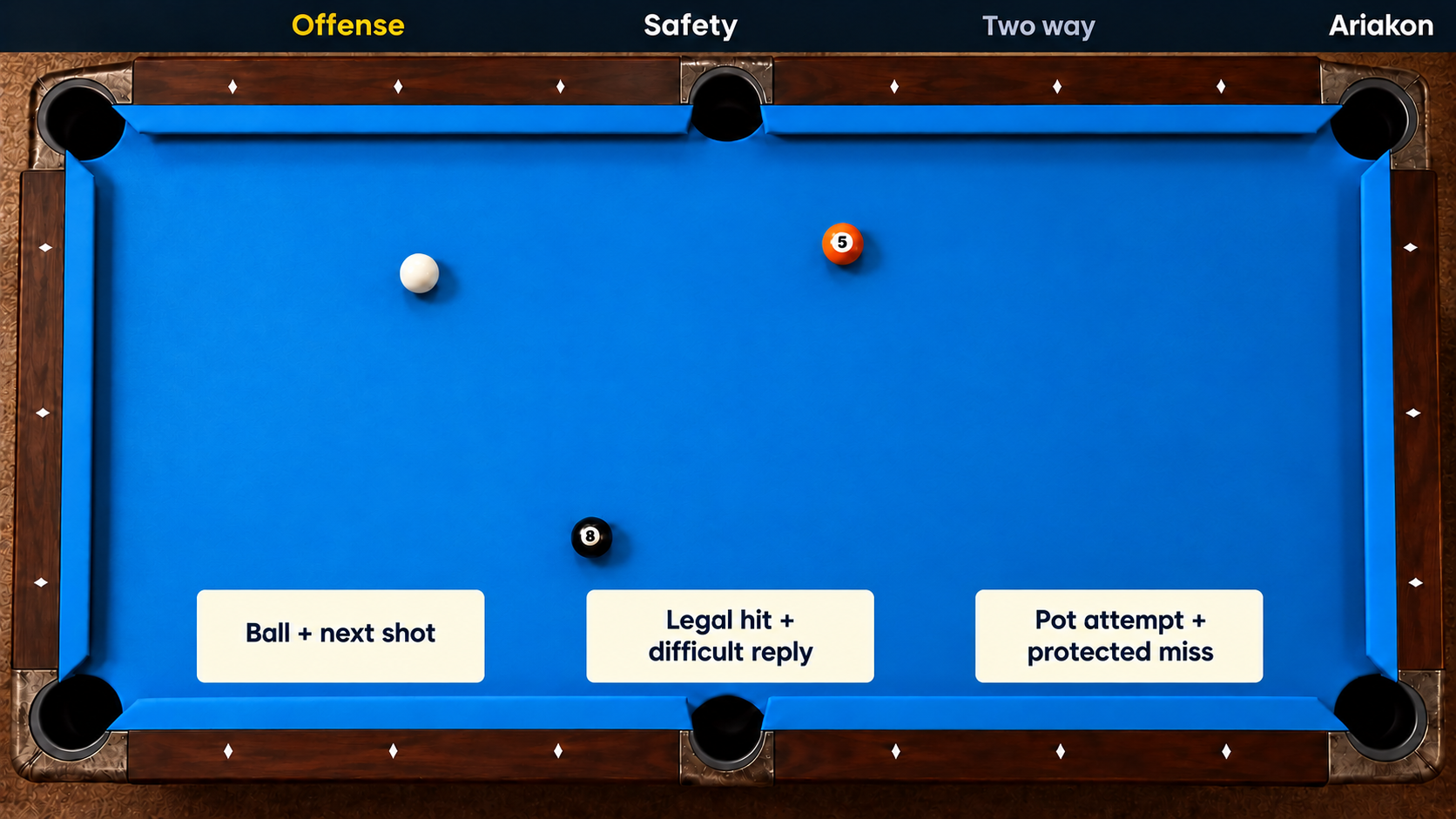
Evaluate the whole inning
Start with the current shot, then look one decision farther. A ball may be makeable but leave no route to continue. Another shot may be slightly harder yet open the rack and produce a simple next ball.
Estimate in broad bands rather than pretending you know an exact percentage. Use high confidence, competitive, and low confidence. Those categories become more accurate when you record your own results from repeatable layouts.
Price the miss
Ask what the opponent receives if the offensive shot fails. A miss that leaves distance and a difficult angle has a different cost from a miss that hangs the game ball. Pocket difficulty alone does not define the risk.
Also trace the cue ball. A scratch, kiss or cluster collision can turn a reasonable make attempt into a low value choice. If the shot has several losing misses and only one good result, demand a higher execution margin.
Compare the safety honestly
A safety is not automatically high percentage. It must satisfy the rules, control the cue ball or object ball, and leave a difficult reply. A thin hide with a tiny landing zone may be harder than the offensive shot.
Look for a containing safety with a broad finishing region: substantial distance, cover behind a blocker, or an object ball left near an unhelpful cushion. Compare its common miss with the common offensive miss. A safety is valuable only when you can execute its legal contact and finish reliably.
Prefer two way results when available
A two way shot combines a real scoring attempt with protection on a miss. The cue ball may finish behind traffic while the object ball travels toward the pocket, or the object ball may move to a harmless rail if it does not fall.
Do not call every hopeful miss a two way shot. Trace a specific defensive finish and confirm that the speed required to pocket the ball can also produce that finish.
Let the score change the threshold
When the opponent has an open run and your safety offers little protection, accepting a difficult offense may be rational. When one foul or sellout likely ends the match, a strong containing safety can be worth more than a marginal pot.
Tournament format matters too. Short races amplify individual racks, but that does not justify abandoning your known strengths. Use the score as one input, not permission for panic.
Use a three column decision drill
- Set a game like layout and write offense, safety and two way.
- For each option, identify the best result, common miss and worst result.
- Choose the option with the most favorable range, then shoot it.
- Reset the layout five times and record whether your predicted miss was accurate.
- Update your confidence bands from results instead of protecting your original opinion.
- Use the three illustrated cards as the worksheet headings: offense needs a ball and a next shot; safety needs a legal hit and a difficult reply; two way needs a real pot attempt and a protected miss. The image contains no predicted paths. Sketch and test each route separately for your actual layout.
Sources and further reading
References support the specific factual information above. The practical checklists are Ariakon editorial guidance.