
Strategy · 3 min read
Find Alternative Pool Routes When the Obvious Shot Is Blocked
When a direct shot is blocked, creativity starts with a legal-contact check and ends with a risk comparison. Generate at least three routes, test them from fixed marks and include a containing safety. The carom guide teaches one specialty family; this resource compares carom, bank, kick and safety routes for the same reader decision.
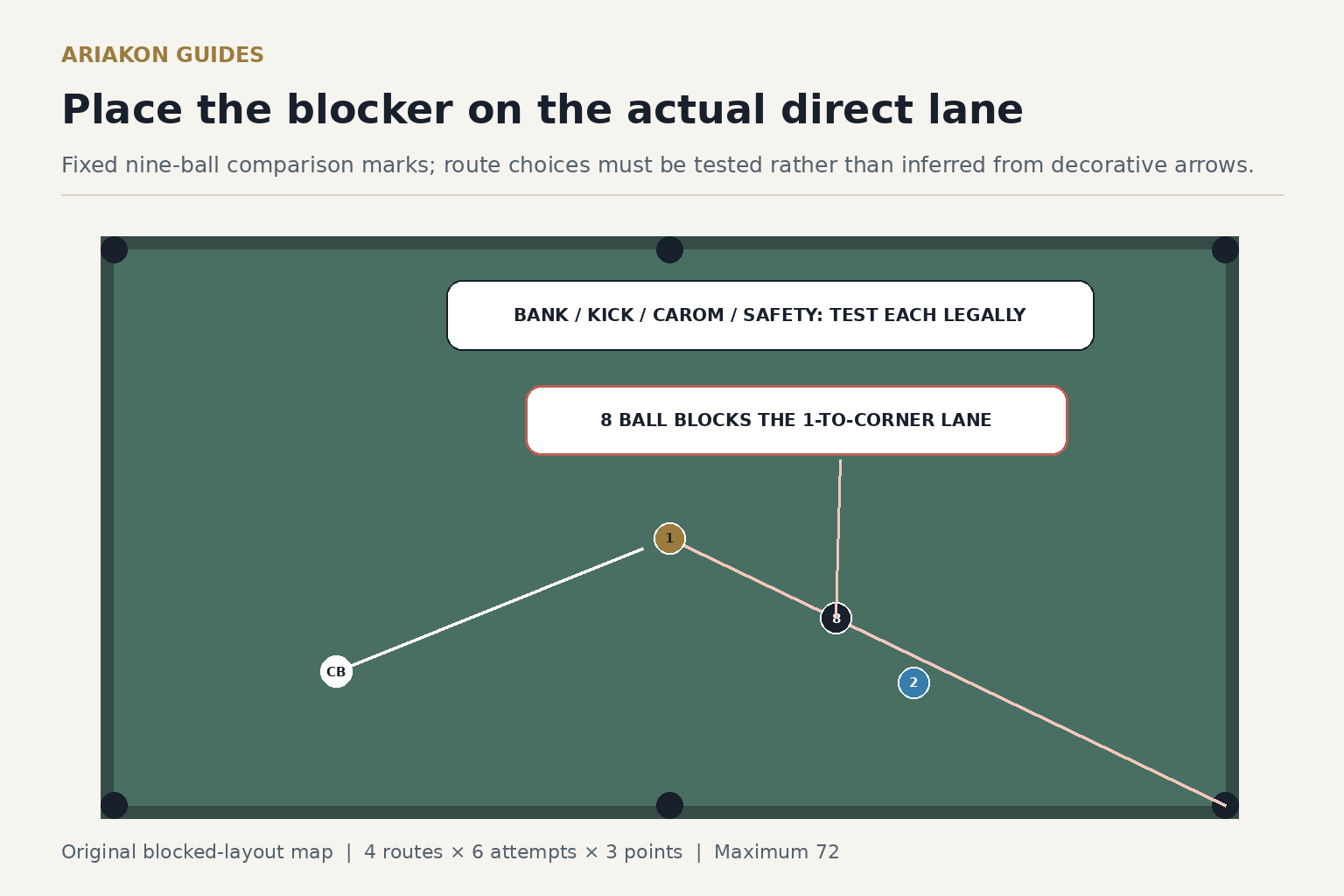
Build the fixed blocked layout
Use a normalized 100-by-50 table map between cushion noses. Place cue ball at (20,38), legal 1 ball at (50,26), blocker 8 at (65,33.2) on the 1-to-lower-right-corner line, and a second ball 2 at (72,39). The 1 remains lowest numbered, so every candidate must contact it first under standard nine-ball play. The cue ball has a clear approach to the 1. These are original comparison marks, not a promised runout.
Before shooting, confirm current event rules. A route that contacts the wrong ball first, fails the post-contact rail requirement or uses an unavailable option is not an alternative—it is a foul or an illegal plan.
Practice creative carom shots when the carom route has earned focused work.
Compare safety outcomes when containment is the best percentage choice.
Create a four-route card
Draw the intended cushion and cue-ball path for every candidate. Reject a route before practice when it is illegal in the selected game, requires equipment-damaging elevation, crosses an uncontrolled scratch lane or sells out a routine reply after the most common miss.
The listed cushion points are point-ball mirror references, not literal ball-center contact coordinates or guaranteed rebound aims. Allow for ball radius and the actual cushion nose, then calibrate at one speed. Reject a route that cannot meet legal contact and reply-control requirements. The diagram marks only the fixed balls and blocked direct lane; it does not invent untested carom or safety trajectories.
| Route | First-contact plan | Primary failure cost |
|---|---|---|
| Bank | Cue ball to 1 first; approximate object-ball mirror reference via top cushion (67.11,0), then lower-right corner | Miss may leave object ball near pocket |
| Kick | Approximate cue-ball mirror reference via top cushion (37.81,0), then contact the 1 at (50,26) | Contact window or scratch may be small |
| Carom | Cue ball contacts the legal object ball first, then reaches the second object ball | Secondary contact and speed must both resolve |
| Safety | Legal contact sends the object ball to the upper-left zone and cue ball to the lower-left zone | Thin hit may expose a direct reply |
Score six attempts per route
Each route has eighteen available points and the full test has seventy-two. Record scratches and easy replies separately. Pocket count alone can make an attacking route look better even when its misses lose the rack.
| Point | Evidence |
|---|---|
| Legal start | Correct ball contacted first and rail requirement met |
| Primary outcome | Called pocket, legal hit window or safety separation reached |
| Reply control | Cue ball and object ball finish outside the premarked sell-out zone |
Use the route ladder in a game
The ladder does not prescribe safety every time. It forces an attack to compete with a legal containing option on outcome and miss cost.
| Question | If no |
|---|---|
| Is the direct shot legal and controllable? | Generate alternatives |
| Does an attacking route have a known contact and speed window? | Prefer containment |
| Is the common miss acceptable? | Reject that attack |
| Can the safety create separation without a foul? | Choose the lowest-cost legal recovery |
Worked comparison and next practice choice
A hypothetical block scores Bank 9/18 with three easy replies, Kick 11/18 with one scratch, Carom 7/18 with four failed secondary contacts and Safety 14/18 with one easy reply. The current game choice is the safety. The kick earns a separate six-shot contact-window session; the carom is not retained merely because it is creative.
For transfer, move the blocker half a ball in six photographed layouts and choose without shooting. Award one point for a legal route and one for naming the common miss cost. Then shoot only the chosen route. This separates route generation from specialty-shot execution.
Sources and further reading
References support the specific factual information above. The practical checklists are Ariakon editorial guidance.