
Shotmaking · 4 min read
See and Practice Creative Carom Shots
A carom uses one contact to create another. In pool, the cue ball may contact a legal object ball and continue into a second ball, or an object ball may glance from another ball toward a pocket. The creative part is seeing the route; the dependable part is controlling contact fullness and speed.
Name the moving ball
Before aiming, identify which ball must make the second contact. In a cue ball carom, the cue ball continues after striking the first object ball. In an object ball carom, the first object ball glances from another ball toward the target.
Then confirm the game rules. The required first contact and called shot requirements still apply. A clever route is useful only if it is legal in the discipline being played.
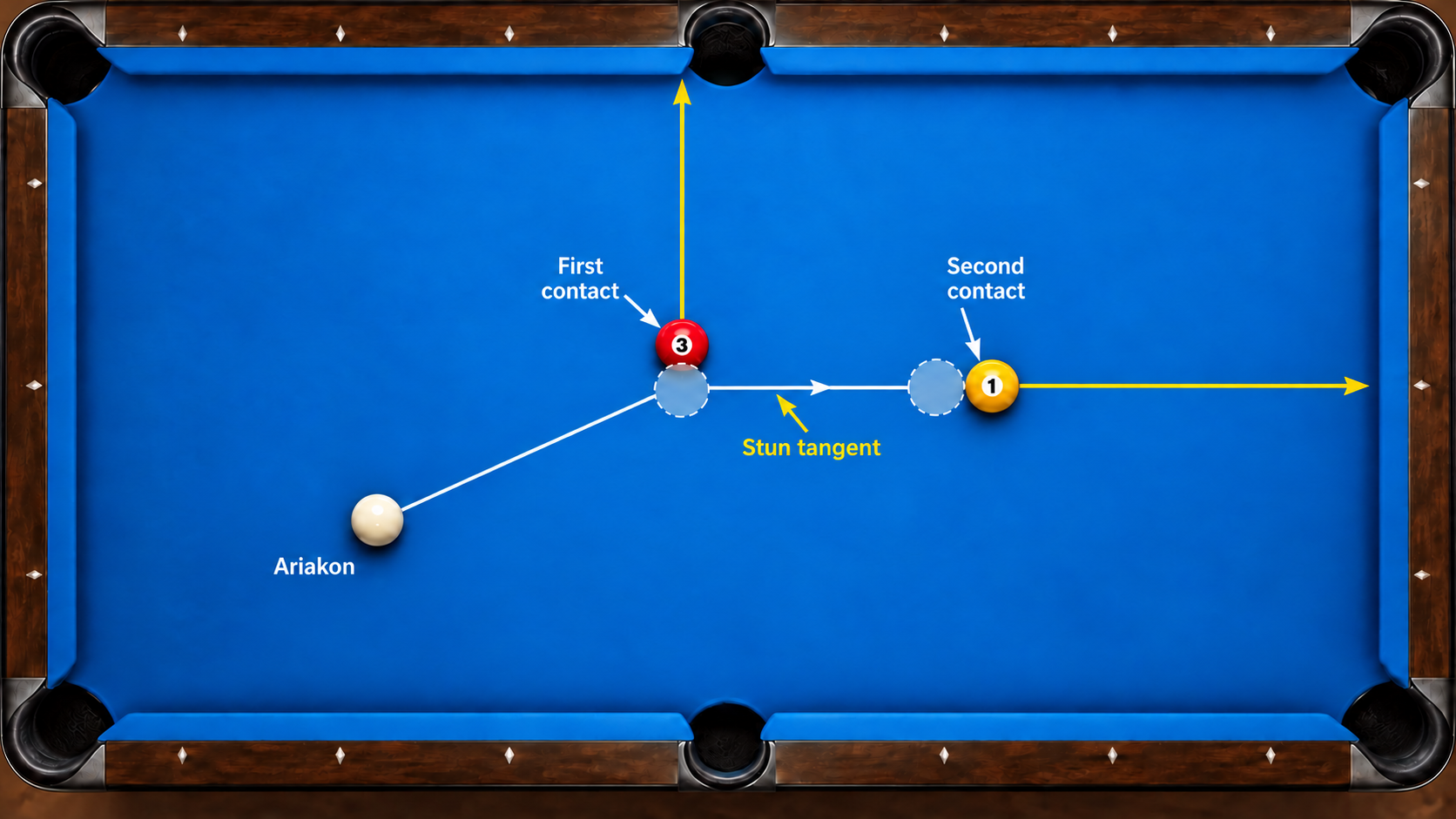
The illustration is an eight ball solids practice layout with the red 3 as the first legal contact and the yellow 1 as the second ball. It is not a rotation shot while the 1 remains. For a rotation exercise, renumber or rearrange the balls so the lowest numbered ball is contacted first.
Start with the tangent line reference
With little forward or backward rotation at impact, the cue ball initially leaves close to a line perpendicular to the first object ball's departure. This is the stun tangent reference for an ordinary cut. A center tip hit does not necessarily arrive as stun, so adjust vertical contact and speed by observing the actual departure.
Follow curves the cue ball forward from that reference; draw curves it backward. Speed and distance influence how quickly the curve develops, so build the shot from stun before adding vertical spin.
Use contact fullness to move the route
A fuller hit sends more energy into the first object ball and changes the cue ball's departure. A thinner hit preserves more cue ball speed and sends it farther across the table. Move the first contact a little at a time.
Mark the ball positions and shoot three speeds at one contact before changing aim. Otherwise, you cannot tell whether the route moved because of speed or cut angle.
Build the shot backward
Start at the second contact. Ask which side of the second ball sends the scoring ball toward the pocket or leaves both balls safe. Trace that line backward to the first contact and then to the cue ball.
Backward planning prevents you from choosing a dramatic first contact that reaches the wrong side of the second ball. It also reveals when a simple combination is more reliable than a carom.
Control the miss
Caroms often involve several moving balls, so evaluate scratches and sellouts. Reduce speed when the geometry already supplies the second contact. Use a wide second contact window rather than forcing a thin edge.
If the scoring path is narrow, look for a two way result. A missed carom may still move the object ball to a cushion and leave the cue ball behind traffic.
Build an actual second contact before adding difficulty
- Start with one object ball and a cue ball. Mark the original centers, produce a cut with stun at contact and observe the cue ball tangent route over five shots.
- Place the second object ball on that observed route, initially within one diamond of the first cue ball impact position. Leave at least one ball diameter of free travel between the two contacts.
- Reset all three centers after each shot. Score 0 for a foul or wrong first ball, 1 for the legal first contact and 2 for both intended contacts with the shot legal under the chosen rules. Five attempts have a maximum of 10.
- Advance only after four clean second contacts out of five. Move the second ball half a diamond farther along the same observed route, rather than one diamond away from it. Repeat before introducing any follow or draw.
- Mirror the layout for the opposite cut. Finally add a blocker and compare this genuine cue ball carom with a separate object ball combination or safety. A white path must pass through both cue ball impact positions, not through both object ball centers.
Sources and further reading
References support the specific factual information above. The practical checklists are Ariakon editorial guidance.