
Shotmaking · 4 min read
Recognize a Dead Combination Before Changing Its Geometry
In pool language, a dead combination is normally one whose object balls already align for an easy path toward the pocket. Players also use ‘dead’ informally to mean hopeless. Those meanings point in opposite directions, so this guide uses observable geometry: aligned, marginal or unavailable. The goal is to decide what the balls offer before imagination or a helpful nudge changes the layout.
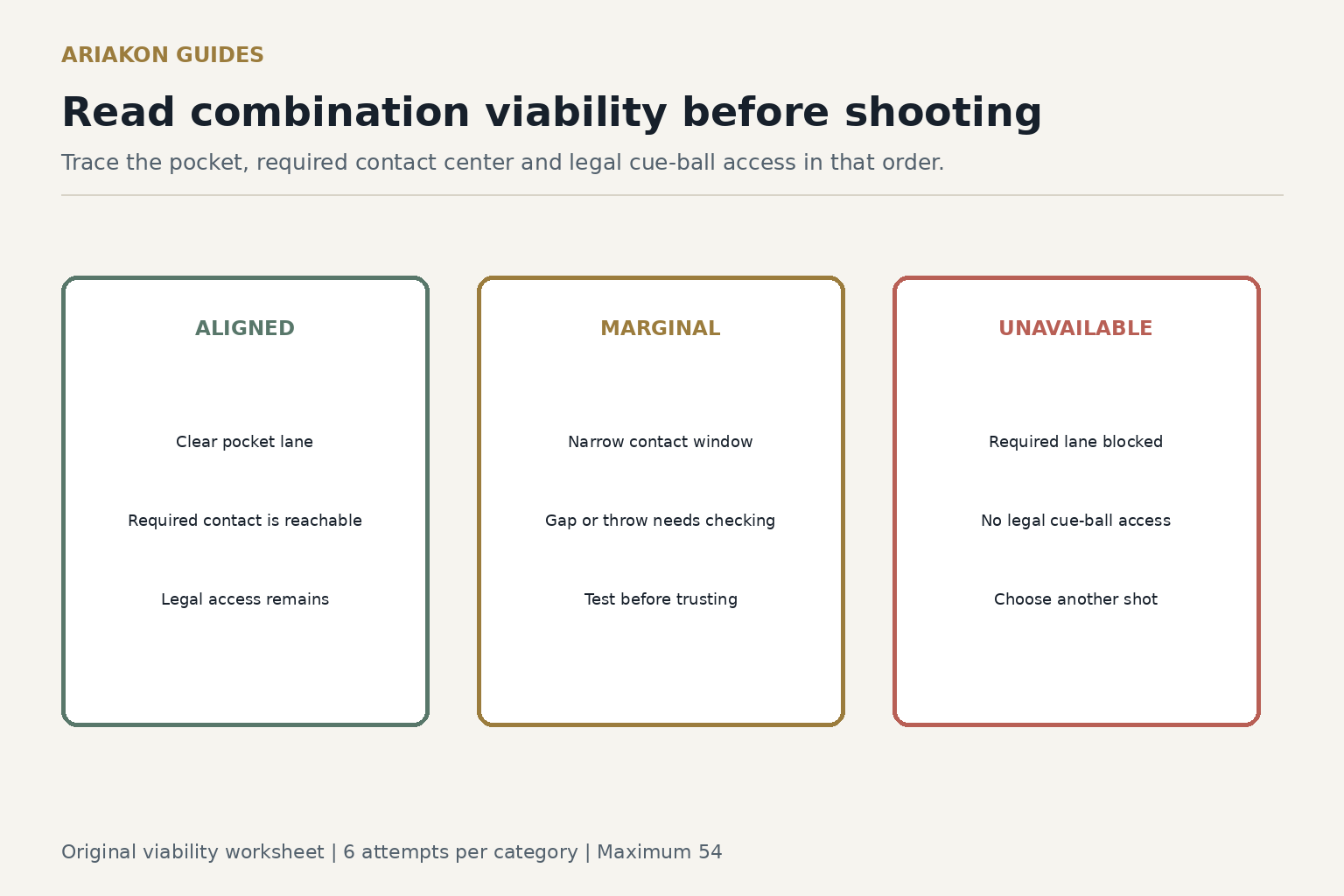
Build the combination backward from the pocket
Start at the called pocket. Draw an imaginary line from pocket center through the center of the last object ball. The first object ball must contact that last ball on the point opposite the pocket line. Next, locate the ghost-ball center for the first object ball at that contact. Finally, check whether the cue ball can send the first object ball to that ghost-ball center without a blocker or illegal first contact.
A pair that appears aimed at the pocket from the cue-ball view can still fail the backward trace. Small gaps make this harder to see, and frozen or nearly frozen balls can throw away from the pure line of centers. Do not promise a universal throw adjustment: cut angle, speed, spin and ball condition all matter.
Aim combinations from the pocket backward for the complete aiming foundation.
Understand pool ball throw before treating a small gap as a perfect line.
Use a five-gate viability worksheet
| Gate | Observable question | Record |
|---|---|---|
| Pocket line | Does the last ball have a clear center-to-pocket lane? | Clear / blocked |
| Contact point | Can the first ball reach the required point? | Full / marginal / no |
| Cue access | Can the cue ball create that first-ball path legally? | Yes / forced / no |
| Gap | Frozen, near-gap or separated? | Mark actual state |
| After-contact risk | Where can cue ball and first ball finish? | Playable / scratch / collision |
| Decision | Aligned, marginal or unavailable | Shoot / test / choose another shot |
Map three layouts without moving a live ball
During practice only, place the last object ball about one diamond from a corner on the pocket line and the first object ball one ball width behind it. Mark both centers. Layout A is aligned. For Layout B, move only the first ball half a ball to one side. For Layout C, restore the first ball and move the last ball half a ball to the other side. The cue ball stays two diamonds away on one fixed approach line.
Shoot six attempts per layout at one moderate speed with vertical-axis contact. Before each attempt, label the layout aligned, marginal or unavailable. Reset exact centers. This is a geometry comparison, not permission to touch or test balls in competition; follow the active rules and ask an official before any close-ball ruling.
| Point | Requirement |
|---|---|
| 1 | Pre-shot viability call matches the marked geometry |
| 1 | First object ball reaches the intended second-ball contact side |
| 1 | Last object ball reaches the called pocket |
| Maximum 54 | 18 attempts; record miss side and gap state |
Worked example: the pair is close but not dead
A player calls all six Layout A shots aligned and pockets five. In Layout B, the backward trace shows the first ball must approach from the opposite side, but the fixed cue-ball line cannot create it. The player still calls four attempts ‘aligned’ based on the small gap and pockets only one by catching the pocket facing. The worksheet exposes a picture error, not bad luck.
Layout C pockets three of six and consistently misses toward the same jaw. Its score is 12 of 18, so it is marginal under the fixed conditions, not automatically unavailable. The next action is to draw the pocket line before looking back at the cue ball. In a rack, if access, traffic or scratch risk fails a gate, compare an offensive alternative or safety rather than forcing the word ‘dead’ to become true.
Use three questions to choose the right shot when the combination fails one viability gate.
Diagnose the changing geometry
| Evidence | Next action |
|---|---|
| Last ball misses same jaw | Recheck its pocket line and first-ball contact point |
| First ball misses contact side | Rebuild its ghost-ball center from the last ball backward |
| Frozen pair behaves unlike gap pair | Record state; calibrate throw separately |
| Makes only at pocket speed | Treat speed window as part of the shot, not proof of alignment |
| Cue ball has no legal approach | Combination is unavailable from this cue-ball position |
Sources and further reading
References support the specific factual information above. The practical checklists are Ariakon editorial guidance.