
Shotmaking · 3 min read
Aim Combination Shots From the Pocket Backward
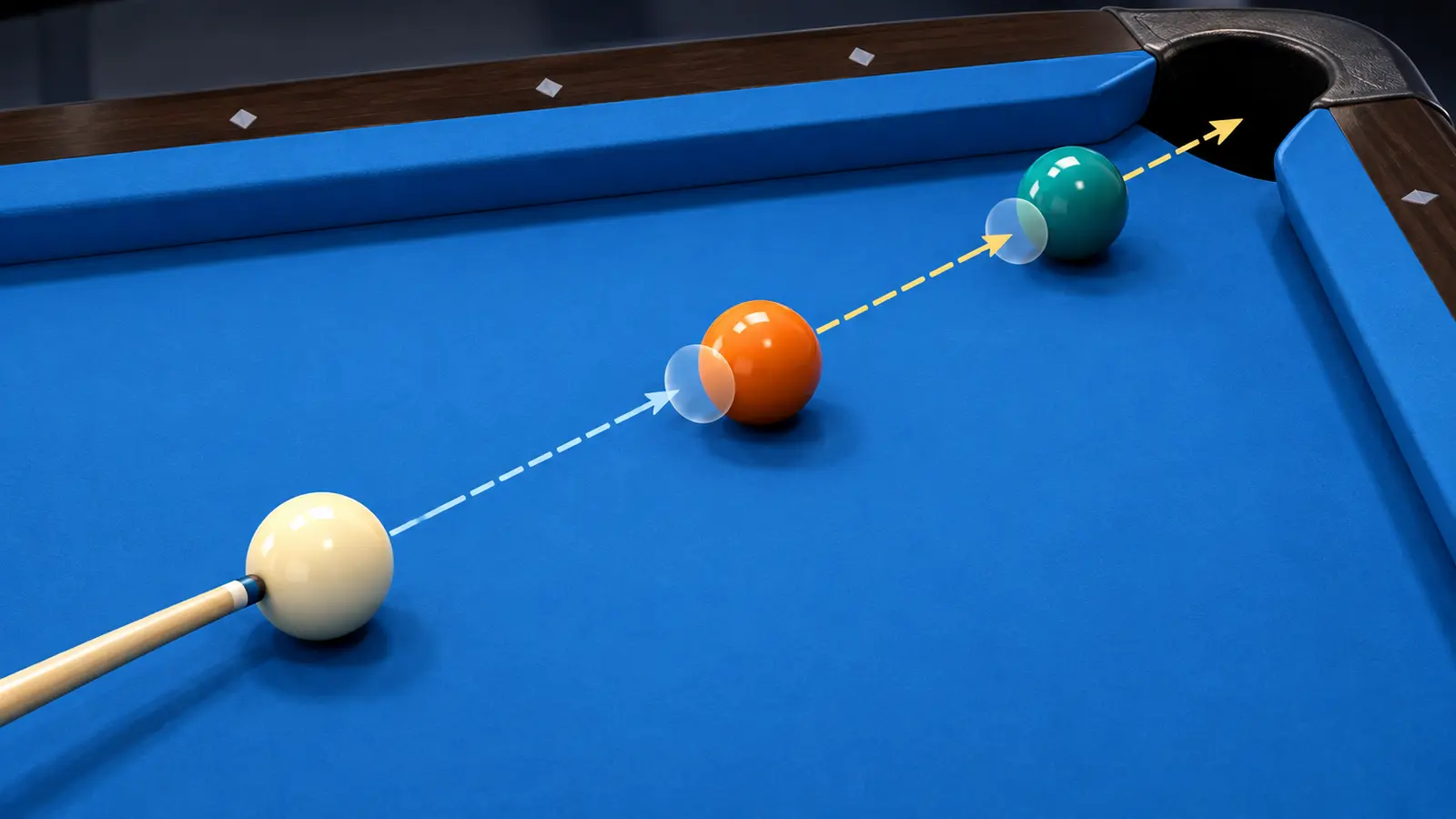
A combination asks one object ball to send another toward a pocket. The first ball is not the real target; it is the delivery system. Build the shot backward from the pocket, then decide whether the contact window is large enough to justify the attempt.
Start with the pocketing ball
Choose the pocket and visualize the line from its center through the ball that will be pocketed. Mark the required contact point on that ball. Only then trace backward to the first object ball.
This prevents the common error of aiming the first ball at the second ball's center. A cut combination needs the first ball to arrive at an offset contact point.
Aim the first ball to the delivery point
Build the contact geometry independently. Imagine the center of the first object ball exactly one ball diameter behind the second object ball on its pocket line. That is the required arrival center. Work back from there to the first ball and then to the cue ball: pocket, second-ball contact, first-ball path, cue-ball aim.
Stand up and confirm all four parts before settling into the stance. If the paths do not agree, reset rather than steering during the stroke.
Respect distance and cut angle
The farther the first ball must travel, the more a small directional error grows before contact. Thin cuts also reduce the usable contact window. Long, thin combinations therefore demand more accuracy than short, nearly straight ones.
Use pocket speed when the layout allows it. Extra speed can make a slight error more costly and may send the first ball into open space if the scoring ball rattles out.
Account for throw without guessing
Ball-to-ball friction can change the pocketing ball's path, especially in slow or fuller combinations and when balls are frozen. Conditions and cut geometry matter, so do not apply one universal compensation.
Calibrate on the table when possible. Shoot the same marked combination at two speeds and observe the difference before using sidespin or a large aim correction.
Plan the first ball after contact
Even when the second ball drops, the first ball and cue ball keep moving. Check scratches, blocked routes and whether the first ball can become your next shot. A scoring combination that loses the cue ball may be a poor pattern choice.
In called-shot games, follow the governing rules for designating the intended ball and pocket. The creative route does not replace the discipline's legal-contact requirements.
Build a combination ladder
- Begin with two object balls six inches apart on a straight pocket line.
- Make five shots, then move the first ball one diamond farther away.
- Add a small cut angle only after the straight version is repeatable.
- Compare soft and medium speed without changing aim between sets.
- Finish by choosing between the combination, a direct shot and a safety.
Sources and further reading
References support the specific factual information above. The practical checklists are Ariakon editorial guidance.