
Strategy · 3 min read
Estimate Runout Risk Before Committing to an Eight Ball Pattern
A runout is not just a list of makeable balls. It is a chain whose weakest transition may sell out the rack. Before choosing offense, identify the blocker, the hardest cue-ball transition, the key ball to the 8 and the likely table left after a miss. This guide turns that pre-commitment audit into a scored test; the broader percentage guide compares offense and safety across many situations.
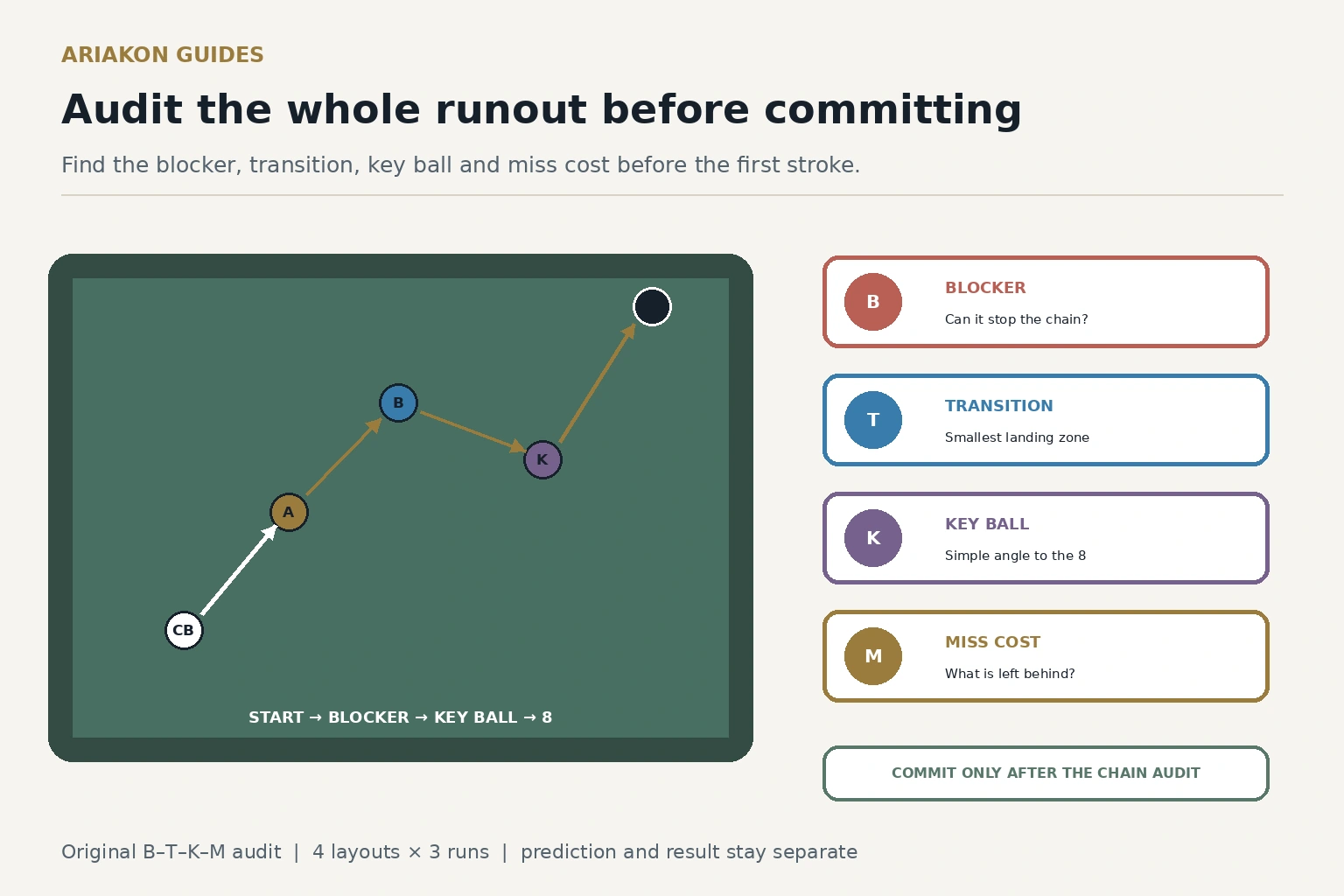
Audit the layout with B–T–K–M
| Check | Question | Red flag |
|---|---|---|
| B — Blocker | Which ball or cluster can stop the pattern? | No clean opening route |
| T — Transition | Which position move has the smallest usable zone? | One exact-speed path |
| K — Key ball | What ball produces a simple 8-ball angle? | Key ball must be disturbed late |
| M — Miss cost | What does the opponent inherit if the chain breaks? | Open rack and easy starter |
Play percentage decisions without playing scared for the broader offense-versus-safety framework.
Choose solids or stripes from the whole layout before building a group-specific pattern.
Set one fixed eight-ball decision layout
Use an open table after the break only as a practice condition. Place three solids and the 8 on the table: one easy starter, one side-pocket transition ball, one ball near a long rail that serves as the key ball, and the 8 near a corner. Add one stripe that partly blocks the starter-to-transition route. Mark every position.
Before shooting, write an offensive order and one legal safety. Confirm the rules actually in use; under current WPA eight-ball rules, called-shot and group requirements apply once groups are chosen.
Score four layouts before and after shooting
Run the same four marked layouts in three scored rounds, planning and executing each layout in every round. Rounds 1 and 2 use the chosen pattern; Round 3 makes the written safety mandatory whenever a named checkpoint is missed. Four layouts × three rounds × five component points gives 60. A first failed event or a completed pattern must be observed before Calibration can score. Do not turn the score into a universal runout percentage.
| Point | Earn it when |
|---|---|
| Pattern | Every ball has an order and purpose |
| Transition | The narrowest route and target zone are named |
| Key ball | The 8-ball entry angle is protected |
| Bailout | A legal safety is available before the pattern collapses |
| Calibration | The pre-shot prediction matches the first failed event |
Diagnose the first failed event
| First failure | Next action |
|---|---|
| Blocker was ignored | Change group, opening ball or choose safety |
| Transition zone was smaller than predicted | Widen the route or move the key decision earlier |
| Key-ball angle disappeared | Reverse the final three-ball order |
| Pocketing failed before position mattered | Use a personal make-rate threshold |
| Safety left an open starter | Practice the bailout as its own shot |
Worked example: reject a tempting starter
A hypothetical player rates the first ball easy but notices that its natural cue-ball path crosses the blocking stripe and leaves only one narrow route to the side-pocket ball. The B–T–K–M audit scores 2/4 before execution: the key ball is sound, but the blocker and transition are unresolved. The player chooses the marked safety instead of treating the easy starter as proof of a runout.
In the next practice round, moving the starter choice changes the transition to a two-diamond-wide zone. The player commits to offense, logs the first failed event and reviews after the full set rather than after every result.
Sources and further reading
References support the specific factual information above. The practical checklists are Ariakon editorial guidance.